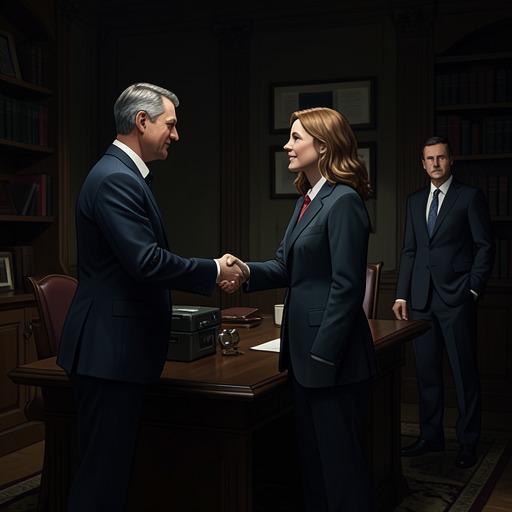
Sir David Pentland–Lady Radha Pentland marriage
Just DesertsSir David Pentland–Lady Radha Pentland marriage was founded in the aftermath of violence and displacement, but came to signify a durable partnership grounded in care, trust, and shared life. Sir David rescued Radha from pirates, helped her survive a nearly fatal wound, and continued courting her after she disclosed what had happened during her captivity. Their marriage took them from Barbados to Britain and eventually to Grenadine Reef, where they made a quiet life together and where their example became formative for Elizabeth Bennet.
Origins and Rescue
Radha’s life before meeting Sir David had been shaped by forced movement. Born Radha Bhimani in Kutch, in western India, she lost her mother in childbirth and was raised by her paternal grandmother and aunts. Conflict among the Mughals, Marathas, and British repeatedly displaced her family. As a child, she was kidnapped for sale into slavery, but was rescued before being sold by a Spanish ship carrying priests. She learned rudimentary Spanish during the voyage, then was forced into a nunnery near Cadiz, where she remained cloistered for six years. At twenty-one, she was selected, without a say in the decision, for a mission to South America.
In the spring of 1772, Radha and twenty-nine other members of her order sailed from Cadiz toward Cartagena. Pirates captured their ship. Sir David, then serving with the crew of HMS Glory, engaged the pirates and freed the captives. During the fighting, the pirate captain dragged Radha onto the deck and stabbed her through the womb. As she collapsed with a wound usually fatal, she saw Sir David kill her attacker. The rest of the surviving order continued onward under a flag of neutrality, while Radha was left behind because her condition made her too ill to move.
Sir David took her to his house in Bridgetown, Barbados, where his housekeeper and a nurse helped care for her. Radha nearly died twice, but eventually recovered from the infection. The rescue thus became more than a single act in battle: Sir David’s continued personal care gave Radha a chance to live after she had been abandoned as too sick to travel. Once she was well enough, she moved to the home of a widow he knew, a step taken for propriety, and Sir David began to court her.
Courtship, Marriage, and a Quiet Estate
Radha was candid with Sir David about the four days before her rescue, including the violence she had endured in pirate captivity. He took her hand and made clear that what had happened did not diminish his regard for her. Their courtship began after she moved, for propriety, into the home of a widow known to him. The acceptance she found in Sir David stood against the hostility she encountered elsewhere: even after surviving a wound that was nearly always fatal, she heard people say it would have been better had she died. Some treated her survival as an embarrassment and blamed her for having lived near the coast where she was captured.
That treatment helped determine the shape of their life together. Sir David had been uncertain about continuing his naval career; the contempt directed at Lady Radha became the last straw, and he resigned his commission. They returned to Britain, where Lady Radha willingly, though only superficially, converted to the Church of Scotland. They married in Sir David’s home town outside Edinburgh, then travelled together before moving to London. There they heard of an estate for sale, bought it, and made it their home. By the time Lady Radha recounted the history to Elizabeth Bennet, the couple had lived there for thirty-two years.
The marriage was also formed with a clear knowledge of what their future could not include: Lady Radha’s injuries meant she could not bear children. The couple’s response was not to seek social prominence or to perform the role of lord and lady of the manor. They valued the safety and privacy they had found at Grenadine Reef, and their household became the centre of a life deliberately turned inward. Their reserve helped keep the story of their meeting little known: Sir David did not explain how they had met, and others assumed he had encountered her while serving in Indian waters. The Pentlands did not correct them.
Partnership and Household
Their marriage developed into a shared working partnership as well as an intimate one. Lady Radha did more than set the household’s menus: she helped Sir David across the affairs of the estate, sometimes alongside its steward, Mr. Case. The couple’s attention centred on Grenadine Reef, the dower house and the people who lived there, as well as on each other. They did not seek the public role of lord and lady of the manor; the quiet, comparatively frugal life they preferred allowed them to remain close and to invest the surplus their estate produced.
That daily companionship became a model for Elizabeth Bennet. During her regular visits, she watched the Pentlands take pleasure in one another’s company after more than thirty years together, and learned practical lessons about managing an estate through Lady Radha’s conversations and example rather than formal instruction. Their bond offered Elizabeth a living counterexample to marriage treated chiefly as a material arrangement: the Pentlands’ shared life showed her a partnership in which affection and practical responsibility reinforced one another.
Bereavement and Legacy
Lady Radha’s death ended that companionship abruptly. She died in her sleep after an apoplexy, and more than a month passed before Elizabeth returned to Grenadine Reef to visit her resting place and speak with Sir David. The chapel scene made the loss visible in him: the light seemed to have gone from his life. He described the house as lifeless after the departure of visiting relatives, and the silence he had once wanted as relief now felt like an emptiness that echoed. The two had expected Sir David, ten years older, to die first; he was grateful that Lady Radha had been spared the pain of being left alone.
The estate’s later history preserved traces of the life they had built together. Their wealth began with Sir David’s recovery of treasure from a Spanish galleon wrecked on a reef during a hurricane, and their restrained spending helped the capital grow through investment. The couple’s childlessness and the quiet scale of their household meant they had no children’s schooling, dowries, or other family expenses to absorb the surplus. After Sir David’s death, the land around the dower house remained distinct within the estate; Elizabeth and Darcy later built St. Vincent Lodge there, named for the nearest large island to the place where Sir David had found the wreck. The marriage’s legacy thus endured not only in Elizabeth’s understanding of love and estate responsibility, but in the geography and stewardship of Grenadine Reef.
Wealth, Stewardship, and the Estate’s Afterlife
The estate’s name preserved the maritime event that financed the Pentlands’ life together. In 1770, Sir David, newly appointed captain of HMS Glory, was sent to the West Indies after the ship’s refit at Plymouth. A hurricane damaged the vessel, but it survived; two days later, its crew found a Spanish treasure galleon wrecked on a reef near one of the Grenadine Islands. They recovered a substantial portion of the treasure before the wreck broke apart and sank. Sir David’s share paid for Grenadine Reef, an estate more than fifty miles from the sea, whose name Elizabeth initially found amusing when she learned its origin.
The couple’s wealth grew beyond that original prize. They lived quietly, did not maintain an expensive London social season, and had no children whose education, travel, or dowries would have absorbed their income. They invested their yearly surplus, allowing returns to enlarge the capital over time. Elizabeth later applied the same practical attention to new opportunities: after surveying the beer preferences of servants, tradesmen, and workers through her uncle’s warehouse and the Gardiners’ household, she identified breweries in Alton and Lewes and proposed acquiring nearby acreage for hops and barley. She also suggested extending the inquiry to Southampton and Portsmouth, where merchant sailors and the Royal Navy created a substantial market for beer.
The financial scale of this accumulated wealth became clear when Sir David’s estate was settled. He left £50,000 in Consols and a further £25,000 to his twin brother; after those payments, Elizabeth’s assets amounted to £400,000 and generated nearly £20,000 a year after tax. The figures reflected both the initial naval prize and decades of restrained spending and investment, rather than a life of conspicuous consumption.
The estate’s future was shaped by the same planning and care that had governed the Pentlands’ household. The final 1,000 acres of the original Grenadine Reef estate surrounded the dower house. Elizabeth and Darcy later built St. Vincent Lodge on this land, naming it for the nearest large island to the site of Sir David’s discovery of the wreck. The family stayed there when visiting the estate, and Edward and Madeline Gardiner were to move into the lodge when Helena inherited. Annabel, their older cousin, had long been closely involved in running the dower house; the St. Vincent estate was eventually intended for her, with a niece or cousin of the next generation as her heiress. The arrangements carried the Pentlands’ legacy forward not as a monument to wealth alone, but as an actively managed estate and a continuing home for the people connected to it.