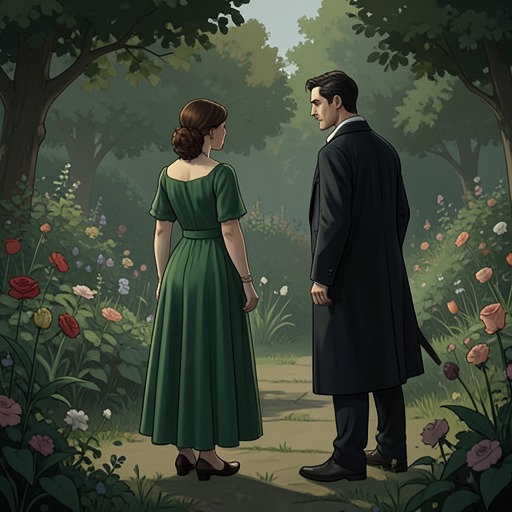
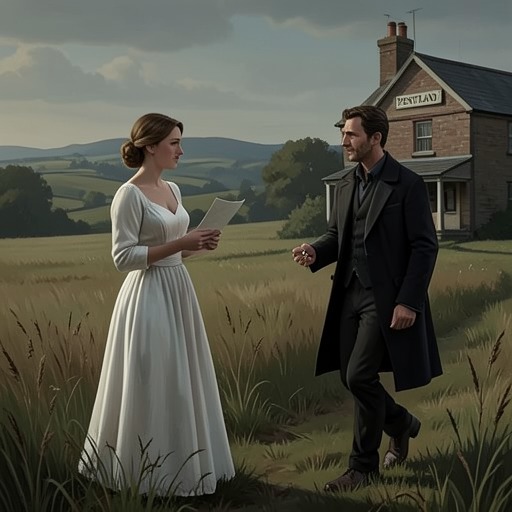
Sir David proposes a marriage of convenience to Elizabeth
Just DesertsSir David Pentland’s proposal of a marriage of convenience to Elizabeth Bennet is the decisive turning point through which his terminal illness becomes an ethical and legal crisis. He offers her not romance or consummation, but widowhood, estate control, and the responsibility of preserving the home and people entrusted to him. The proposal temporarily interrupts Elizabeth’s expected future with Fitzwilliam Darcy while converting her affection for Sir David into an irreversible public obligation.
Causes and Background
Sir David’s proposal arises from a rapidly narrowing horizon. He tells Elizabeth that he is dying of cancer and that his doctor doubts he will survive the year. The illness is physically present as a growing lump in his stomach, a constant ache, and occasional spikes of pain for which he takes a diluted solution of laudanum before retiring. Because his condition deteriorates quickly, a plan that might once have been arranged over months must be executed within weeks.
The proposal also grows from the long relationship between Elizabeth and the Pentlands. Sir David and Lady Radha Pentland had given Elizabeth an alternative model of adult responsibility, kindness, and household authority. Lady Radha, born Radha Bhimani in Kutch, had endured forced movement, kidnapping, attempted enslavement, religious confinement, pirate violence, and social condemnation before finding safety with Sir David. He had cared for her after she was left gravely wounded in Barbados, resigned his naval commission partly because of the treatment she received, married her, and built a life with her in Britain. Elizabeth therefore understands the proposal not as a random financial maneuver but as the final expression of a household whose moral claims on her have been accumulating for years.
Sir David’s material position gives the request unusual force. His estate, Grenadine Reef, was purchased with his share of treasure recovered in 1770, when he commanded HMS Glory and salvaged wealth from a Spanish treasure galleon wrecked on a reef in the Grenadine Islands. The estate’s prosperity thus carries the history of naval service, imperial violence, survival, and social responsibility. Sir David now seeks a successor who will preserve more than property: he wants Elizabeth to care for the servants, tenants, and dependants whose lives are tied to the estate.
The Proposal and Its Terms
The scene begins with the Gardiners acting as chaperones while Elizabeth is with two gentlemen, although Edward and Madeline Gardiner privately wonder why Elizabeth’s usual chaperones are absent. At the far end of the drawing room Sir David dispenses with delay and asks Elizabeth, “Miss Elizabeth Bennet, will you marry me?” The bluntness of the question is matched by the urgency of his condition.
He immediately explains that he loves Elizabeth as the granddaughter he never had. The proposed marriage will be platonic and unconsummated. Its purpose is to make Elizabeth his widow, because widowhood is the exceptional legal condition in which a woman can control real property that would otherwise remain under the authority of her father or husband. As Sir David’s widow, Elizabeth would have control of and responsibility for Grenadine Reef after his death.
The arrangement is therefore both protective and coercive. Sir David wants to give Elizabeth independence and secure the estate’s future, but he also asks her to place her own marriage plans on hold for a year. On the previous evening Elizabeth had expected to marry Fitzwilliam Darcy within weeks. The proposal transforms that anticipated union into a delayed possibility and confronts her with the prospect of becoming Lady Pentland, losing Sir David almost immediately, and assuming authority over an enormous estate while still fearing the unknown.
Elizabeth’s hesitation is not caused by concern about consummation; that possibility is so remote that it has no practical meaning for her. Her real difficulty is the scale of the responsibility. She thinks of the servants, tenants, and everyone associated with Grenadine Reef, recognizing that the request would bind her future to their welfare. She asks for a walk before answering, creating a pause in which personal desire and public duty can be weighed against one another.
Legal and Emotional Negotiation
Sir David has not improvised the proposal entirely. He explains that Lady Radha may have begun imagining such an arrangement within a year of meeting Elizabeth, and that his own thoughts became more urgent after Lady Radha’s death and after Elizabeth’s need to reach legal adulthood and escape Mrs. Bennet’s household became clear. His original will had left everything to his twin brother, James Pentland, but Elizabeth’s presence gave him a different means of protecting both her and Grenadine Reef.
The discovery of cancer removes the time needed for a less disruptive solution. Sir David has written to James, arranged for him to witness the new will, and secured medical and magistrate certification that he remains of sound mind. James and his descendants are to receive significant bequests, leaving no obvious family challenge to the arrangement. The plan is not merely sentimental: it is supported by a will, a marriage settlement, witnesses, and an explicit effort to prevent later legal contest.
The burden also falls on Darcy. Sir David acknowledges that the proposal is inappropriate because Elizabeth and Darcy are courting, yet he asks them to suspend their personal happiness for a year. Darcy is torn between supporting Elizabeth and resenting the interference in their future. His conflict is not between reason and desire but between two forms of love: his love for Elizabeth and his respect for the dying man who has offered her independence. The proposal thus tests whether courtship can become partnership without treating Elizabeth’s agency as an obstacle.
Marriage, Death, and Immediate Consequences
The decision is followed by a sudden rush of legal and domestic activity. Sir David is fading so quickly that arrangements shift from urgent to requiring the utmost despatch. The will and marriage settlement leave nearly everything, apart from specific bequests to James Pentland, named children, Sir David’s valet, and other long-serving servants, to his widow. The usual provisions for a widow and unmarried children are unnecessary because the marriage is designed around Elizabeth’s future control of the estate.
Six days after the proposal, Sir David marries Elizabeth by common licence. He is too weak to walk and must be carried into the church in a chair. James serves as his groomsman; Edward Gardiner escorts Elizabeth; Lily is her maid of honour; the Gardiner family and Darcy attend, along with servants and tenants from Grenadine Reef. The small church is unexpectedly full, making the ceremony a visible declaration that the estate’s people approve of its new mistress.
The marriage is performed according to the rites of the Church of England. Lady Radha had converted to the Church of Scotland when she married Sir David, but after her death Sir David had sought counsel from a local vicar and converted himself so that he could worship at the local church. The ceremony is short and functional. Afterward, Sir David gently kisses Lady Pentland on the forehead, a gesture that confirms the marriage’s tenderness while also preserving its stated platonic character.
The wedding breakfast resembles a tenant celebration more than a conventional social occasion. Relief and genuine joy appear on many faces, but Sir David cannot remain downstairs for long. His face marked by pain, he retires to his room, having endured the exertion with the aid of a large dose of laudanum. Elizabeth escorts him to his bedroom while holding his hand.
Sir David never leaves that bedroom alive. Elizabeth sits with him for long periods on Friday and Saturday, reading aloud even though she cannot know whether he is lucid enough to hear her. She goes to bed late on Saturday night in her cottage and wakes the next morning a widow. His death fulfils the legal purpose of the proposal almost at once, but it also makes the emotional price unavoidable: Elizabeth has gained authority over Grenadine Reef by losing the man who entrusted it to her.
Narrative Significance
The event shifts the value of Elizabeth’s future from romantic expectation to legal and domestic independence. Before the proposal, marriage to Darcy appears imminent; afterward, Elizabeth must become a widow in order to possess the authority that society normally denies an adult woman. The arrangement exposes the contradiction at the centre of her world: marriage can restrict female control of property, while widowhood can create a narrow path to autonomy.
Sir David’s request is also a form of love expressed through institutional means. He cannot leave Elizabeth a secure independent life simply by affection, so he uses the legal structures of will, settlement, marriage, and inheritance. Yet the same structures exert pressure on her emotions, making the proposal an act of generosity that resembles emotional blackmail. Elizabeth’s acceptance does not erase that contradiction; it makes her responsible for carrying it forward.
The event connects the Pentland family’s global history to the future of Grenadine Reef. Radha’s forced migrations and survival, Sir David’s naval career and recovered Spanish treasure, and Elizabeth’s education through the Pentlands’ example converge in a marriage that is neither a conventional love match nor a simple transaction. Its immediate outcome is widowhood, but its lasting consequence is Elizabeth’s emergence as the estate’s responsible female owner, with the power to turn inherited wealth and painful history toward continued care for the people who depend on the house.