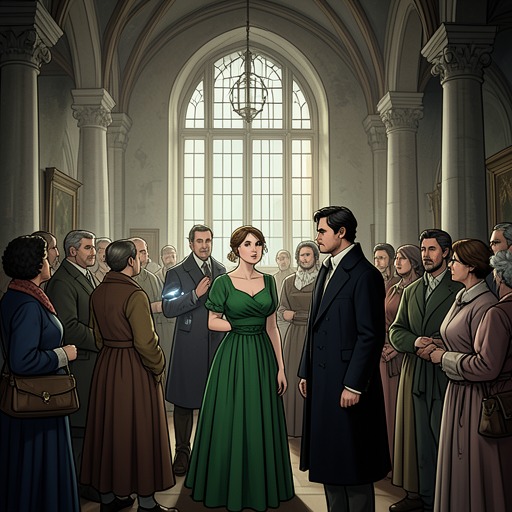
Society is about power, money, connections, advancement
Just Deserts“Society is about power, money, connections, advancement” is a defining expression of the novel’s social analysis. Spoken in a discussion of rank and family strategy, it strips away the ceremonial surface of Regency life and identifies the forces that actually govern it: political power shapes laws, money determines independence, connections open or close doors, and advancement organizes marriage and status. The phrase becomes especially revealing because the story repeatedly contrasts this transactional structure with relationships founded on care, loyalty, and the deepest love.
Meaning Beneath Social Glamour
In the conversation where the expression is explained, society is divided between its visible glamour and its material core. Families want their children to marry well, but “marry well” means more than personal happiness. Rank, wealth, titles, inheritance, and influence are assessed together, turning courtship into an alliance among social positions. A daughter may marry upward into a title, while a son may seek a woman whose dowry repairs or enlarges his prospects. The surface language is elegance and propriety; the underlying logic is exchange.
The expression therefore describes a hierarchy that is both economic and political. An Earl in the House of Lords possesses influence over laws affecting ordinary people and commercial interests, even when he has no direct connection with trade. The consequences of legislation reach merchants and estates alike, while those with titles help determine the rules under which others must live. Social distinction is consequently not merely a matter of invitations, clothing, or conversation. It is a distribution of decision-making power.
Marriage, Rank, and Advancement
Family histories in the discussion illustrate the system through successive marriages. A baron’s daughter becomes a countess and rises two steps above her brother, who remains only a baron. A woman related to Darcy’s family marries a baronet, a lower title, but gains comfort through his large estate and wealth. Another daughter of an Earl appears to marry with more love than calculation, yet even that marriage is described as a significant decision because her grandfather could have opposed it before she reached twenty-one. The examples show that affection may exist within the marriage market without erasing the market’s power.
The same logic governs younger sons. Colonel Richard Fitzwilliam jokes that he needs to marry a lady with a significant dowry. The expression’s force lies in the frankness of this admission: a second son of an Earl has birth and connections but lacks the financial security attached to an inherited estate. A wealthy gentlewoman without powerful connections could therefore be an ideal match for him. Anne de Bourgh is valuable for a different reason, as the heiress to a large estate. Her property makes her a desirable alliance even before her personal qualities are considered.
Networks, Information, and Protection
The novel also presents society as a network through which information and protection travel. Elizabeth Bennet’s relationship with Lady Radha Pentland gives her more than companionship. Through repeated conversations, Lady Radha gradually trains Elizabeth in the practical knowledge required of an estate’s mistress, including household organization, estate management, and the judgment involved in working with a steward. Lady Radha’s instruction is informal, but it transfers cultural and managerial capital that Longbourn has failed to provide.
Elizabeth’s access to Sir David Pentland is itself made possible by a network of intermediaries. Because a young gentlewoman could neither meet an unrelated man alone nor correspond with him directly, Vivian Harkness and Violet Harkness create a carefully maintained channel of communication. Letters addressed to Vivian carry Elizabeth’s questions to Sir David, and his answers return through the same route. The arrangement is a thin veneer of respectability, but it demonstrates how social restrictions can be navigated through trusted connections. The network does not abolish the rule; it makes useful action possible within it.
Charity operates through a similar structure. The Asylum for Female Orphans is supported by royal patronage and governed by nineteen male governors, while women volunteers and staff provide much of the practical work. Elizabeth’s visits expose the gap between institutional authority and daily service. The Asylum houses about two hundred girls aged nine to fourteen, cleans and feeds new arrivals, educates them, and prepares them for employment, especially domestic service. Its organization reveals both the reach of male governance and the indispensable labor of women who convert patronage into actual care.
Reputation, Exclusion, and Social Power
The expression also explains why reputation can function as a form of social currency. Caroline Bingley’s false claim that Elizabeth is Fitzwilliam Darcy’s mistress threatens Elizabeth not simply because it is cruel, but because it attacks the standing on which a woman’s future depends. Darcy refuses to waste time proving the rumour in detail; instead, he severs all acquaintance with Caroline Bingley and asks the Countess of Matlock and Lady Maitland to impose the cut direct as well. The result is Caroline’s irreparable ruin in society. A network of influential relationships becomes the instrument of punishment, demonstrating that inclusion and exclusion are active forms of power.
The same culture polices women through labels. Elizabeth observes that intelligent women who are plain or lack a conventionally feminine figure are more likely to be called blue-stockings than equally intelligent attractive women. The insult reduces female intellect to a social defect when it is not softened by beauty. In this setting, appearance affects the value assigned to intelligence, while reputation determines whether a woman’s intelligence is respected or mocked.
Alternatives to a Transactional Society
The novel does not treat the social order as all-powerful, because its most important relationships expose what the system cannot measure. Lady Radha Pentland recounts that Sir David Pentland continued to care for her after her captivity, illness, and pirate violence, and that he told her her past did not matter when she disclosed what had happened before her rescue. Their marriage began under circumstances in which society had judged her survival an embarrassment, yet it endured for more than thirty years as a partnership grounded in fidelity and shared life.
Elizabeth learns from the Pentlands that marriage can be something other than property exchange. Lady Radha works beside Sir David across the estate, and the couple takes pleasure in each other’s company long after their wedding. Their example makes Charlotte Lucas’s material view of marriage appear painfully narrow and gives Elizabeth a standard against which to judge both her parents’ unhappy union and the pressure to marry for Longbourn. The social world treats marriage as advancement; the Pentlands show it as mutual care.
Elizabeth’s own decisions continue this tension between social calculation and ethical independence. She refuses to be treated as something that can be bought for Longbourn and invokes the principle that a bride cannot be forced to marry. Yet she also understands that protection requires practical arrangements. When she becomes vulnerable to slander and to fortune-hunters after Sir David’s death, she asks the Gardiners to move permanently to Grenadine Reef. Their presence will protect her by making the household appear a family establishment rather than the property of an isolated young widow. The strategy uses social appearances to secure personal freedom rather than surrendering freedom to social expectations.
The expression thus functions as both diagnosis and challenge. It accurately names the machinery through which Regency society distributes rank, money, influence, marriage prospects, and punishment. But the plot repeatedly places that machinery beside forms of loyalty that cannot be reduced to advancement: the Pentlands’ enduring love, the Gardiners’ protection, Elizabeth’s education through conversation, and the women’s refuge at Grenadine Reef. Society may be organized around power, money, connections, and advancement, but the novel asks whether people can redirect those resources toward dignity, recovery, and genuine partnership rather than leaving them in the service of status alone.