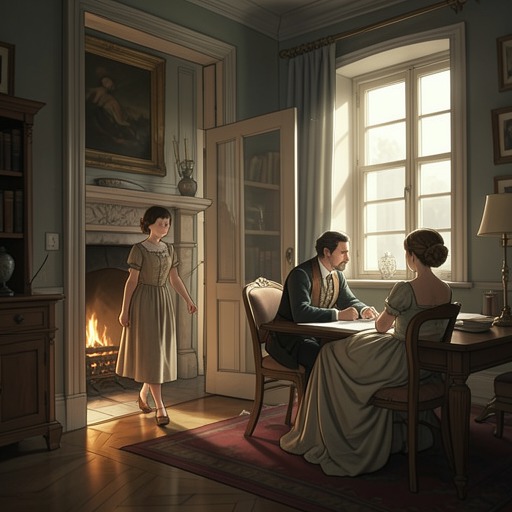
The Gardiners relocate to Grenadine Reef
Just DesertsThe Gardiners’ relocation to Grenadine Reef is a deliberate act of protection and estate-building rather than a simple change of residence. Proposed by Elizabeth Bennet after the death of Sir David Pentland, it brings Edward Gardiner, Madeline Gardiner, and their children into the manor-house community, strengthens Elizabeth’s security, and helps transform Grenadine Reef from a vulnerable inheritance into a stable family and social base.
Causes and Background
Elizabeth’s need for a safer household arises from the unusual history and public position attached to Grenadine Reef. The estate is connected to Lady Radha Pentland’s life as Radha Bhimani, a woman born in Kutch whose childhood was disrupted by conflict among the Mughals, the Marathas, and the British. She was kidnapped for sale into slavery, rescued off the Arabian Peninsula, taken to Spain, forced into a nunnery outside Cadiz, and later sent on a Spanish mission toward Cartagena. After pirates captured the ship, she was wounded and left behind until Sir David Pentland brought her into his home in Bridgetown, Barbados, where she eventually recovered. Sir David later resigned from the navy because of the hostility directed at her, married her after her willing but superficial conversion to the Church of Scotland, and established their life in Britain.
That history makes the estate more than a country property. Grenadine Reef embodies forced movement, imperial violence, rescue, marriage, and the conversion of maritime fortune into landed security. Elizabeth has also learned from Lady Radha’s example how an estate’s master or mistress bears responsibility for tenants and vulnerable people. Her understanding of household management was formed through her own walks and tenant visits at Longbourn, her education by Edward and Madeline Gardiner, and her sustained conversations with Sir David about business and investment.
The Gardiners already provide Elizabeth with an unusually dependable form of family support. Madeline Gardiner’s practical example as the wife of a London tradesman, mother of four young children, and hostess for Edward’s business stands beside Lady Radha’s very different example as a private, injured, childless survivor who rarely appeared in society. Elizabeth sees both women as teaching that a lady’s life consists not merely of display but of love, responsibility, and the daily work of sustaining others. Relocation therefore extends an existing relationship of mutual education into a permanent domestic arrangement.
The Proposal and Its Logic
Elizabeth presents the plan to the Gardiners as a solution to several connected risks. She asks them to move permanently to Grenadine Reef so that their children can grow up in the country and the family can occupy the manor house. Their presence will make it less plausible that Elizabeth alone inherited the estate, weakening the gossip already directed at her. It will also shift attention away from her as an isolated wealthy woman and reduce the likelihood that male fortune-hunters will treat the estate as an invitation.
Elizabeth states that she does not want to become a prisoner in her own home, forced to fear compromise whenever she receives a visitor or conducts estate business. The relocation thus answers a social problem through household architecture: a married couple with children provides visible respectability, while Elizabeth gains a family household around her without surrendering control of her property or movements.
Fitzwilliam Darcy immediately recognizes the proposal’s strength. He describes it as elegant and sensible because the Gardiners can care for the manor while Elizabeth can care for her family. Their presence creates a protective social arrangement without making Edward and Madeline themselves objects of the same pursuit. Darcy also notes that Lily and Eddy, though still too young to attract such attention, will eventually need to understand the risks surrounding the estate and its wealth.
The Move and Household Arrangement
The Gardiners accept the proposal readily. Madeline responds physically before she answers, pulling Elizabeth to her feet and embracing her possessively; Edward then embraces her as well. His acceptance is practical as well as affectionate: the arrangement works for everyone, and he expects the children to enjoy country life. The family will retain its London house as a base for Edward’s business and as a residence for the wider family during visits, so the move does not sever the Gardiners from London or from their commercial world.
Elizabeth postpones any argument over rent, making clear that the arrangement is intended to be mutually useful rather than a one-sided gift. The Gardiners’ role is not that of passive dependants. They will manage and inhabit the manor house, maintain a visible family presence, and help make the estate socially defensible; Elizabeth, in turn, remains responsible for the property and continues to shape its future.
The move also preserves Elizabeth’s emotional boundaries during mourning. She asks that Sir David and Lady Radha’s suite remain unused throughout the mourning period and says that she will continue living in her cottage. The cottage contains her good memories, while living in the former master and mistress’s rooms would force her to confront the impression of trespassing upon a ghost. Because the Gardiners did not know Lady Radha, Elizabeth does not want their occupation of the manor to alter her own memories of that relationship. She plans to visit the suite in autumn, select the memorabilia she wishes to keep, and allow the Gardiners to decorate it as they choose after her marriage.
Consequences and Significance
The relocation gives Grenadine Reef a form of domestic continuity after the death of Sir David. Instead of leaving Elizabeth isolated in a large inherited property, it places the estate within a functioning intergenerational household. The children bring ordinary family life into a property burdened by bereavement and public speculation, while Edward and Madeline provide adult supervision, social credibility, and practical assistance.
Its protection is both material and symbolic. Materially, Elizabeth is less exposed to unwanted visitors and the danger of being treated as an unguarded fortune. Symbolically, the manor ceases to appear as a mysterious estate possessed by a solitary woman and becomes visibly connected to a married family. The arrangement therefore counters slander without requiring Elizabeth to deny her wealth, conceal her authority, or retreat from active estate management.
The event also completes a pattern running through Elizabeth’s life. At Longbourn, she escaped the noise of the house by walking north from the kitchen, circling away from the parlour window, and finding safety along the brook at the estate boundary. At Grenadine Reef, safety is no longer achieved by slipping out of sight. It is constructed through people, space, and recognized household forms. The family relocation turns refuge from a hidden personal retreat into a durable social institution, preserving Elizabeth’s independence while ensuring that she need not defend it alone.