The Meryton Assembly of 1811
Just DesertsThe Meryton Assembly of 1811 is the decisive first public encounter between Elizabeth Bennet and Fitzwilliam Darcy, as well as the occasion on which the social world of Meryton turns observation into conflict. In an overheated Assembly Rooms, Elizabeth Bennet meets the newly arrived Netherfield party, sees Fitzwilliam Darcy as exceptionally handsome, overhears his dismissal of her, and converts wounded attraction into anger. The event establishes the central contrast between appearance and character: Darcy’s beauty attracts Elizabeth before his pride repels her, while the public nature of his insult makes it socially memorable and personally consequential.
Setting and Social Function
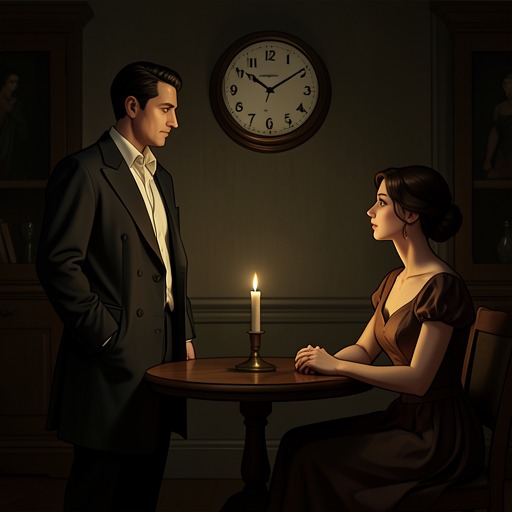
The assembly takes place at the Meryton Assembly Rooms at the beginning of autumn, but the weather remains unseasonably warm. The room is made more oppressive by the mass of bodies, producing a stifling, sweaty atmosphere in which dancing and watching are inseparable. After the first dance, Elizabeth Bennet and Charlotte Lucas retreat toward the refreshment table for tepid punch whose chill has long since disappeared. The physical discomfort of the room gives the polished rituals of the evening a material edge: the assembly is not an abstract scene of elegance but a crowded, overheated public test.
Charlotte Lucas explains that an assembly is a chance to see and be seen. Dancing is among the few respectable ways for an unrelated man and woman to spend time together, and several dances can become the unofficial beginning of courtship. In a countryside where people believe they already know one another, the event permits unmarried men and women to present themselves differently from their ordinary daily selves. The scarcity of eligible gentlemen makes the ritual more intense. Meryton lies close enough to London to be convenient, yet not close enough to attract travelers who would rather reach the capital or escape farther from it; the continuing continental war further reduces the supply of eligible men.
Arrival of the Netherfield Party
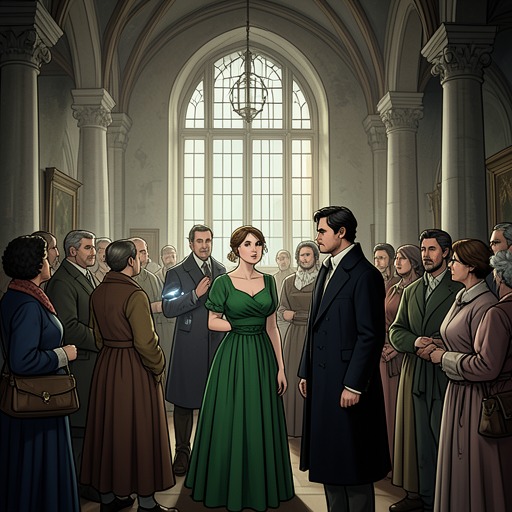
The arrival of the Netherfield party interrupts the limited social routine Elizabeth Bennet and Charlotte Lucas know so well. They identify Charles Bingley by his sandy hair and broad smile, while the married couple and the rest of the group become visible among the crowd and refreshments. Elizabeth Bennet, Jane Bennet, and Mary Bennet are formally presented to Charles Bingley by Sir William Lucas. Charles Bingley then introduces Caroline Bingley, Louisa Hurst, Mr. Hurst, and his close friend Fitzwilliam Darcy.
Elizabeth Bennet’s first sight of Fitzwilliam Darcy is momentarily overwhelming. She is transfixed by his handsomeness, flushes while looking at him, and briefly loses track of her mother’s rambling conversation. The attraction is immediate but not yet informed by knowledge of his conduct. This first impression therefore places Elizabeth Bennet in a vulnerable position: before she can judge Darcy’s character, his appearance has already made an impression upon her.
Darcy’s Insult and Elizabeth’s Response
The encounter changes when Elizabeth Bennet overhears Charles Bingley encouraging Fitzwilliam Darcy to dance. Darcy objects that there is no other woman in the room with whom it would not be a punishment for him to stand. Charles Bingley defends the evening’s company, insisting that several women are unusually pretty. Darcy then acknowledges that Charles Bingley is dancing with the only handsome girl in the room, looking toward Jane Bennet as he says so.
Charles Bingley attempts to draw Darcy’s attention to Elizabeth Bennet, describing her as very pretty and likely agreeable. Darcy is aware that Elizabeth Bennet is being discussed and scrutinizes her before answering. His refusal is not private or tactful. He tells Charles Bingley, "She is tolerable, but not handsome enough to tempt me; I am in no humour at present to give consequence to young ladies who are slighted by other men. You had better return to your partner and enjoy her smiles, for you are wasting your time with me."
The words produce a sharp emotional reversal. Elizabeth Bennet experiences the shock of public dismissal, then recognizes that the insult is worse than a mere failure to receive a dance. She had considered Darcy the most handsome man she had ever met; within less than an hour, he has reduced her in public to being merely tolerable. Her composure, learned partly through dealing with Mrs. Bennet, conceals sadness and anger rather than eliminating either feeling. The insult’s social setting ensures that it can be remembered, repeated, and transformed into a basis for judgment.
Elizabeth Bennet’s anger finally displaces her attraction. She privately brands Darcy an arrogant and pompous man, reasoning that handsome exterior cannot conceal an unpleasant interior. Her decisive inward word is "Vengeance." It is not spoken aloud, but it becomes the emotional emblem of the assembly: a wounded response to humiliation and the first sign that Elizabeth Bennet will meet Darcy’s hauteur with wit, resistance, and independent judgment.
Consequences and Narrative Significance
The assembly establishes the initial pattern of Elizabeth Bennet and Fitzwilliam Darcy’s relationship: attraction is immediately entangled with offense, and social performance becomes evidence of moral character. Darcy’s refusal is presented through the ordinary courtship machinery of the dance, yet it exposes his contempt for the local society and his readiness to make a young woman’s inferiority publicly legible. Elizabeth Bennet, in turn, mistakes a single arrogant performance for a complete account of Darcy’s nature, but the mistake is understandable because the assembly makes conduct visible before motives are known.
The event also introduces the broader social network that will shape the plot. Jane Bennet’s beauty attracts Charles Bingley’s notice, while the presence of Caroline Bingley, Louisa Hurst, and Mr. Hurst establishes the relationships and judgments surrounding the Netherfield household. Elizabeth Bennet’s encounter with Fitzwilliam Darcy is therefore not isolated from the marriage market; it is produced by that market’s rituals, scarcity, spectatorship, and pressure to interpret every glance or dance as social evidence.
In the larger structure of the story, the assembly is later recalled alongside the history of Lady Radha Pentland. Lady Radha describes a life that began as Radha Bhimani in Kutch, was marked by forced migration, kidnapping, attempted enslavement, a pirate attack, confinement in a nunnery outside Cadiz, rescue and recovery in Barbados, and eventual marriage to Sir David Pentland. Her history, as Elizabeth Bennet later explains to the Gardiners, gives the assembly’s seemingly narrow concerns a larger counterpoint. The Meryton room is governed by judgments about beauty, eligibility, and reputation, while Lady Radha’s life reveals how women can be judged, displaced, and punished for circumstances imposed upon them. Elizabeth Bennet’s first experience of Darcy’s public dismissal thus becomes part of a wider narrative about social power, female vulnerability, survival, and the need to distinguish a person’s worth from the judgments imposed upon her.
The assembly’s decisive legacy is not the dance that does not occur but the interpretation that follows. Elizabeth Bennet leaves the evening with a grievance and a sharpened view of Darcy; Darcy leaves it having created the very hostility that will later challenge his assumptions. A crowded room, a few overheard exchanges, and one public refusal become the first durable structure of their conflict, making the Meryton Assembly the point at which their eventual relationship begins in antagonism rather than indifference.