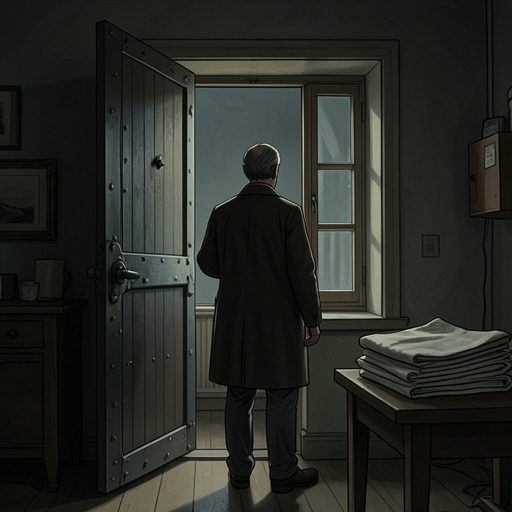
The breaking of the Bennet entail
Just DesertsThe breaking of the Bennet entail is the legal resolution of the succession system that had bound Longbourn to a prescribed male line. Once the family establishes that no surviving male heir descends from Martin Bennet, the last heir’s death without male issue ends the restriction and restores the power to dispose of Longbourn to the Bennet family. The result is more than a technical change in property law: it alters the economic and emotional leverage that has shaped Elizabeth Bennet’s life, her conflict with Mrs. Bennet, and the future of the family estate.
The Entail and the Bennet Inheritance
The inquiry begins with Martin Bennet, whose loyalty to the crown between 1651 and 1660 was rewarded with the deed to Longbourn and its attendant lands. Thomas Bennet, his brothers-in-law Philips and Edward Gardiner, Sir William Lucas, and Clive Bredason, the vicar of Longbourn Chapel, reconstruct the succession through legal documents preserved from the creation of the entail, parish records, and the Bennet Family Bible. Their investigation follows each generation rather than relying on family assumption, making the estate’s legal history a matter of documentary proof.
The conclusion is explicit: there are no male heirs in any line extending back to Martin Bennet. William Collins, the current claimant in the entail’s operation, has died without male issue, and the legal chain therefore terminates with him. The death of the last heir without a son breaks the entail rather than passing Longbourn onward to another collateral male relative.
The Legal Resolution at Longbourn
The determination is announced around Thomas Bennet’s dining table, where the assembled men agree that the entail is broken because the last heir died without male issue. The finding reverses the expectation that Longbourn must leave the Bennet family through the existing succession. It also undercuts the threatened displacement associated with William Collins and Charlotte Collins’s marriage, since the estate is no longer locked into the next male claimant once Collins dies.
The practical consequence is stated without qualification: Thomas Bennet may bestow Longbourn on any of his children, divide it among them, or sell the estate. Edward Gardiner undertakes to file the appropriate paperwork with the Court of Chancery, converting the family’s genealogical conclusion into a formal legal change. The property becomes transferable and divisible, rather than an indivisible inheritance controlled by the rules of male succession.
Elizabeth Bennet and the Cost of Longbourn
The entail’s significance is inseparable from Elizabeth Bennet’s earlier account of her family life. When she refuses William Collins’s proposal, she rejects the idea that a woman can be treated as an instrument for preserving Longbourn. She insists that a bride cannot be forced to marry and argues that the issue is not love but the attempt to sell her for the estate. Her deepest accusation is that Mrs. Bennet may love Longbourn more than she loves her daughter.
That conflict explains why the legal breaking of the entail carries such emotional force. Longbourn had functioned as the material reason behind pressure on Elizabeth, the reason her mother could treat an unwanted marriage as necessary, and the reason Elizabeth’s future seemed subordinate to property. Once the restriction is removed, the premise that her marriage must secure the estate loses its legal foundation. The law does not repair the Bennet household’s emotional injuries, but it removes one of the structures that enabled them.
The wider succession question also becomes urgent because Sir David Pentland is aging, frail, and increasingly aware that time is running out. His wealth arose from the treasure recovered from a Spanish galleon wrecked on a reef near the Grenadine Islands, and he later transformed that prize into Grenadine Reef and extensive investments. His childless marriage to Lady Radha Pentland, restrained expenditure, and reinvestment of surplus income produced an estate capable of supporting future generations. The contrast is pointed: the Bennet inheritance is trapped by an old legal mechanism, while the Pentland fortune has been actively managed and reorganized.
From Fixed Succession to Planned Distribution
The end of the Bennet entail belongs to a broader movement in the story from inherited rigidity toward deliberate stewardship. Sir David’s assets grow because the Pentlands live quietly, avoid the expense of London seasons and a townhouse, have no children’s schooling or dowries to fund, and invest their yearly surplus. Their wealth is not merely received; it is accumulated, transferred, and planned. The same principle later governs the division of the Darcy estates.
Elizabeth Bennet and Fitzwilliam Darcy eventually plan the future distribution of their lands among seven children. Grenadine Reef is divided into four portions: their daughter Helena Darcy is to receive 3,000 acres, while David and Richard Fitzwilliam receive 2,000 acres each from different portions; Richard’s lands include those formerly belonging to Longbourn. Pemberley passes to Bennet, and other estates are assigned across the family, while the Essex estate is sold to strengthen the remaining holdings. The final 1,000 acres around the dower house become the site of St Vincent Lodge, named for the island nearest the wreck discovered by Sir David.
In that later arrangement, property is treated as a responsibility to be designed around actual family circumstances rather than as an unquestionable chain of male privilege. The breaking of the Bennet entail makes such planning possible at Longbourn and places the estate within the same wider debate over inheritance, independence, and the duties attached to wealth.
Consequences and Narrative Significance
The legal release of Longbourn changes the available futures of the Bennet daughters. Instead of being exposed to a succession rule that privileges an unrelated male heir, they can potentially receive the estate, share it, or benefit from its sale. The decision remains in Thomas Bennet’s hands, but the family’s legal horizon is transformed: Longbourn is no longer predetermined by the entail.
The event also exposes the difference between formal law and lived dependence. The entail had shaped marriage negotiations, parental pressure, and fears about displacement, yet its removal cannot by itself create affection, competence, or security. It supplies legal agency where the household had previously experienced inevitability. In this sense, the broken entail is both an ending and an opening: the old inheritance order is closed, while the family must now confront the more difficult question of what it will do with freedom.