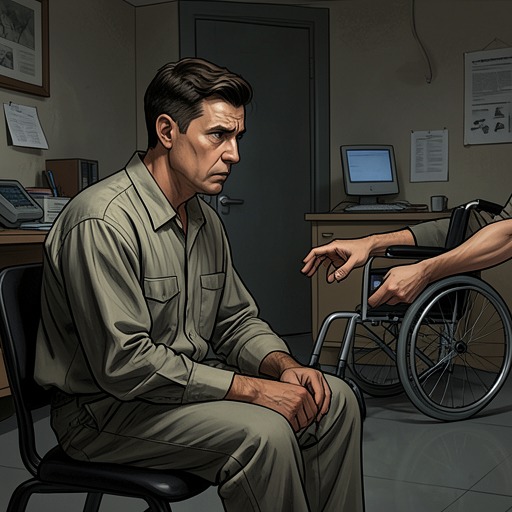
Avery Jenkins's chocolate milkshake
Just MercyAvery Jenkins's chocolate milkshake is a modest object with an unusually clear narrative arc: prison rules repeatedly keep it from Avery, until a correctional officer quietly takes him to Wendy's and buys him one. The milkshake begins as the subject of a recurring question during visits, becomes part of Bryan Stevenson's effort to sustain Avery's attention and trust, and finally arrives through an act that crosses the boundary between custody and care. Its significance lies not in changing the legal evidence, but in giving a concrete, personal form to a relationship otherwise shaped by institutional restrictions and the account of Avery's profound illness.
The Milkshake as a Visit Ritual
At the beginning of their visits, Avery asks whether Bryan has brought him a milkshake. The prison will not allow Bryan to bring one in. He explains this each time, but also tells Avery that he will keep trying. The repetition gives the request a recognizable place in their meetings: before legal discussion can begin, there is a small question about a treat that Avery wants and Bryan cannot provide. Bryan says that continuing to answer and promise matters because it helps him get Avery to focus on something else. The ritual therefore has both a practical obstacle and a purpose in the conversation, even while the desired object remains absent.
The request recurs when the stakes of the visits become more immediate. After a three-hour drive to the court where Avery's hearing will take place, Bryan visits him in the basement holding cell and goes through the usual milkshake protocol before trying to explain what is about to happen. The hearing will include people who had dealt with Avery in foster care, whom Bryan worries might upset him, and expert testimony directly describing his disabilities and illness. Bryan wants Avery to understand why the evidence is being presented. The familiar question offers a point of continuity before an unfamiliar and potentially distressing court proceeding; Bryan does not treat the milkshake as a substitute for explaining the hearing, but as part of the established way he approaches Avery.
The Hearing Behind the Request
The milkshake's repeated absence unfolds alongside the effort to show why Avery's history should have mattered at trial. His lawyers had not investigated that history or presented his disabilities as relevant to his culpability and sentence. At the hearing, over three days, experts explain how organic brain damage, schizophrenia, and bipolar disorder combined to produce severe mental impairment. They describe dangerous behavior as a manifestation of serious illness, not as a measure of Avery's character. The evidence also traces the foster-care system's failures: Avery had been passed from one unhappy placement to another, and several foster parents were later convicted of sexual abuse and criminal mismanagement of foster children.
That history includes the circumstances behind Avery's repeated need for care. As a child, he was abused by foster parents, confined in a closet, denied food, and beaten. When he was ten, his foster mother tied him to a tree in the woods and left him; hunters found him three days later in very poor health. His later drug and alcohol abuse, seizures, and psychotic episodes preceded homelessness and repeated jail stays. At twenty, during a psychotic episode, he entered a stranger's house believing demons were attacking him and stabbed a man to death. By bringing the previously unpresented history and expert explanation into court, the hearing challenges the idea that the crime alone tells the full story of Avery. The milkshake remains a small matter beside that evidentiary work, but the recurring request keeps attention on Avery as a person with immediate needs, not only as the subject of a murder case.
An Unexpected Delivery
After the last day of the hearing, the correctional officer who had transported Avery tells Bryan what happened on the return trip. The officer had been difficult during Bryan's first encounter with him; another client had described him as having a bad reputation, and Bryan had worried about how Avery might have been treated during transport. Instead, the officer says he took an exit off the interstate, drove Avery to a Wendy's, and bought him a chocolate milkshake. The disclosure follows a more personal exchange: the officer tells Bryan that he had looked up the word mitigation after hearing him use it in court, and says he believes Bryan did good work. The purchase comes not from the attorney who had repeatedly tried to bring a milkshake through the prison's rules, but from the officer who controlled Avery's transport.
When Avery comes into the room, Bryan does not yet know that he has already received one. He begins the usual explanation that he tried to bring a chocolate milkshake but was not allowed to. Avery interrupts to say that he got a milkshake and is okay now. The exchange turns the visit's familiar script inside out: for once, Bryan does not have to promise to keep trying, because Avery has something concrete to report. Avery grins as they begin talking about the hearing, and they continue for an hour before Bryan has to see another client.
What Changes—and What Does Not
Avery never again asks Bryan for a chocolate milkshake. That ending gives the object a defined place in the relationship: it is first a repeated request met with explanation and continued effort, then a gift received during transport, and finally a subject that no longer has to recur in their visits. The book does not say that the milkshake caused Avery's change in attention or that the officer's act resolved the larger harms in his life. It does show the immediate consequence in their conversation: when Bryan starts the old ritual, Avery can answer that he has already received one, and the two move on to discussing the hearing.
The legal outcome belongs to the same sequence but is distinct from the gift. Avery wins a new trial, is removed from death row, and is placed in a facility where he can receive mental-health treatment. The milkshake neither supplies the expert evidence nor secures that result. Instead, its small, material presence sits beside the hearing's larger claims: Avery's illness and history had been overlooked, and his behavior could not fairly be reduced to a judgment about his character. A request that began under the prison's refusal ends with Avery able to speak first about what he has received. In that contrast, the milkshake makes care visible on an intimate scale, while the court's decision addresses the larger failure to recognize what Avery needed.