Capital punishment
Just MercyCapital punishment is the book’s most concentrated expression of state power: a legal sentence that turns fear, racial hierarchy, and judgments about human worth into an irreversible act. Bryan Stevenson places executions within a broader history of mass incarceration and institutionalized punishment, but also brings the reader close to their particular costs. The distance between debating a penalty and carrying out a killing is central to his account; so is the question of what justice overlooks when it reduces a person to a crime and a sentence.
A punishment shaped by history and politics
The book connects modern executions to a longer American history in which law and racial power have reinforced one another. In the South, fear of interracial intimacy helped sustain racial hierarchy after slavery and fueled political conflict long after Reconstruction. Laws against interracial relationships made Black men’s relationships with white women a particular target of official scrutiny and punishment. Stevenson also traces a connection between racial terror and the modern death penalty: speedy executions helped redirect the violence of lynching while assuring white Southerners that Black men would still face the ultimate punishment. Capital punishment therefore appears not as an institution separate from racial history, but as one shaped by that history and its enduring assumptions.
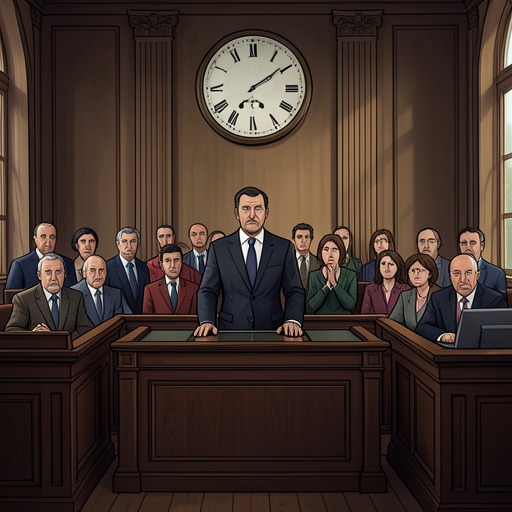
That history operates through courtroom practices as well as public violence. In 1987, every one of Alabama’s forty elected district attorneys was white, despite the state having sixteen majority-Black counties. In serious felony cases, prosecutors could use discretionary peremptory strikes to remove Black potential jurors. Although the Supreme Court of the United States had ruled against racial exclusion from jury service, earlier standards made discriminatory strikes extraordinarily difficult to challenge; the practice of striking all or nearly all Black prospective jurors continued. The 1986 decision in Batson v. Kentucky offered defendants a more direct means to challenge such strikes, but it also forced prosecutors to find more creative ways of excluding Black jurors. For Walter McMillian, facing a capital trial in a county that was 40 percent Black, the possibility of an all-white jury was not an abstraction. Race shaped who could decide whether he lived or died.
A widening punitive system
Stevenson sets the death penalty inside a national transformation toward harsher punishment. When he first visited death row in December 1983, the country was entering a period of expanding imprisonment. The prison population rose from 300,000 people in the early 1970s to 2.3 million; nearly six million more people were on probation or parole. The projected risks were unequal: one in fifteen people born in the United States in 2001 was expected to go to jail or prison, compared with one in three Black male babies born in that century. Executions by shooting, hanging, gas, electrocution, and lethal injection accompanied this expansion, while thousands of people awaited execution on death row.
The same political turn made childhood no reliable protection from the harshest penalties. States lowered or eliminated minimum ages for trying children as adults, and hundreds of thousands of children entered adult jails and prisons; some were under twelve. Nearly three thousand juveniles received life-without-parole sentences. A wave of fear about supposed “super-predators” helped produce laws that increased children’s exposure to adult prosecution, even though the predictions behind that theory proved false: juvenile crime declined, and a 2001 surgeon general’s report called the theory a myth. For children such as Trina Garnett, Ian Manuel, and Antonio Nuñez, the correction came too late to undo sentences made difficult to challenge by procedural barriers.
The larger punitive culture also weakened alternatives to punishment. Many states abolished parole; slogans such as “Three strikes and you’re out” advertised toughness, while rehabilitation, education, and services for imprisoned people were treated as excessive kindness. Drug imprisonment grew from 41,000 people in 1980 to more than half a million in state and federal prisons. The book’s account shows capital punishment as the sharpest edge of a system that increasingly treated severity as a measure of public resolve, rather than asking what circumstances, evidence, or possibilities for change a sentence ought to take into account.
Appeals, finality, and the narrowing of review
The legal safeguards once offered to capital defendants were also contracting. The Supreme Court of the United States increasingly restricted federal habeas review when claims had not first been presented in state court, limited consideration of new evidence, and instructed federal judges to defer more heavily to state-court rulings. In the 1980s, the Court rejected a constitutional challenge to executing juveniles, upheld the death penalty for people with intellectual disability, and found no constitutional violation in the extreme racial disparities visible across many death-penalty jurisdictions. The promise that capital proceedings would receive heightened scrutiny gave way to rules that made it harder to reopen them.
That change became stark in the treatment of Herbert Richardson. His appointed lawyer told him there was no reason to appeal, despite the death sentence, and filed no brief. Richardson remained on death row for eleven years. When Stevenson took his case shortly before the scheduled execution, he filed emergency motions but faced a system increasingly impatient with efforts to delay a sentence. Richardson’s guilt was not the central dispute. The case raised questions about whether he had possessed the specific intent required for capital murder and whether the court had heard important mitigating evidence about his childhood, military service, and trauma. That evidence had not been presented at trial. The case thus exposed a central tension in capital review: a sentence claimed to be carefully lawful can become final without a full consideration of the reasons death may not be appropriate.
The execution and its human costs
The account of Richardson’s execution brings the institution’s physical procedures into view. Officials prepared him for the electric chair; men shaved his body so he could be killed more efficiently, and officers strapped him into the chair. A cassette recorder played “The Old Rugged Cross” as he was taken away. Stevenson remembered Richardson’s desire to receive the American flag he had earned through his service in Vietnam, alongside the suffering of Richardson’s family and the family of the victim. These details resist the clean abstraction of a sentence imposed in court: execution requires people to prepare, restrain, and kill another person.
The consequences reached the victim’s family too. After a hearing, a group of Black women and children approached Stevenson; the victim’s mother said that the family had been promised help and had received none. She described lasting hearing problems for one daughter, nerve problems for another, and injuries affecting herself. Stevenson represented Richardson, not the family, but their appeal for assistance made visible a second failure surrounding the case: the people harmed by the crime had also been left without the support they had been promised. The book does not treat that suffering as an argument for ignoring the defendant’s rights. Instead, it exposes the limits of a system that can carry out a killing while failing to attend adequately to the lives damaged by the crime.
After Richardson’s execution, Stevenson recalled discomfort and shame among people at the prison, including officials who had prepared themselves to proceed with determination. Public statements celebrating the execution seemed remote from the work of killing that had just taken place. His comparison was pointed: society would not call it humane to rape or abuse a person convicted of rape or assault, yet it could regard killing a person convicted of killing as acceptable when the act was carried out in a controlled, institutional manner. The procedure could make violence appear impersonal without removing the human beings who performed it.
The changing climate and the book’s argument
Alabama’s execution pace intensified even as national support for the death penalty began to weaken. Between the adoption of the state’s new death-penalty law in 1975 and the end of 1988, Alabama carried out only three executions. In 1989, changes in the treatment of appeals and the political climate led the attorney general’s office to pursue executions more aggressively; by the end of that year, the state’s cumulative number of executions had doubled. Later, wrongful-conviction revelations helped reduce death sentencing nationally, and by 2010 annual executions had fallen to less than half their 1999 level. Several states repealed the death penalty. Alabama’s rate also declined from its late-1990s peak, but remained the country’s highest death-sentencing rate, and by the end of 2009 it had the highest per-capita execution rate.
This uneven history reinforces the book’s refusal to treat legal change as a simple march toward fairness. National retreat from executions coexisted with Alabama’s exceptionally high rates; new protections for jury selection coexisted with continued efforts to exclude Black jurors; and procedural rules could preserve death sentences even when compelling evidence had never been heard. Against that structure, Stevenson’s insistence on proximity becomes a method of judgment. A death sentence must be considered not only as a legal outcome, but through the defendant’s history, the reliability and fairness of the proceeding, the people affected by the crime, and the concrete acts required to carry out the punishment. The institution’s abstractions lose their authority when the people inside them come into view.