Mozelle and Onzelle
Just MercyMozelle and Onzelle are Vickie Pittman’s twin aunts, rural women who have spent years pursuing answers about their niece’s murder. Their meeting with Bryan Stevenson and Michael O’Connor turns them from determined relatives into witnesses to a broader failure: a criminal justice system increasingly organized around victims’ rights can still ignore families whose grief carries little institutional weight.
Identity and Background
Mozelle and Onzelle are middle-aged white women who live in rural Escambia County and share an unusually close bond. They spend so much time together that they finish one another’s sentences without seeming to notice. Opinionated and direct, they describe themselves as “country tough” and present themselves as fearless women who cannot be intimidated. Their toughness is not an ornamental personality detail: it shapes how they confront people and institutions that have left their questions unanswered.
The sisters have been collecting information about Vickie’s death and searching desperately for an explanation. Early police reports had implicated Vickie’s father, Vic Pittman, as a suspect, but he was never formally charged. The sisters also believe there is more to the case than the account they have been given. Their suspicions extend to their brother and to local law enforcement; the narrative records those suspicions as theirs, not as established findings.
Meeting the Defense Team
When Stevenson and O’Connor decide to investigate the Pittman murder, they contact the twins hoping they will speak with them. The sisters agree eagerly. Mozelle’s final warning on their first telephone conversation is characteristically blunt: “Just so you know: We’re gun owners, so don’t bring no drama when you come.” It sets the terms for an encounter in which the visitors will be questioned as directly as the officials the sisters distrust.
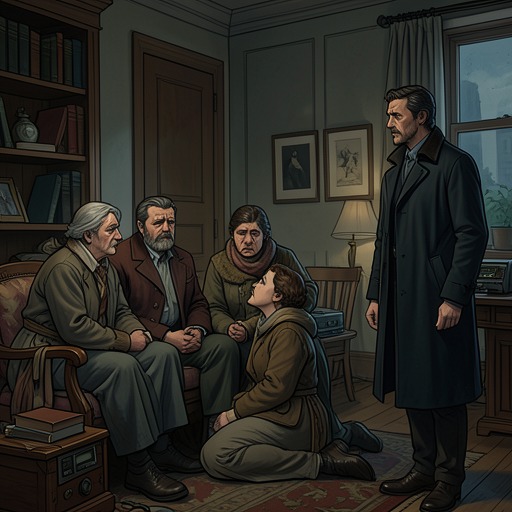
The lawyers travel to rural Escambia County. Mozelle and Onzelle welcome them into their home, seat them at the kitchen table, and waste no time getting to the point. Mozelle asks, “Did your client kill our baby?” Stevenson answers, “No, ma’am, I sincerely believe he did not.” The question’s intimacy makes clear that Vickie was not an abstraction or merely a case file to her aunts. It also tests the visitors’ candor at the beginning of a conversation shaped by years of uncertainty.
Stevenson does not pretend that the whole case has been solved. He explains that he and his colleagues have spoken with Ralph Myers and believe Myers and Karen Kelly were involved, while Myers insists that other people were involved too. Onzelle responds that the sisters already know there is more to the story. Their exchange reveals both the limits and the purpose of the lawyers’ inquiry: they cannot offer a complete account at the kitchen table, but they are willing to listen and investigate rather than dismiss the question.
Neglect and the Search for Answers
The sisters say that the prosecutor disrespected and ignored them. They were turned away even by the state’s victims’ rights group, an especially sharp disappointment in a period when victims and their families were being promised a more visible place in criminal proceedings. Mozelle’s anger is captured in her complaint: “They treated us like we were low-class white trash. They could not have cared less about us.” She had expected victims to be treated better and believed families should have some say.
Their experience complicates the public language of victims’ rights. By the 1980s, states were expanding victims’ participation, creating advocacy groups, and giving families more opportunities to take part in cases. But greater formal attention did not ensure equal attention in practice. The book connects the twins’ neglect to a larger disparity: poor and minority victims and their relatives could still be excluded from communication and decision-making, while the status of a victim could itself become another means by which the system valued some people more than others. Mozelle and Onzelle’s account makes that disparity concrete through the ordinary facts of being ignored, turned away, and left to pursue the investigation themselves.
After nearly three hours of listening to the sisters’ painful reflections, Stevenson and O’Connor promise to do what they can to find out who else was involved in Vickie’s death. Onzelle tells them, “You’re the first two people to come to our house and spend time with us talking about Vickie.” The importance of the visit lies not in a claim that the lawyers have already delivered answers, but in the contrast between their willingness to sit with the family and the years of institutional indifference the twins describe.
Narrative Role and Significance
The twins’ account gives the investigation a purpose beyond defending Walter McMillian. Stevenson and O’Connor seek information about Vickie’s murder partly to test the circumstances and coercion surrounding Myers’s testimony against McMillian. The sisters are not simply sources for that defense: their own demand to know who killed their niece remains central to the encounter. The possibility that the case involved other people, and the unresolved questions about Vickie’s death, cannot be reduced to whether one accusation against McMillian was false.
Mozelle and Onzelle also complicate any simple division between victims who receive attention and defendants who are mistreated. Their family has suffered a killing, yet the systems meant to respond to crime have failed to hear them. Their story shows how a victim-centered process can still leave particular victims’ relatives outside the room. The twins’ directness and insistence make that exclusion visible, while their willingness to speak with the defense team opens a path toward further inquiry without pretending that the answers are already known.