Racial bias and criminal justice
Just MercyRacial bias in criminal justice, as traced in the book, is not confined to openly prejudiced acts. It is a history and structure that can turn racialized fear into suspicion, make exclusion seem procedurally ordinary, and allow official judgments to outweigh evidence. The prosecution of Walter McMillian shows how an interracial relationship could become a substitute for proof; the history of jury selection shows how formal legal protections could coexist with persistent exclusion. Other cases reveal how race intersects with poverty, gender, disability, and childhood, placing the most vulnerable at particular risk of severe punishment.
Historical Foundations
The book links contemporary criminal justice to the racial hierarchy built after slavery. Following the collapse of Reconstruction, white supremacy returned quickly in Alabama: African Americans lost voting rights, and restrictive laws helped restore subordination. Anti-miscegenation statutes made intimate relationships between Black men and white women a matter of criminal law. The fear of interracial sex and marriage, cultivated in the 1860s as a defense of slavery, endured as a force in Southern racial politics and policing. Authorities in many Southern communities treated the investigation and punishment of Black men involved with white women as part of their duty.
That history gave interracial intimacy a danger beyond the ordinary criminal law. In the South, murder or assault might lead to prison, but interracial sex was regarded by many white people as a uniquely threatening transgression. Hundreds of Black men were lynched on even unsubstantiated suggestions of such relationships. In Monroe County, nearly a dozen people had been lynched since the county’s incorporation, with more killings in neighboring counties. Their power lay not only in the number killed but in the terror they spread: any encounter, misstep, or perceived slight could seem to invite lethal violence.
Walter McMillian had learned that danger through family memory rather than legal history. When he was twelve, Russell Charley, a Black man known to Walter’s family, was found hanging from a tree in Vredenburgh, Alabama. The lynching was believed to have followed an interracial romance; Charley’s bullet-ridden body intensified fear in the Black community. Alabama’s constitutional ban on interracial marriage remained on the books into the twenty-first century, although federal law prevented its enforcement. When voters finally considered removing it in 2000, 41 percent voted to keep the ban. The persistence of that vote underscores how long the old hierarchy survived its formal legal defeat.
Suspicion, Prosecution, and the McMillian Case
Walter’s relationship with Karen Kelly changed how the community perceived him. Before the affair became public, white residents knew him chiefly as a hardworking pulpwood worker trusted to do good work. After he testified at a custody hearing involving the Kellys, gossip recast him as something more threatening. Drinking, fighting, or an extramarital affair might not have destroyed the standing of an industrious Black man; a relationship with a married white woman was treated differently. The racial meaning attached to the affair altered Walter’s reputation before it established any connection to the murder of Ronda Morrison.
The investigation made that substitution visible. Ralph Myers could not identify Walter among several Black men in a store and had to ask the owner to point him out. Myers delivered a note supposedly written by Karen; Walter appeared confused, discarded it, and returned to what he had been doing. The monitoring agents found no sign that the two men had a relationship and substantial reason to think they had never met. Yet, seven months after the murder, public anger and pressure for an arrest were mounting. Sheriff Tom Tate had little law-enforcement experience, and the evidence against Walter was lacking. The account identifies Walter’s race and his adulterous interracial relationship as the only apparent basis for treating him as reckless or dangerous, despite his lack of a criminal history and good reputation.
The prosecution proceeded despite doubts about its witnesses and objections from Black residents who believed Walter innocent. In 1987, all forty elected district attorneys in Alabama were white, including those serving a state with sixteen majority-Black counties. Political boundaries had been arranged to preserve white majorities in judicial circuits that included majority-Black counties. Ted Pearson knew of the community’s concerns, but remained confident he could win a conviction. The book presents this confidence alongside the institutional imbalance: the people making prosecutorial decisions were not representative of the communities whose residents faced them.
Jury Selection and the Limits of Formal Protection
The jury system provides a second, institutional account of racial bias. Monroe County was 40 percent Black, yet serious felony trials there could still proceed before all-white juries. In the Deep South, jury rolls had long been drawn from voter lists that excluded African Americans. After the Voting Rights Act, clerks and judges continued to keep jury rolls largely white through other tactics, including requirements that jurors be intelligent and upright. The Supreme Court had ruled in Strauder v. West Virginia that excluding Black people from jury service was unconstitutional, but that principle did not ensure their presence in courtrooms. A 1945 ruling even upheld a Texas statute limiting Black jurors to one per case.
Later decisions addressed underrepresentation and racially discriminatory strikes, but left room for exclusion to continue. The Supreme Court held that discriminatory use of peremptory strikes was unconstitutional in the 1960s, yet set a demanding standard for proving bias; no challenge succeeded for twenty years, while prosecutors continued striking all or nearly all Black prospective jurors. In 1986, Batson v. Kentucky offered defendants a more direct way to challenge such strikes. The ruling raised hope, but also pushed prosecutors toward more creative methods of exclusion. Walter, held on death row before trial, heard other prisoners describe cases in which prosecutors had struck every Black prospective juror or nearly all of them. Their stories made the possibility of an all-white jury a concrete concern, not an abstract legal issue.
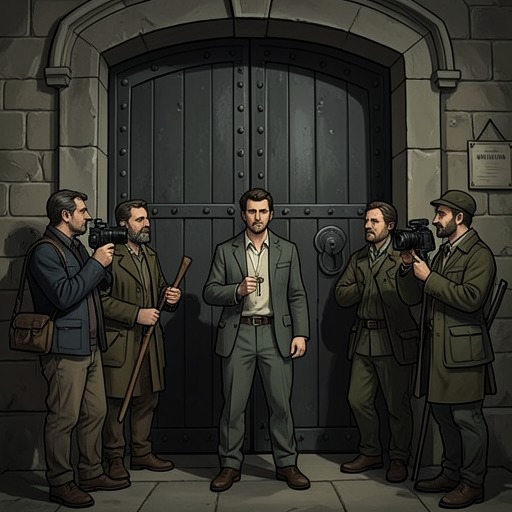
During Walter’s proceedings, the courtroom itself offered a stark contrast. A metal detector and a German shepherd stood inside the entrance. The benches that had held Walter’s supporters the previous day were now mostly occupied by older white supporters of the Morrisons and the prosecution, while Walter’s family and supporters had been told they could not enter. Bryan Stevenson challenged the unequal access before Judge Norton. The scene does not replace the legal history of jury selection, but it gives that history a physical setting: who could enter, who could sit, and whose presence counted as ordinary support were matters with immediate consequences.
Unequal Exposure to Punishment
The book situates these cases within a broader system that is quick to presume guilt. Poverty, racial bias, and structural and political forces contribute to wrongful convictions; people sentenced to death have been exonerated after coming close to execution, and many others have been freed after DNA evidence proved innocence in noncapital cases. The point is not that every mistaken prosecution has the same cause, but that a system shaped by presumptions of guilt and unequal power can turn error into imprisonment.
Other cases show how vulnerability compounds that risk. In Chester, Pennsylvania, fourteen-year-old Trina Garnett grew up amid severe poverty, abuse, and untreated mental-health problems. After a fire killed two boys, her lawyer failed to seek an incompetency determination or challenge her trial as an adult. A judge found that she had not intended to kill, but mandatory sentencing law prevented him from considering her age, illness, poverty, or the abuse she had endured; she received life imprisonment without parole. Her case shows how age, deprivation, and procedural failure can narrow a defendant’s chances of being understood, even apart from any claim that race alone explains the result.
The treatment of women accused after infant deaths likewise shows punishment organized around judgments of gender and class. Marsha Colbey was charged with capital murder only weeks after delivering a stillborn child, following a pathologist’s premature claim that the baby had been born alive. Her own state’s expert witnesses undermined that conclusion: one described the pregnancy as high risk for unexplained fetal death, while another rejected the basis for declaring a live birth or homicide. Bridget Lee was also charged after a stillbirth; six pathologists later concluded that neonatal pneumonia had killed the child, and the prosecutor dropped the charges. In Victoria Banks’s case, an intellectually disabled Black woman was coerced into pleading guilty to killing an infant who had never existed. Her release came after the defense established that a tubal ligation years earlier had made pregnancy impossible. These cases expose the danger of allowing suspicion about a woman’s conduct to stand in for reliable evidence.
Children and people with disabilities also reveal the gap between a person’s circumstances and the labels imposed by courts. At thirteen, Joe Sullivan had mental disabilities, read at a first-grade level, experienced abuse and neglect, and lacked a stable home; nevertheless, the court characterized him as a violent recidivist and sentenced him to life without parole. In a different kind of confinement, Ian Manuel’s monthly phone call on Christmas Eve in 1992 reached Debbie Baigre, the woman he had shot. His apology began a correspondence; after years of communication, Baigre challenged his harsh sentence and inhumane conditions, while acknowledging the seriousness of his crime. The relationship complicates the fixed categories of offender and victim without erasing responsibility or harm.
Significance
These accounts connect racial bias to a wider pattern of reducing people to a single accusation or an unchangeable identity. The book describes a country that expanded imprisonment on an unprecedented scale while institutionalizing labels such as criminal, murderer, or felon and limiting rehabilitation and support. Racialized suspicion is one force within that system, but its effects interact with poverty, age, disability, gender, and access to competent representation. Those intersections help explain why ostensibly neutral rules can deliver radically unequal outcomes.
The book’s method is to place a person’s circumstances beside the official version of the case. Walter’s discarded note, the absence of evidence linking him to Myers, the racial composition of juries, and the blocked courtroom door all test the prosecution’s account against details it cannot easily absorb. The broader cases perform a similar test: they restore the histories and capacities that severe sentences erase. Getting closer to condemned people, rather than accepting distance and fear as guides to judgment, becomes both a way of seeing racial injustice and a challenge to the institutions that reproduce it.