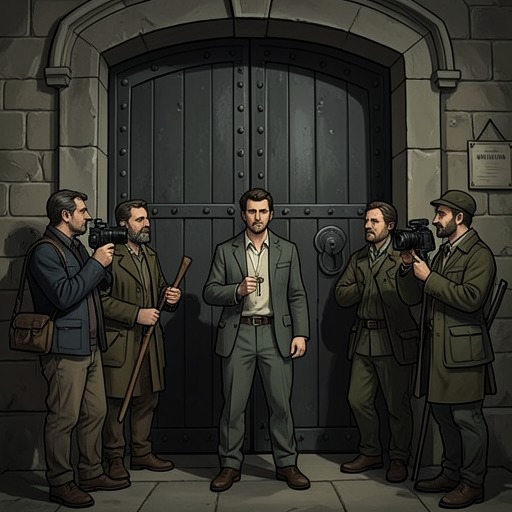
Tom Chapman
Just MercyTom Chapman is the Monroe County district attorney whose changing role in Walter McMillian’s case traces a fraught path from anticipated reform to resistance and, finally, agreement to dismiss the charges. A former criminal defense attorney elected after Ted Pearson’s long tenure, Chapman initially appeared to Bryan Stevenson as a possible opening for a more searching review of a conviction built on unreliable evidence. That hope was tested when Darnell Houston, an alibi witness, was indicted for perjury after contradicting the State’s account; later, Chapman helped defend McMillian’s conviction. Yet at the final hearing, he joined the motion to dismiss every charge, bringing the prosecution to an end.
Appointment and Early Promise
Chapman took office as Monroe County district attorney after Ted Pearson’s long service. His election suggested a new era to people who hoped for changes in local law enforcement. In his forties, he had spoken about modernizing policing and prosecution in the region. Some observers considered him ambitious and speculated that he might seek statewide office, though that was not established as a goal. His background as a former criminal defense attorney also distinguished him from Pearson, a lifelong prosecutor.
Stevenson learned that Chapman had represented Karen Kelly in an earlier proceeding. Because Kelly was connected to the McMillian case, Stevenson took this as a sign that Chapman already knew something about its history. He hoped that the new district attorney might be more receptive than his predecessor to the possibility that an innocent man had been convicted. Chapman’s professional manner initially reinforced that expectation: when they met, he was courteous, presented himself as a studious lawyer, and arranged to speak with Stevenson privately rather than with a group of local officials present.
The Houston Indictment and a Fractured Meeting
Before meeting Chapman, Stevenson had moved to reconsider the denial of a new-trial motion. Houston provided an affidavit saying that Bill Hooks’s testimony was false, and Stevenson was trying to persuade local lawyers that the new evidence undermined the reliability of McMillian’s conviction. The stakes were immediate: once the case proceeded on direct appeal, new evidence could no longer be introduced through the trial court’s new-trial process.
Then Houston called Stevenson’s office to report that he had been arrested and indicted for perjury. Houston said he had received no warning or inquiry; he had simply been told he was charged and then released on bond. Stevenson regarded the indictment as punishment for cooperating with the defense and as an alarming sign that people who challenged the State’s witnesses might be intimidated. He nevertheless chose to give Chapman a chance to explain before filing further motions, hoping not to begin their first meeting with an angry accusation.
At the meeting, Stevenson explained that he doubted McMillian’s guilt and the reliability of the conviction. Chapman stressed that he had not participated in the original prosecution. When Stevenson confirmed that he represented Houston as well as McMillian, Chapman raised a possible conflict of interest. He then said that he might drop the perjury charges now that the judge had denied Stevenson’s motion to reopen the case, while adding that people who made false statements about the case should be held accountable. Stevenson was confused by Chapman’s reference to the denial and stunned by the warning that accompanied the possible dismissal. The exchange did not settle the underlying dispute; it exposed how precarious Houston’s position had become while his testimony threatened the prosecution’s case.
Defending the Conviction
Chapman’s subsequent conduct frustrated Stevenson’s hope that the new district attorney would independently reconsider McMillian’s guilt. By the time of the Rule 32 post-conviction hearing, Chapman had called in the State attorney general’s office to help defend the conviction. Stevenson and his investigative partner had repeatedly asked Chapman to reopen the investigation and examine the case independently, but those efforts met growing hostility from Chapman and law enforcement officers. The defense had uncovered substantial exculpatory material that had not previously been disclosed and feared that further evidence remained hidden. Its repeated requests for files also strained relations with the judge, who complained that the defense was fishing.
This stance made Chapman’s early promise more complicated, not simply because he was now opposing the defense, but because the case had placed before him questions about the reliability of the prosecution he had inherited. The evidence does not establish that Chapman took part in the original wrongful conviction; he had explicitly distinguished himself from that prosecution. It does show that, as district attorney, he helped defend the conviction against a challenge supported by undisclosed exculpatory evidence, even as Stevenson continued to ask him to reconsider it. The divide was between the possibility of a fresh review and the institutional defense of an existing result.
Joint Motion and Resolution
After the Alabama Court of Criminal Appeals ruled in McMillian’s favor, the case returned for a hearing before a new judge. The courtroom atmosphere contrasted sharply with earlier proceedings: McMillian’s family and supporters filled the benches, there was no metal detector or police dog, and McMillian entered unshackled in a black suit and white shirt Stevenson had brought him. The judge told Stevenson that she intended to grant the motion without lengthy argument so that the parties could conclude the matter quickly.
Stevenson presented the procedural history and informed the court that both McMillian and the State were moving to dismiss all charges. Chapman thus joined the motion that ended the prosecution. The judge granted it promptly. The scene did not erase the earlier intimidation of Houston, the resistance to renewed investigation, or the years of wrongful imprisonment. Instead, the abrupt cooperation underscored how much the outcome had changed: the district attorney who had helped defend the conviction now agreed that the charges should be dismissed.
Narrative Role
Chapman’s arc is defined by the gap between the reforming possibility attached to a new officeholder and the choices he made as the inherited case came under challenge. His election and defense-law background gave Stevenson grounds for cautious optimism; the perjury indictment of Houston and Chapman’s response to it made that optimism harder to sustain. His later role in defending the conviction prolonged the conflict, while his eventual agreement to dismiss the charges enabled its formal resolution.
The account does not reduce Chapman to a single motive or claim that his final decision repaired every injury. It shows instead how institutional positions shift under pressure from new evidence and legal developments, and how a procedural ending can arrive without undoing what preceded it. McMillian’s release required the State’s charges to be dismissed; it did not answer who killed Ronda Morrison. Chapman’s part in the case therefore closes with a consequential reversal, but not with a complete accounting of the harm or the unresolved crime.