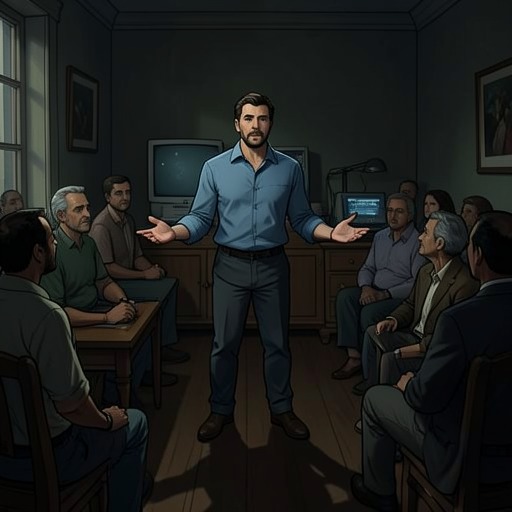
Tom Taylor
Just MercyTom Taylor was an Alabama Bureau of Investigation investigator whose review of the case against Walter McMillian supplied an unusually direct challenge to the prosecution’s account: Taylor concluded that McMillian was innocent and said he would report that conclusion to state officials. Working with Greg Cole, he helped turn evidence long disputed by the defense into findings reached by investigators asked to confirm McMillian’s guilt.
Role in the Reinvestigation
Taylor entered the case after the hearing had exposed serious contradictions in the prosecution’s evidence. District Attorney Tommy Chapman gathered local investigators to explain those contradictions and was dissatisfied with their answers. He then formally asked the Alabama Bureau of Investigation to conduct another investigation, ostensibly to confirm McMillian’s guilt. The renewed inquiry thus began at the prosecution’s request, not as an announced effort to vindicate the defense.
Taylor and Cole contacted the defense team, which agreed to share its files and information. When the investigators met with the defense, they came across as experienced and intent on doing credible work. They had no ties to the local figures in South Alabama who had handled the case. Within a few weeks, their assessment appeared to be moving away from the original theory of guilt.
The defense provided files, memoranda, and even original evidence. That openness carried a risk: if the conviction were overturned and McMillian had to face a new trial, state investigators would have received material that could help the prosecution prepare to challenge the defense. The defense shared it anyway, trusting that an honest review would expose the weakness of the charges. Taylor and Cole’s conclusions vindicated that choice.
Findings on the Evidence
Six months after the appeal had been filed, with a ruling from the Court of Criminal Appeals expected, Taylor and Cole returned to meet with the defense and discuss what they had found. Taylor did not hedge his conclusion: “There is no way Walter McMillian killed Ronda Morrison.” He said the investigators would report to the attorney general, the district attorney, and anyone else who asked that McMillian had nothing to do with either murder and was completely innocent. His statement went beyond expressing doubt about the prosecution’s case; it rejected the central accusation outright.
Taylor explained why the account of McMillian as a dangerous drug kingpin did not fit the evidence known to the investigators. He pointed to the contrast between that characterization and McMillian’s circumstances: a man working fifteen hours a day cutting timber on difficult terrain. Taylor also found that Ralph Myers’s trial story made no sense and wondered aloud how a jury had convicted McMillian. The details that had been used to make McMillian seem threatening instead looked to Taylor like reasons to question the prosecution’s narrative.
Cole added a separate, consequential finding: Bill Hooks and Joe Hightower had both admitted that their trial testimony was false. The disclosure undercut testimony the prosecution had relied upon and reinforced Taylor’s conclusion that McMillian had been wrongly implicated. The investigators had not merely raised doubts about one witness or one part of the case; their findings challenged multiple supports for the conviction.
The Case’s Public Narrative
Taylor’s conclusions mattered in a case where public descriptions of McMillian had often displaced careful attention to the evidence. Local newspapers had portrayed him as a drug kingpin, sexual predator, and gang leader, and had emphasized courtroom metal detectors and police presence as signs of danger. After the hearing, coverage revived other murder allegations and represented McMillian as the leader of a criminal ring. Against that accumulated portrayal, an investigation conducted by state investigators offered a stark counter-account: the evidence did not connect him to either murder.
The contrast was also sharpened by District Attorney Chapman’s public position. In the televised interview, Chapman dismissed suggestions of racial bias, professed confidence that McMillian was guilty, and said he should be executed as soon as possible. Privately, however, Chapman had become concerned about the reliability of the evidence exposed at the hearing and had sought the ABI investigation. Taylor’s findings gave force to the gap between the prosecutor’s public certainty and the evidence that investigators were now reporting.
Significance
Taylor’s role was not simply to echo the defense’s objections. The ABI had been asked to confirm guilt, yet Taylor and Cole examined material supplied by the defense and reached a conclusion that contradicted the original prosecution theory. Taylor’s willingness to state that conclusion plainly—and to promise that it would be reported to state officials—made the investigation a turning point in the account of McMillian’s case.
The record establishes Taylor’s conclusion and his commitment to communicate it; it does not, by itself, establish what each official did in response. His significance lies in the reversal he represented: an investigator brought in to test the prosecution’s case came back saying that McMillian was innocent, while the investigation also surfaced admissions that important trial testimony had been false. In a case shaped by confident accusations and hostile public descriptions, that reversal made the question of guilt impossible to separate from the reliability of the institutions and witnesses that had produced the conviction.