Walter McMillian’s trauma-related cognitive decline
Just MercyWalter McMillian’s trauma-related cognitive decline began after his exoneration and release, when the threat of execution he had endured on death row returned in nightmares, confusion, and eventually dementia. The most devastating expression of that decline was also its clearest reversal: in a hospital, he believed he had been imprisoned again and pleaded for help escaping execution. His freedom had ended the legal sentence, but not the fear it had made part of his life.
The delayed return of death-row fear
A few months after his release, Walter spent his first week in Montgomery and then moved to Florida to stay with his sister for a couple of months. Bryan Stevenson remained in almost daily contact with him. Walter had accepted that Minnie wanted to move forward without him and seemed mostly happy and hopeful, but his outward adjustment did not mean the imprisonment had left him unharmed. He gradually began to describe how unbearable it had been to live under the constant threat of execution.
While on death row, Walter had witnessed six men leave for execution. At the time, he coped as the other prisoners did, through symbolic protests and private moments of anguish. Only after leaving prison did he understand how deeply those executions had terrified him. He was unsettled by the belated force of the memories and asked, “Why do I keep thinking about this?” The question marks a divide between what he had managed to endure inside prison and what became possible to feel after release.
Nightmares made the past return during sleep, while ordinary conversation could bring it back into waking life. If a friend or relative said that they supported the death penalty, but not for Walter, he found himself shaken. The qualification did not reassure him: it placed his own case inside a system of punishment that those closest to him still accepted in principle. Stevenson could tell him only that it would get better.
Confusion, loss, and diagnosis
Walter’s decline came quickly. His moments of confusion lengthened, and he began forgetting things he had done only hours earlier. Details of his business slipped away; managing work became difficult in ways he could not understand, and the difficulty depressed him. When Stevenson reviewed his records with him, they found that Walter had been selling things for a fraction of their worth and losing substantial money. The cognitive changes were therefore not only frightening; they were disrupting his ability to protect the livelihood he had rebuilt.
At a public screening of a short Irish documentary about the death penalty, Walter’s difficulty became visible to others. The film featured his case and those of two other Alabama death-row prisoners: James “Bo” Cochran, who had won a new trial after federal courts reversed his conviction because of racial bias in jury selection and was acquitted by a racially diverse jury, and Robert Tarver, who maintained his innocence but was executed after courts refused to review a jury-selection claim. About seventy-five community members gathered at the Equal Justice Initiative office for the screening. Walter was more terse than usual and looked frantically toward Stevenson whenever someone asked him a question; Stevenson told him he would not have to give any more presentations.
Walter’s sister reported that he had begun wandering in the evenings and getting lost. He also began drinking heavily, which he had not done before, and said that he was anxious all the time and that alcohol calmed his nerves. After he collapsed, he was taken to a hospital in Mobile. A doctor told Stevenson that Walter had advancing dementia, likely induced by trauma, and would need constant care. The doctor warned that the dementia would progress and that Walter would likely become incapacitated.
Care constrained by circumstance
Walter’s family and Stevenson agreed that he should move to Huntsville to live with a relative able to provide consistent care. That arrangement worked for a time, but Walter became agitated and ran out of money. He returned to Monroeville, where his sister Katie Lee agreed to watch him. His condition improved for a while, then deteriorated again. The sequence offered no stable resolution: familiar surroundings and family care could help, but could not halt the decline.
Eventually Walter needed a facility equipped to care for elderly and infirm residents. Most facilities would not admit him because he had a felony conviction. Explaining that he had been wrongfully convicted and later proved innocent did not overcome that barrier. The conviction continued to shape his prospects even after the state’s case against him had collapsed. Maria Morrison, a social worker at the Equal Justice Initiative, worked with Walter and his family to find an appropriate placement. The search was frustrating, and the facility she eventually found in Montgomery would accept him only for a short stay of no more than ninety days, leaving the family to plan for what came next.
Death row restored in memory
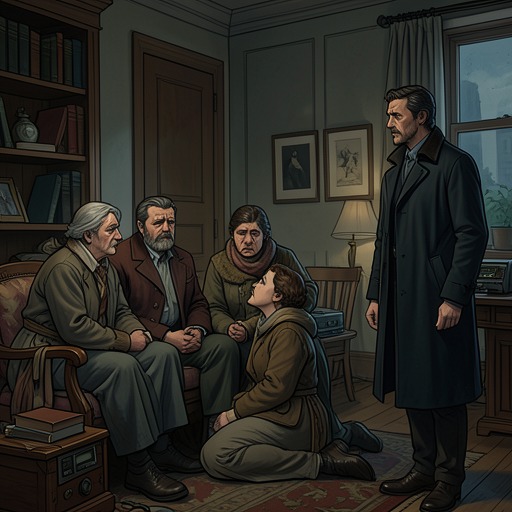
During one hospital visit, Walter first spoke defiantly about the cars he owned, insisting that people had not believed him and that he knew what he was talking about. Then he became quiet and worried. With a heavy sigh, he said, “Well, it looks like I’m back here,” and added, “They done put me back on death row.” The hospital room had become, in his understanding, the place from which execution threatened him again.
Stevenson tried to explain that Walter was not on death row but in a hospital because he had been unwell. Walter insisted that he had been taken again and that Stevenson had to get him out. As he began to panic, he cried, “They’re going to execute me for no good reason, and I don’t want to die in no electric chair.” Stevenson put an arm around him and reassured him. Walter trembled, then stopped crying when his head reached the pillow. Stevenson spoke softly about arranging for him to stay at home and finding help, while also explaining that it was not safe for him to be alone. Within minutes Walter was asleep. The episode compresses the distance between the actual hospital and the feared death row: his mind had returned him to the old danger even as another person tried to care for him in the present.
Memory, friendship, and the meaning of release
Walter’s distress was not limited to the symptoms of dementia. After his release, he had spoken publicly with Stevenson about his case and the death penalty, and remained troubled by the men he had left behind on death row, whom he considered friends. His own experience had made him fiercely opposed to capital punishment. The later hospital scene shows that release could not simply undo the years in which execution had been made an imminent possibility; the men he remembered and the danger he feared remained bound together in his mind.
The book places this decline within a larger account of trauma, mercy, and the limits of punishment. Walter genuinely forgave the people who had unfairly accused and convicted him, and Stevenson describes mercy toward others as part of Walter’s recovery of a life worth celebrating. That account does not make the cognitive decline a redemptive symbol or erase its material consequences: lost business, fear, dependence, and difficulty securing a place to live. Instead, the contrast makes clear that the man who had regained freedom and extended forgiveness was also living with damage that freedom alone could not repair. His decline reveals a lasting cost of wrongful death-row imprisonment, while the struggle to obtain care shows how the consequences of conviction can persist even after innocence has been established.