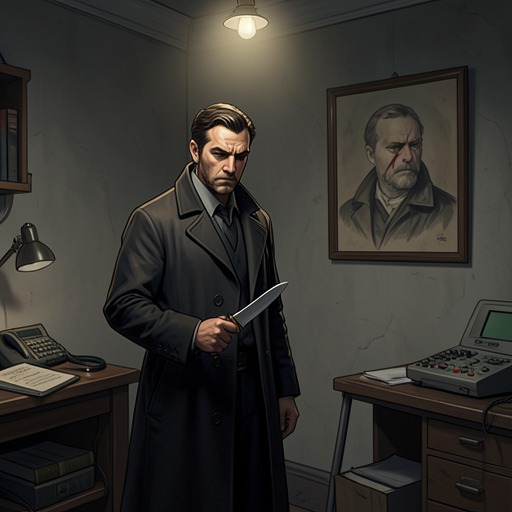
Carl Vespa’s grief and desire for vengeance
Just One LookCarl Vespa’s grief and desire for vengeance are inseparable: the death of his son Ryan becomes, for Vespa, a loss time cannot alter and a debt the world must repay. His fixation narrows a tragedy in which eighteen people died to one person whose absence governs his life, while the language of balance gives revenge the shape of a moral obligation.
The loss that remains
In a conversation with Grace Lawson, the scale of the past comes into view through competing measures. Grace notes that a man has been in jail for almost fifteen years and that eighteen people died. Vespa does not dispute the number; inwardly, however, he dismisses it as beside the point. Only Ryan matters to him. The contrast is not a denial that others suffered, but evidence of how completely his grief has organized his attention around his son.
The sound of Max Lawson laughing from the kitchen makes that private wound visible to Grace. Vespa keeps his face composed, but she recognizes the turmoil beneath it. His unspoken question is whether she would be so ready to excuse a frightened, intoxicated offender if the victim had been Max or Emma Lawson. The imagined loss of another parent’s child briefly makes his own anger legible: what Grace might call rationalization looks, from Vespa’s position, like an unbearable difference between abstract victims and a beloved son.
A future he cannot imagine
Ryan’s death also stands against the family life Vespa and Sharon had hoped to build. They wanted more children, but Vespa’s sperm count was too low. He told no one and subtly allowed Sharon to bear the blame. Looking back, he believes that another child—someone who could have been Ryan’s sibling—might have made the tragedy bearable, if not easier. The thought exposes both his old concealment and his later understanding of what it cost: he had wanted a family large enough to continue living through loss, but that future never came to pass.
Sharon is gone, and the relationship between them had been bound more closely to Ryan in death than in life. Vespa recognizes that this was never a healthy connection. His reflection on parents who must get out of bed for their surviving children leads to a stark conclusion about himself: he has no such reason anymore. The statement does not mean that grief has ended his life; rather, it describes how little he can imagine beyond the loss. Fifteen years later, the absence still structures the present.
Revenge as an account of balance
When Wade Larue asks whether the revenge is personal—whether it is about Vespa or his son—Vespa will not name the intended target. He insists only that the act needs to be done. Asked whether he means that the world needs balance, he agrees. His reasoning converts grief into an account that can be settled: eighteen people died, and someone must pay. The language of balance gives his purpose a universal-sounding justification, even as his earlier focus on Ryan reveals its deeply personal source.
The exchange leaves an important gap between the principle Vespa announces and the person or act he withholds. He does not explain the full object of his revenge in that moment. Instead, the certainty that repayment is necessary stands in for disclosure. That silence makes his appeal to balance both forceful and troubling: it presents retaliation as a duty without demonstrating that it can restore what was lost.
The limits of time and retribution
The later events sharpen the cost of that conviction. Wade Larue’s body is found near the Port Authority Bus Terminal in New York City less than twenty-four hours after his release, shot at point-blank range. A reporter says that after leaving a press conference at the Crowne Plaza, Wade got into a black sedan with a man matching Cram’s description. No arrest follows, but the account strongly points toward Vespa’s circle. Grace tries to understand what Vespa has done and observes that, for him, nothing has changed: Ryan is still dead, and fifteen years have not been enough.
When Grace accuses Vespa of killing Wade as well, Vespa replies by offering a truth she already knows he wants to tell: Wade had contacted him the day before his release and asked to talk. Grace understands that disclosure alone will not satisfy him. Truth cannot make the dead return, and vengeance cannot become justice simply by being described as payment. Her judgment that neither will ever be enough marks the limit of Vespa’s project. His grief persists, but the revenge it produces cannot deliver the balance he claims to seek.