Charlaine Swain and Mike Swain’s marriage
Just One LookCharlaine Swain and Mike Swain’s marriage moves from quiet domestic estrangement into a crisis that makes their remaining attachment unmistakable. Before danger reaches them, they share a house but increasingly live separate lives; when Mike is hurt during their pursuit of a suspected intruder, Charlaine’s wish to hold his hand exposes how much intimacy had already been lost—and how sharply she now feels its absence.
A marriage diminished by routine
Charlaine remembers herself as energetic, ambitious, and full of zest, but she feels that ordinary life has gradually extinguished that vitality. She wonders whether her children or Mike contributed to the change, then recognizes that the explanation is not his alone. Pregnancy, nursing, and the exhaustion of caring for infants had altered her own drive; she regrets not making more effort before those temporary changes hardened into an enduring apathy. The marriage’s distance is therefore presented as gradual and shared, rather than as a single rupture with one clear cause.
Her recollection of their earlier intimacy makes the change concrete. Mike once romanced and surprised her, and his desire made her feel pursued; now their sexual routine seems to her mechanical and narrowly focused on completion and sleep. Their conversations, too, have contracted to the children’s schedules, pickups, homework, medical appointments, and activities. Charlaine finds the same child-centered talk stifling among neighborhood mothers, so the narrowing of conversation belongs not only to her marriage but to the broader domestic world in which she feels trapped.
Separate rooms, shared house
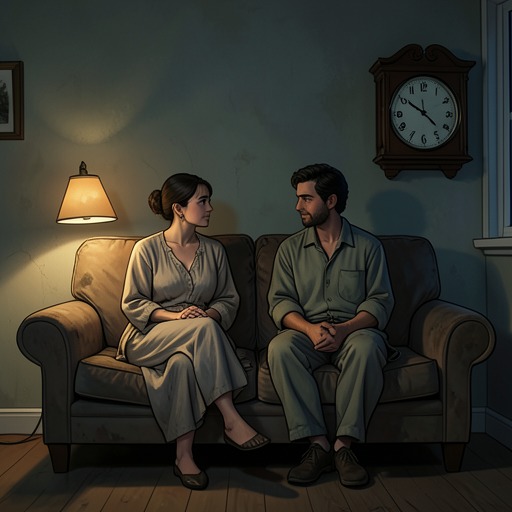
The distance becomes visible in the arrangement of their evenings. Mike watches television downstairs in the den while Charlaine stays in the bedroom; they prefer different programs, but she suspects that their separation is not really about what is on television. They watch alone, in the dark. Their children remain in their own rooms, and Charlaine finds it difficult to limit their time on the Internet. She understands the household as four separate people who interact only when necessary, a family structure that gives physical form to the couple’s isolation.
Against that pattern, her memory of the beginning of the marriage is striking. When she runs downstairs and finds Mike in the kitchen, his expression recalls the way he looked at her when they first fell in love at Vanderbilt. His appearance has changed, but she recognizes the eyes. The moment does not erase the accumulated distance or establish that the marriage has been repaired. Instead, it shows that an old form of recognition remains available beneath the routines that have come to divide them.
Danger and the decision to act together
When Charlaine grows suspicious of a man near the Sykes home, she calls for help and then tells Mike that she needs to go somewhere. He accompanies her. As they drive through the winding residential development in Ho-Ho-Kus, Charlaine gives him most of what she has seen and why she became concerned. Mike listens without interrupting, although she leaves out part of the reason she had been watching from the window. Their exchange combines renewed cooperation with the old habit of withholding: she turns to him in an emergency, but does not yet tell him everything.
They pursue the man in their car, and Mike voices confidence in the protection its locked doors seem to offer. The apparent safety fails when the man makes a sudden move and the windshield shatters. Charlaine screams and ducks; Mike slumps against her. The attack abruptly changes the meaning of their earlier separation. The husband who had occupied another room and seemed emotionally distant is now physically beside her in a moment of danger, and Charlaine’s concern for him becomes immediate.
Hospital vigil and belated recognition
At the hospital, Charlaine wants to sit beside Mike’s bed and hold his hand, but the room’s only chair is poorly suited to the bedside. She stands instead, occasionally sitting on the edge of the bed before worrying that she might disturb him. She interprets this awkward vigil as a kind of penance. Her choice of that word links her present attentiveness to the intimacy she had neglected, without implying that Mike’s injury itself resolves the marriage’s problems.
Holding his hand also recalls their last such gesture, two months earlier, at a romantic comedy. Mike had reached for her and tried to interlace their fingers; Charlaine shifted her hand so he could not. At the time, she felt unmoved by his attempt at closeness. In the hospital, that small refusal acquires lasting weight: she remembers not simply that they had held hands, but that she had blocked him when he sought contact. The marriage’s emotional arc is consequently defined by a painful contrast between a past in which Mike reached for her and a present in which she longs to reach for him. The evidence establishes her regret and renewed concern, but leaves the longer-term state of their relationship unresolved.