False identities and concealment
Just One LookFalse identities and concealment are not a single trick in the novel but a set of ways a person can become unreachable: changing names and appearance, inventing an online self, disappearing from records, or losing access to one’s own past. Such concealment can protect someone from recognition, give a predator access to a target, or leave investigators unable to establish where a missing person has gone. The novel also distinguishes intentional disguise from involuntary uncertainty, especially when Grace Lawson’s damaged memory makes the past difficult to recover.
Reinvention and the hidden past
Jimmy X’s account presents concealment as a long attempt to live beyond recognition. After leaving the music business, he went to Alaska and spent about a year gutting fish, then travelled and played with small bar bands. In Seattle, he met a group of older hippies who had made identification papers for members of the Weather Underground; they provided him with new papers. When he came closest to returning, he played drums in a cover band at the Tropicana in Atlantic City, dyed his hair, and avoided the role that had once made him conspicuous. This was not simply a new stage name: changed documents, appearance, and work helped him pass through ordinary life without being identified.
That reinvention did not resolve his relationship with the life he had left. Jimmy X says he wanted to return, make amends, and move on, but the longer he stayed away, the harder return became. His invented distance therefore works as both shelter and trap: it obscures his former identity while extending the estrangement that makes reconciliation difficult. The account gives concealment an emotional cost without suggesting that a new appearance or name can erase the history behind it.
Online personas as access
Eric Wu uses false identities not to escape recognition but to approach people. With Freddy Sykes, the name Al Singer links two apparently separate encounters: Wu used it while pretending to make a delivery, and Freddy had been corresponding online with someone using that same alias. Freddy initially denied knowing Al Singer, but the name prompts investigators to consider that the online correspondent and the supposed delivery person were Wu. Their inference is that Wu used the dating service to meet potential victims, with Freddy as one such contact. In this case, an alias is more than concealment after the fact; it is a means of establishing access and disguising the connection between online contact and a physical intrusion.
Wu also approached Beatrice Smith through the fictional persona Kurt McFaddon, a widower from Philadelphia considering a move to New York City. Beatrice had shared personal information online with this invented correspondent, including her isolation after her husband’s death and her uncertainty about leaving Armonk. Wu then travelled to her home. The intended disappearance was part of the plan: he reasoned that Beatrice could not be allowed to remain findable, and that nothing could connect her to Freddy Sykes. The fabricated online self and the intended erasure of its target are linked stages of concealment, though the evidence does not establish that every online persona Wu used was identical in purpose or detail.
Missing people and missing records
The investigation around the mystery photograph shows a different form of concealment: people become difficult to trace even when investigators know their names and connections. Scott Duncan identifies Shane Alworth as Geri Duncan’s boyfriend; Shane is also one of the people Grace Lawson connects to the photograph and to Jack Lawson’s disappearance. A retired dean identifies another woman in the photograph as Sheila Lambert, but a full check finds no sign of Sheila’s existence over the preceding decade: no payroll-tax record and no Social Security number hit. Scott compares the result to Shane’s case. The absence of ordinary records does not by itself explain where either person went, but it denies investigators the routine traces that might confirm a life and lead them onward.
The photograph supplies partial recognition rather than a complete answer. Grace and Scott can connect Geri, Shane, and Jack to it, while the identities of the other women remain uncertain; Scott expects they may identify the redhead but doubts they will ever identify the woman turned away from the camera. The image makes concealment visible as a gap in knowledge: a face, a name, or a relationship may be present without enough information to reconstruct the person’s history. The inquiry advances through these partial connections rather than through a single revelation that makes everyone legible.
When institutions cannot establish absence
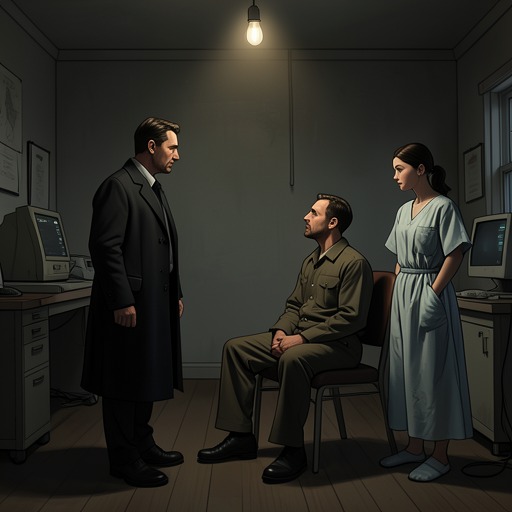
The missing-person process adds an institutional limit to the novel’s treatment of disappearance. When Grace tries to report her adult husband missing, Officer Daley explains that the rules require an adult to meet specified criteria before being entered into the system. He runs through categories that include disability, danger, catastrophe, and juvenile status; Jack does not qualify under the categories discussed. Daley says there is no evidence of foul play and that the investigation would be upgraded if evidence emerged. Captain Perlmutter later reiterates that the police do not consider foul play likely and are not obliged to give Grace further information simply because Jack is an adult.
The rules do not prove that Jack has assumed another identity or that the officers are deliberately concealing his whereabouts. Their effect is narrower and consequential: without evidence that fits the threshold, his absence does not receive the formal recognition Grace seeks. The novel thereby places private disappearance beside administrative classification. A person may be missing to a family while remaining outside the system’s available categories, and the lack of an official entry can make the search harder without explaining the disappearance itself.
Memory, identity, and uncertainty
Grace’s experience after the Boston concert stampede offers a necessary contrast to deliberate impersonation. She was twenty-one at the concert, but in a dream she experiences a self who is also married to Jack and the mother of Emma and Max. She cannot tell whether the dream’s details come from her subconscious, memories, or what she later read about the tragedy. In waking life, head trauma left her unable to recall the concert or the days immediately before it; she initially believed it was time to take a political-science final. The doctors explain the memory loss as a consequence of the injury, not as psychological repression.
This uncertainty is not a disguise Grace chooses. It shows instead that identity can be obscured without anyone deliberately assuming a false name: the person remains herself, but cannot confidently separate lived recollection from later information or imagination. Set beside Jimmy X’s self-concealment and Wu’s calculated aliases, her memory loss sharpens the distinction between hiding a past and being unable to retrieve it. Across these cases, concealment shapes what other people can know, what institutions can verify, and what the people themselves can recover.