Jack Lawson’s assumed identity
Just One LookJack Lawson’s assumed identity is the name Shane Alworth adopts in place of John Lawson after the concert shooting, a substitution that turns a missing man into a husband and makes an unresolved death look like a continuous life. Grace Lawson reconstructs the change years later through the difference between her husband and the brother whose scar he does not bear. Her account connects the personal deception to the Lawson family trust, while leaving the precise circumstances of John’s death and the other participants’ responsibility contested in the confrontation where she lays out her theory.
Identity and the substitution
Grace’s decisive clue is a physical absence: Jack Lawson has no scar from the bullet wound that, she reasons, John Lawson must have suffered. She concludes that the man she married was not John but Shane Alworth, and tells Sandra Koval that Jack had formerly been known as Shane. The distinction is not merely between two names. It divides the injured man pulled from the concert melee from the man who later lived as Jack Lawson, and makes Grace’s own marriage part of a concealed change of identity.
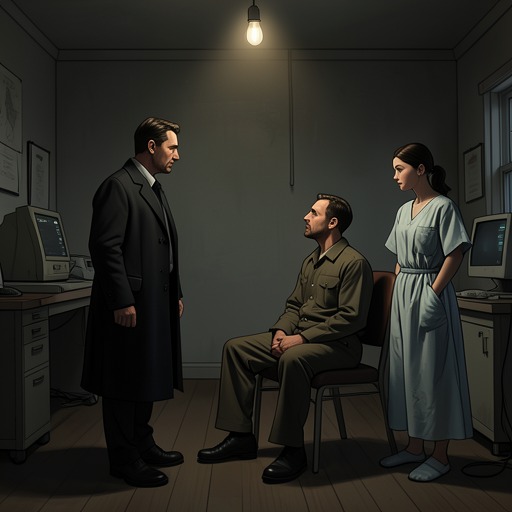
Grace’s reconstruction begins with John’s fate on the night of the concert. She says Sandra Koval and Sheila Lambert helped drag John out during the melee, but that his wounds were lethal. She also raises a darker possibility: if he survived, Sandra may have killed him rather than take him to a hospital, because a hospital would have had to report the shooting. A body left in public, she argues, could likewise have prompted an investigation into where and how he was shot. These are accusations and deductions Grace presents to Sandra, not a confession from Sandra; the exchange leaves the exact end of John’s life unresolved.
How the assumed identity could work
Grace argues that the substitution was practical because Shane did not have to reproduce John’s entire past in public. In her account, Sandra and her father could help him obtain identification using John’s birth certificate and related paperwork, with a stolen-wallet explanation offered if questions arose. Grace says screening was easier at the time. She imagines the new identity extending to a driver’s license and passport, giving Shane documents with which to travel and function as John Lawson.
The family’s familiarity with the new identity could make it seem ordinary. Grace says Sandra, her father, and Shane could appear together before a new trust lawyer with proper identification, while the lawyer—now in Boston rather than Los Angeles—would not know John’s face. John had already graduated from Vermont University, so Shane would not need to appear there and account for the change in appearance. If someone encountered him overseas, Grace suggests, he could use the name Jack and pass as another John Lawson, a name she describes as common. The proposed arrangement depends on paperwork, family cooperation, and the absence of people who could compare the two men directly.
The family trust and the proposed motive
Grace connects the identity change to documents she found in Jack’s desk and took to a lawyer friend. As she explains the Lawson family trust, the grandfather had established six trusts for his two children and four grandchildren. Voting power was divided into six equal shares, with the father receiving an additional four percent; the resulting balance left his side of the family with a 52-to-48 majority in the business.
The succession clause, as Grace understands it, redistributed voting power equally among the five survivors if one of the six beneficiaries died before age twenty-five. She tells Sandra that if John died on the concert night, Sandra and her father would lose their majority position. Grace therefore proposes two possible pressures behind the concealment: fear that the shooting would be exposed and fear of losing control of the family business. She allows that both could have mattered. The trust gives her theory a concrete financial and political stake, but Sandra rejects the accusation and does not confirm it.
Discovery and significance
The confrontation changes the meaning of Jack’s absence and of his relationship to Grace. When she recognizes that Jack bears no scar, she can no longer treat her husband and the John Lawson who was shot as one continuous person. She tells Sandra that she married Jack Lawson, formerly Shane Alworth, and concludes that Eric Wu had held only one man in the basement: Jack, who had sacrificed himself to save her and may have been trying to leave her a final truth. The assumed identity is thus exposed not by an official record in this exchange but by Grace’s reasoning from a missing mark on her husband’s body and the fragments of the past that she assembles around it.
The deception also has a bureaucratic dimension. When Grace reports her adult husband missing, Daley explains that recent rules allow an adult to be entered into the computer only if he meets specified criteria, such as being disabled, endangered, a catastrophe victim, or a juvenile. Jack meets none of these categories, and the police say they have no evidence of foul play; Captain Stuart Perlmutter later reiterates that the department does not believe Jack has met with foul play and is not obliged to tell Grace more. His assumed identity therefore compounds the difficulty of establishing who is missing: the woman seeking her husband cannot explain the concealed history that would make his disappearance legible to authorities. The plot’s central reversal is that the missing person’s apparent identity was itself a cover, and that recovering the truth requires Grace to question the name, marriage, and family history she had taken for granted.