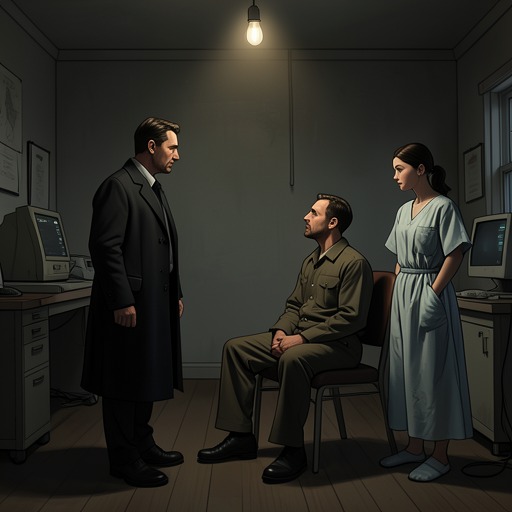
Monte Scanlon, Geri's accidental killer
Just One LookMonte Scanlon, Geri's accidental killer is introduced in a high-security federal penitentiary, where he asks Scott Duncan to hear the story behind a death caused by mistaken identity. His account turns on the gap between the rules he claims to follow and the consequence of acting on a telephone message he misunderstood; at the interview’s end, he offers no certainty about his identity or motives, only the possibility that confession might restore an illusion of humanity.
Identity and Position
The file identifies the prisoner as Monte Scanlon, but Scott Duncan doubts that this is his real name. That uncertainty makes even the name under which he tells his story provisional: the interview presents a man known to the authorities by one identity, while suggesting that his history may not be exhausted by it. The evidence does not establish another name, so the discrepancy remains a question rather than a solved secret.
The meeting takes place in a windowless, gray room at a federal penitentiary. Monte Scanlon, Geri's accidental killer wears prison-issued orange and sits handcuffed at a metal table. Scott Duncan, whose usual work is prosecuting corrupt politicians in New Jersey, is there because Monte Scanlon has broken his silence and made a demand. Their roles are sharply unequal in practical terms: Monte Scanlon is restrained, while Scott Duncan has come to listen. Yet the prisoner controls the subject, having summoned the conversation to tell a story that Scott Duncan does not initially understand.
Other people are present at first: United States attorney Linda Morgan, two prison guards, and Monte Scanlon’s lawyer. The guards remain alert despite the prisoner’s restraints. After Linda Morgan and the lawyer leave, Scott Duncan and Monte Scanlon are alone, though the guards continue watching from behind one-way glass. The intercom is switched off at Monte Scanlon’s instruction. This arrangement allows privacy of speech without making the interview private in any absolute sense: the conversation is still observed, and the prisoner remains securely confined.
The Assassin’s Rules
Monte Scanlon identifies himself as a hit man, or, in his more formal description, an assassin for hire. Scott Duncan’s blunt reminder that he has killed many people does not lead Monte Scanlon to deny his record. Instead, he distinguishes himself from what he calls a typical hired assassin and says that he has rules. The claim is not a denial of violence; it is the framework through which he explains how he understands his work and how he believes it can go wrong.
The first rule he discloses is that he never kills women. He stresses that Geri’s death was arranged by telephone, and explains why that detail matters to him: a person who follows rules, he says, can make a mistake through a phone message. His account thus places the failure not in an abandonment of his code but in the process by which an order was conveyed and interpreted. That distinction is central to his explanation, though it does not undo the result.
The rule also exposes the limits of a code built around categories and procedures. Monte Scanlon presents the prohibition as firm, but the protection it was meant to provide depends on correctly identifying the person named in an instruction. In his telling, the safeguard failed before he reached the address: the information itself carried an ambiguity he did not resolve. The episode therefore makes his rules both a claimed boundary and a measure of his error.
The Mistaken Name and Geri’s Death
Monte Scanlon explains that Geri’s name can be mistaken for a man’s name when heard over the phone. Fifteen years before the interview, he received a call from a go-between, was given an address, and was told the time when “Jerry” would be home. He understood the name as referring to a male target. The intended instruction, as he recounts it, led instead to Geri. The evidence establishes the mistaken identification and the resulting death, but does not supply further details about the killing itself.
The time interval matters to the shape of the confession: Monte Scanlon is describing an event from fifteen years earlier, not a recent breakdown of his stated rule. He connects the mistake to the particular medium of communication and to a name whose spelling and sound could be understood in more than one way. His account makes the error concrete—the intermediary, the address, the specified time, and the name “Jerry”—without revealing who ordered the killing or why Geri was targeted. Those unanswered questions remain outside the explanation he offers here.
By foregrounding the rule against killing women, Monte Scanlon asks Scott Duncan to understand the death as a failure of identification rather than an intentional breach of that rule. The narrative supports the mistake he describes, but his own explanation also preserves a distinction between the rules he claims and the actions for which he is responsible. His account does not present the rule as having prevented the death; it shows how little protection it offered once the name was misunderstood.
Confession and Its Uncertainty
When Scott Duncan asks why Monte Scanlon is telling him this now, Monte Scanlon does not give a practical explanation. He looks at his reflection in the mirror and quietly suggests that Scott Duncan may have been right about something said earlier. Asked what he means, he turns back and says that, after everything is done, perhaps he needs the illusion of being human. The statement links the confession to a need he can describe only tentatively; it does not establish remorse, a plea for forgiveness, or a change in his conduct.
The mirror gives the exchange a restrained visual focus: Monte Scanlon studies his reflection before speaking, then turns back toward Scott Duncan. The scene does not resolve whether the story makes him more human in his own eyes or in anyone else’s. Instead, the word illusion keeps the claim unsettled. He can name a possible need for humanity while stopping short of claiming that his rules, his explanation, or the act of telling the story has fulfilled it.
Narrative Role
Monte Scanlon’s account transforms a rule that initially sounds like a mark of professional discipline into the mechanism of a fatal contradiction. He says he never kills women; he also recounts how an ambiguous telephone name led him to kill Geri. The tension lies not in whether the rule exists, but in the distance between a rule as self-description and its actual capacity to prevent harm.
The interview is structured around controlled disclosure. Monte Scanlon first establishes his profession and his code, then identifies the rule relevant to Geri, and only afterward explains the name that caused the mistake. Scott Duncan’s repeated incomprehension keeps the account from becoming an effortless justification: the explanation has to be stated and connected to its consequence. At the close, the focus shifts from the mechanics of the error to the uncertain purpose of confession, leaving Monte Scanlon’s identity and his claim to humanity unresolved.