Photomat
Just One LookPhotomat is the Kasselton photo-processing shop where Grace Lawson finds The photograph of five young people among her prints, an intrusion into an ordinary errand that sets her search for answers in motion. The store matters not simply as the place where the photograph appears, but as the first physical point in a chain of questions: who handled Grace’s film, how the unfamiliar picture entered her packet, and whether the shop’s account of its own process can be trusted.
Setting and First Visit
Grace’s unraveling begins as she enters Photomat. The scene initially carries the texture of routine: she has been speaking with a woman outside, then takes the pause in their conversation to say goodbye, pull open the shop door, and go inside. The glass door snaps shut behind her and rings a small bell. Inside, a sharp chemical smell reminds her of model glue; she wonders briefly about the long-term effects of working around it, then decides the immediate nuisance is enough to occupy her attention. That matter-of-fact irritation establishes Photomat as an everyday workplace before it becomes the setting for a consequential mystery.
The employee behind the counter is Josh, whom Grace privately associates with his conspicuous appearance and lackadaisical manner. He has dyed hair, multiple piercings and tattoos, a headphone looped around his neck, and music loud enough for Grace to feel in her chest. Her comic scrutiny of his tattoos and apparent idleness is not yet an accusation. In retrospect, however, his role becomes important: he is the person Grace believes developed the roll containing the unfamiliar photograph. The ordinary counter transaction acquires a second meaning once the prints are examined.
That change occurs while Grace is thinking about her dead parents and about how much older her children, Emma Lawson and Max Lawson, look than they did in a previous year’s apple-picking photograph. The thought turns her attention to the prints, where she finds a picture that does not belong to her. It sits near the middle of the packet, is the same size as the other photographs, and has a flimsier backing sheet, more like a cheap photocopy. Grace checks the next print and finds no duplicate. The image appears only once, mixed among photographs from her own roll; the possibility that it was inserted by mistake is plausible, but the photograph’s presence makes the shop’s routine handling of images newly visible and suspect.
Processing Questions and an Unanswered Explanation
Grace’s first explanation is an accidental mix-up, perhaps caused by an employee’s mistake. She returns to Photomat with questions about the processing rather than accepting the image as an inexplicable coincidence. On one visit, the assistant manager, Bruce, offers her a coupon for free processing of her next roll, with a surcharge for larger prints. Grace ignores the offer and points to the sign saying that photographs are developed on site. Bruce indicates the large machine behind him, which he calls Old Betsy. Grace’s follow-up question is whether her roll, too, was developed there. The exchange establishes what the store claims about its process, but does not, on the available evidence, resolve how the unfamiliar photograph entered her packet.
The distinction matters. A photograph printed with the rest of a roll would seem to belong to the same chain of custody as Grace’s own pictures; an image mixed in from elsewhere would point to an error or intervention the store has not explained. The shop’s visible machinery and its assurance of on-site processing offer a concrete account of how ordinary work is supposed to happen. They do not identify who handled this particular roll at the decisive moment. Photomat therefore becomes less a source of answers than a place where Grace can test competing explanations against people, equipment, and the envelope associated with the prints.
Josh’s Absences and Grace’s Return
Grace’s attempts to find Josh repeatedly encounter his absence. At exactly 10:15 one morning, she arrives at Photomat and finds no one inside; the window sign says CLOSED, although the posted hours say the shop opens at 10. She waits. At 10:20, another customer arrives, reads the hours, tries the door, and leaves after discovering it closed. Grace exchanges a sympathetic shrug with her, then continues to wait. The small episode makes the shop’s stated schedule an unreliable guide to whether its staff will actually be there, while showing Grace choosing observation and patience over leaving without information.
Later, after the photograph has transformed what had seemed like an uncomplicated family errand, Grace remembers Josh as the person who developed the roll and suspects that he put the image into her packet. She calls the Kasselton Photomat, paying an additional fee to be connected directly. The phone is answered on the third ring. Although Grace says nothing at first, she recognizes Josh by his bored, distinctive manner of speaking. His return to the store after having mysteriously left not long after she collected the pictures sharpens her suspicion, but recognition is not proof. She changes her voice and asks what time the shop closes, avoiding a direct question that might alert him to her interest.
The Shop as an Investigative Site
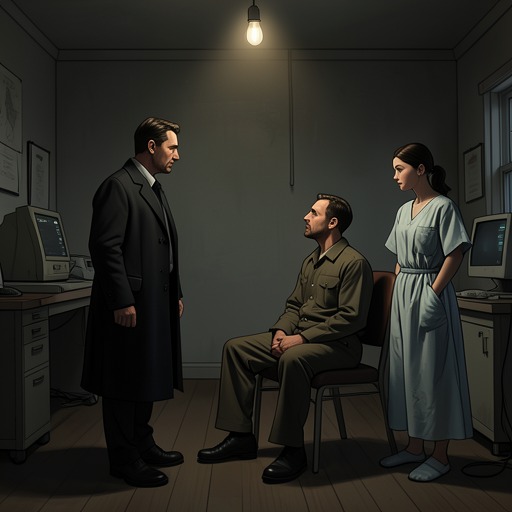
Grace and Scott Duncan later go back to Photomat together. Once again Josh is not at the counter: Bruce says that he is on his lunch break. Scott has brought the Photomat envelope and asks Josh to confirm that he developed the roll. Josh responds evasively, declining to confirm the fact simply on the basis of the question. The envelope thus becomes more than packaging: it is a tangible object Scott can put before the employee while asking him to account for the processing. The encounter leaves the central issue open, but narrows the inquiry to a specific worker and a specific roll.
Photomat’s narrative function rests on that movement from the mundane to the investigative. The shop first appears as a place of chemical odor, noisy music, themed picture frames, a processing machine, and routine service offers. Its ordinary systems—counter staff, opening hours, a machine, and an envelope—then become the means by which Grace and Scott pursue an anomaly those systems have not explained. Josh’s recurring absence, followed by Grace’s recognition of his voice and Scott’s face-to-face questioning, gives the location a pattern of delayed access rather than a clean revelation. Photomat is where the mystery enters Grace’s life, and where its first practical questions take shape; it is not, on the evidence presented here, where those questions are conclusively answered.