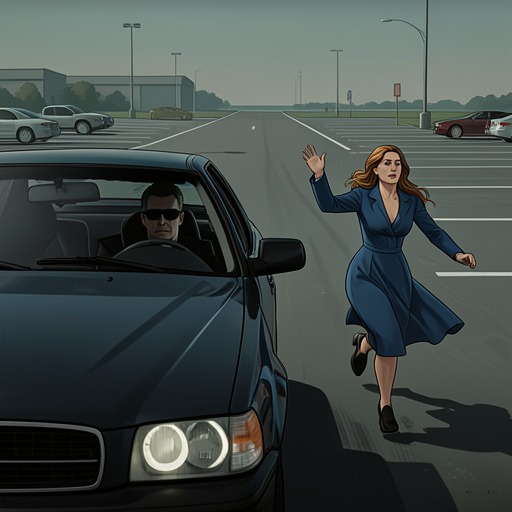
Rocky Conwell is killed while following Jack
Just One LookRocky Conwell’s death marks the point at which his surveillance of Jack Lawson becomes a direct attempt at rescue—and costs him his life. After watching Eric Wu knock Jack unconscious and carry him toward a car, Rocky leaves the safety of observation to challenge the kidnapper. Wu kills him before he can free Jack, then disposes of both men and their vehicles as he continues evading detection.
Surveillance and the attack
Rocky follows Jack to a quiet stretch of road beside Woodbury Commons, a large outdoor shopping center that is closed for the night. He keeps his distance, using binoculars from a parked car because getting closer would risk being spotted. When Jack leaves the minivan and heads toward a wooded area, Rocky sees another car nearby and initially interprets the meeting as a possible romantic rendezvous. The scene changes abruptly when Rocky notices Eric Wu standing beside Jack in fatigues, motionless and square-built. Wu puts a hand on Jack’s shoulder; Jack collapses to the ground.
Rocky watches Wu lift Jack by the neck and carry him toward a car with one hand. The spectacle overturns Rocky’s assumption that he is conducting a routine infidelity investigation. Jack is not simply meeting someone in secret: he has been assaulted and placed in the trunk. Rocky considers following Wu, aware that Jack may be injured and could be running out of air, even though his orders are to observe rather than engage.
Rocky is a six-foot-four, 260-pound professional fighter, but his physical confidence does not erase the risks of intervening. He has no gun, and he does not know why Jack was under surveillance. He nevertheless runs toward the car and calls for Wu to stop. As Rocky approaches, he sees that Wu is younger than he first appeared. Wu remains still and waits rather than trying to flee.
When Rocky tells Wu to let Jack out of the trunk, Wu calmly nods and glances toward it. Rocky follows his glance. That brief shared distraction gives Wu the opening: he ducks, turns his hips into the blow, and drives a fist into Rocky’s kidney. Rocky has endured heavy punches before, including blows from larger men, but this strike overwhelms him. Wu follows with a hard thrust to the liver. Rocky cannot get a scream out before he falls.
Wu crouches beside him and places his hands beneath Rocky’s rib cage. Rocky’s final thought is of Lorraine Conwell. The scene ends not with Rocky succeeding in his attempt to stop the abduction, but with Wu’s calm presence and Rocky’s intervention silenced. The decision to act separates Rocky from the distant observer he had been ordered to remain, while the speed and precision of Wu’s violence leave him no chance to recover or call for help.
Concealment and the delayed aftermath
Wu’s response to the killing was logistical and immediate. Rocky’s wallet identified him, and Wu now had a body and an additional car to remove. He put Rocky in the trunk of his Toyota Celica, then transferred Jack from the Honda Accord’s trunk into the Ford Windstar. With both men out of sight, he changed the vehicles’ license plates and removed the E-ZPass, stripping away details that could connect the cars to their movements.
Wu drove the Windstar back to Freddy Sykes’s garage in Ho-Ho-Kus, then took Rocky’s car to the Route 17 Park-n-Ride and left it in a remote spot by the fence. He judged that abandoned cars there could remain unnoticed for days or weeks; eventually, the smell would attract attention, but not soon. The body’s concealment therefore depended not on permanent secrecy but on buying time. The same Park-n-Ride was only three miles from Sykes’s house, and Wu walked back before catching a bus to Central Valley early the next morning.
On his return journey, Wu briefly detoured past the Lawson residence and saw a patrol car in the driveway. The sight marked a new pressure on his movements, while Rocky’s intervention had already failed to free Jack or summon help. The narrative records Wu’s disposal plan and its anticipated delay, not the eventual discovery of Rocky’s body; his death thus remains embedded in the larger chain of concealment that began with the abduction.
The predatory system behind the encounter
Eric Wu’s attack on Rocky Conwell grew out of a method built to make people disappear into ordinary life. Wu used seven online personas across dating sites, maintaining contact with dozens of people at a time and patiently collecting details before deciding whom to pursue. He sought people with few close ties and little chance of being quickly missed; for the abduction of Jack Lawson, he also needed a target living near the Lawson household. That search led him to Freddy Sykes, whose home was only three miles away.
Freddy’s circumstances made the house as useful as the deception that brought Wu to it. Sykes lived alone in an ordinary-looking home, among neighbors who paid him little attention, and its attached garage allowed someone to enter or leave by car without being seen. Wu’s choice of victim therefore depended not just on personal isolation but on the practical design of a residence and the anonymity of its surroundings. The same approach shaped Wu’s later contingency planning: he had cultivated Beatrice Smith online, learned that she was lonely in a large, secluded house in Armonk, and treated her home as a backup residence. He approached it wearing gloves and had already concluded that Smith could not be left alive if the hideout was to remain untraceable.
This machinery of impersonation, observation, and concealment clarifies the stakes of Rocky’s decision to intervene. Wu had selected the conditions surrounding Jack’s abduction to reduce witnesses and delay discovery; Rocky became dangerous precisely because he watched closely enough to recognize that the encounter was not a tryst and acted despite his instructions to remain an observer. Wu’s response then extended beyond the immediate violence: the body, car, changed plates, and removed E-ZPass became problems to manage within the same larger system of evasion. Rocky’s death is thus both a personal consequence of refusing to look away and a collision with a criminal method designed to exploit isolation, privacy, and time.
The personal cost
Rocky Conwell’s final thought is of Lorraine Conwell, his estranged wife, with whom he had been planning a reconciliation. That name gives the killing a consequence beyond the failed attempt to save Jack Lawson: Rocky’s life ends before the couple’s intended return to one another. The abrupt movement from the physical assault to his thought of Lorraine makes the loss intimate without supplying any further account of what he might have said or done. In the middle of Eric Wu’s calculated effort to erase witnesses and evidence, Rocky’s last moment turns instead toward a relationship that the violence cuts short.