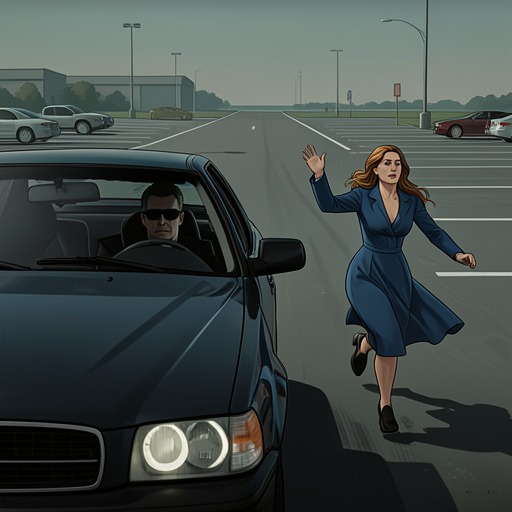
Rocky Conwell, Jack's would-be rescuer
Just One LookRocky Conwell, Jack's would-be rescuer, is a former football standout turned private investigator whose attempt to help Jack Lawson ends in his murder by Eric Wu. His brief role joins two sharply different versions of his life: the celebrated athlete who expected a professional future, and the exhausted, probation-bound man trying to rebuild a relationship while earning money by watching a stranger’s home.
Identity and Background
When Rocky takes up a post near the Lawson residence, the work is already a measure of how far he has fallen. He tries to fit his large frame into a 1989 Toyota Celica, tugging at the seat lever before accepting that it will go no farther. He is tired from working two jobs: a ten-hour Budweiser assembly-line shift in Newark, which helps impress his parole officer, and an off-the-books surveillance job that brings in badly needed cash. When Jack’s minivan starts, Rocky raises his binoculars, confirms that Jack is leaving, and prepares to follow him.
That cramped car contrasts with Rocky’s former physical and professional promise. At Westfield High he was an All-State defensive end; Penn State recruited him, and he became a hard-hitting inside linebacker. At six feet four inches and 260 pounds, he stood out during four years of college football and earned All-Big Ten honors twice. The St. Louis Rams drafted him in the seventh round, giving him reason to believe that his life had been set on a successful course.
Rocky’s name itself carries the story of that early confidence. His parents named him while his mother was in labor and they watched the movie Rocky in the summer of 1976. The name seemed to suit the large, naturally aggressive athlete he became: a professional draft pick eager to reach training camp. During his junior year he began a relationship with Lorraine Conwell, and the two fell deeply for each other. For a time, football and love made his future seem secure.
After his football prospects faded, Rocky tried to earn a living in the Ultimate Fighting Federation, where he could use his size, strength, endurance, and ability to wear down opponents. As states began outlawing the sport, some fighters moved to Japan, where it remained legal; Rocky did not follow them. He still believed the NFL might be within reach if he could become bigger, stronger, and faster. That hope kept him oriented toward physical competition even as the opportunities around him narrowed.
The Surveillance Assignment and Decision to Intervene
Two years before the surveillance job, Rocky’s attempt to defend Lorraine’s attention in a bar had become a violent turning point. After a man stared at her and answered Rocky’s challenge with a dismissive remark, Rocky—high on steroids—beat him so badly that he needed traction. Rocky was convicted of assault, spent three months in jail, and was placed on probation. Lorraine, who had already been his partner since his junior year, called him a loser and moved out; the assault was the final straw in their relationship.
Now Lorraine was cautiously considering a reconciliation, and Rocky believed that earning money could help persuade her. He loved her and felt he owed her better times, accepting punishing work as the price of his own past conduct. His surveillance assignment came with strict limits: follow Jack Lawson, record where he went and whom he spoke to, and do not engage him. Rocky understood the job as easy cash and initially assumed Jack’s wife suspected an affair.
After following Jack’s minivan onto Route 17 in New Jersey, Rocky watched it reach Woodbury Commons about half an hour later. The outdoor mall was closed, and Rocky held back rather than risk being spotted. From a position with his headlights off, he used binoculars to watch Jack leave the minivan and head toward a wooded area, where another car was parked nearby. Rocky guessed that the other driver might be Jack’s girlfriend, but the meeting soon proved to be no ordinary rendezvous: Jack had been assaulted and locked in the minivan’s trunk.
Rocky faced a choice his instructions had not anticipated. He did not know Jack or why anyone wanted him followed, but he could not treat a man trapped in a trunk as merely the subject of an investigation. He worried that Jack might be injured or running out of air, and chose to intervene rather than remain an observer. When Rocky confronted the young man beside the vehicle and demanded that Jack be let out, Eric Wu struck him before Rocky could do anything more.
The Rescue Attempt and Death
At Woodbury Commons, Rocky’s assignment changed from surveillance to intervention. He had been told to follow Jack Lawson, record his movements and contacts, and avoid engaging him; until the scene at the closed mall, he had assumed the job was a routine inquiry into a suspected affair. But when he saw that Jack had been assaulted and locked in a minivan’s trunk, the limits of the assignment no longer seemed decisive. Rocky did not know Jack or why he was being followed. He did understand that a man was trapped, possibly injured and short of air, and he chose not to leave him there.
Rocky confronted the young man beside the vehicle and demanded that Jack be let out. The young man glanced toward the trunk, and Rocky followed his gaze; Eric Wu used that instant to attack. Rocky never saw the first blow. Wu struck him in the kidney with enough force to make him gasp, then drove something hard into his liver. Rocky fell, unable to scream, and Wu dropped beside him. The last thing Rocky saw was Wu’s calm face as he placed his hands beneath Rocky’s rib cage; Rocky’s final thought was of Lorraine, and then he died.
His death turns the surveillance assignment into a fatal collision between professional obedience and immediate responsibility. Rocky had been hired to watch without intervening, but the sight of Jack imprisoned in the trunk made neutrality intolerable to him. The choice costs him his life before he can free Jack, while the brief return of Lorraine to his thoughts gives his death an intimate dimension: even in the instant when his effort to help another man is violently ended, the person he hopes to win back remains foremost in his mind.
Narrative Function
Rocky Conwell, Jack's would-be rescuer, briefly occupies the position of an observer who knows less than the reader wants to know: he follows Jack Lawson, the missing husband, on an assignment he assumes concerns an affair, then encounters evidence of a kidnapping without understanding its larger context. That limited perspective makes his decision immediate rather than strategic. He does not solve the mystery or secure Jack’s release; his role is to recognize that the scene has crossed a threshold from surveillance into danger and act before he can know the full story. Eric Wu’s sudden attack then turns the watcher into a victim, sharply exposing how little control observation offers when violence is already underway.