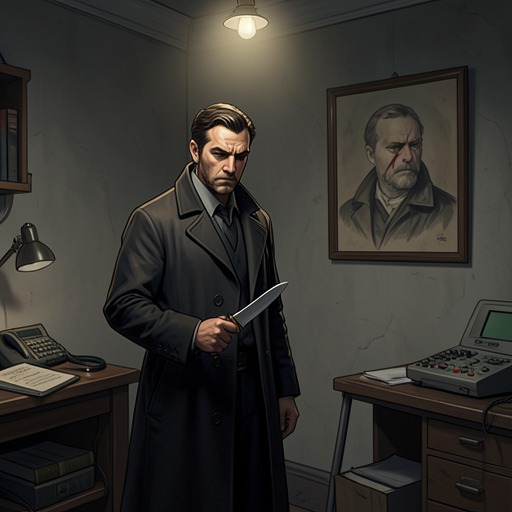
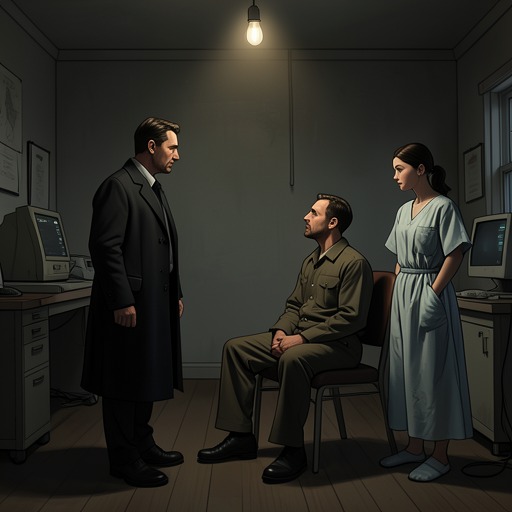
Sandra Koval, Jack's estranged sister
Just One LookSandra Koval, born Sandra Lawson, is Jack Lawson’s estranged sister and a central figure in the family secrets surrounding his disappearance. Grace Lawson discovers that Sandra’s married surname masks her connection to Jack, and later confronts her with evidence suggesting that the family business’s voting control may be tied to the events at the concert. Sandra’s evasions leave the boundary between a sister protecting a brother and a relative protecting her own position unresolved until Grace accuses her of helping another man assume Jack’s identity.
Identity and Family Position
Sandra first enters Grace Lawson’s search through a telephone call to a line answered in Sandra Koval’s name. When Grace asks whether Jack Lawson had contacted her for legal advice, Sandra refuses to discuss the situation and ends the exchange. The refusal is consequential: rather than provide a family member’s account of Jack’s state of mind or whereabouts, she treats the call as confidential, leaving Grace to pursue the relationship behind the name.
Grace’s investigation establishes that Sandra Koval is not the name under which Sandra graduated from law school. The school confirms that the graduate was Sandra Lawson; Grace then checks the connection through LawMar Securities, the firm founded by their grandfather, where Sandra is listed as a board member. Grace recognizes that Sandra is Jack’s sister, not merely a lawyer he consulted. The revelation shifts the inquiry from a professional contact to an estranged family relationship, while also establishing Sandra’s place in the family business.
Sandra’s two surnames therefore mark more than a change in marital status. Sandra Lawson links her to Jack and the family firm; Sandra Koval is the name under which Grace finds her. The distinction becomes important because Grace must uncover both Sandra’s identity and her proximity to the decisions that may have reshaped the family’s ownership and control.
Estrangement and the Last Contact
When Grace asks when Sandra last spoke with Jack, Sandra says it was a long time earlier. She also says she has checked her messages and received none from him that day. These answers do not offer Grace a recent point of contact to follow. Instead, they make the estrangement itself part of the mystery: Sandra may have information about her brother, but the available exchange does not establish how much they communicated or what passed between them.
Sandra later describes Jack’s request for space as something he did not mean literally, but as code. That interpretation suggests that the words concealed another purpose, yet Sandra does not explain the code’s full meaning in the exchange. Her claim complicates the picture of a brother who simply chose distance: she presents his withdrawal as a signal, while withholding the knowledge that would allow Grace to decode it.
The conversation also exposes a difference between what the two women can bear to hear. Grace asks whether Sandra loves Jack; Sandra’s shoulders slump, and she tells Grace to leave the matter alone. Grace says she cannot. Sandra turns toward the door rather than answer. The scene supplies no resolution to their disagreement, but it makes Sandra’s withdrawal visible: she attempts to close a subject that Grace regards as inseparable from finding her husband.
The Photograph and the Unanswered Questions
When Grace places the photograph on the table, Sandra looks down and visibly jolts. Her response is immediate, preceding any explanation of what the image means to her. She asks what it is, while Grace answers with pointed irony. The photograph thus functions as more than a clue in Grace’s investigation: it is a test of Sandra’s composure, and her reaction gives Grace reason to believe that the image bears on matters Sandra would rather leave untouched.
The wider investigation establishes why the photograph has such weight. Grace and Scott Duncan can identify three of the five young people in it: Geri Duncan, who was murdered; Shane Alworth, Geri’s boyfriend, who is missing; and Jack Lawson, who disappeared shortly after seeing the image. Two women remain unidentified. The red-haired woman appears likely to be identifiable through further inquiry, while the woman whose back is turned may remain unknown. The image connects a murder, two disappearances, and an unanswered question about the past, but it does not, by itself, explain Sandra’s reaction.
That gap is characteristic of Sandra’s role in the investigation. Her response confirms neither what she knows nor what she did; it does, however, give Grace a reason to press further. The photograph becomes a point where separate lines of inquiry converge, and Sandra’s guardedness keeps the family connection from serving as a simple explanation.
The Family Trust and Grace’s Accusation
Grace later raises the Lawson family trust documents she found in Jack’s desk. After consulting a lawyer, she has learned that their grandfather created six trusts for his two children and four grandchildren. The financial value is not the issue Grace emphasizes. The documents instead allocate voting power: shares were divided six ways, with Jack and Sandra’s father receiving an additional four percent, so their side of the family held a 52-to-48 majority in the business.
Grace explains a condition that could change that balance. If one of the beneficiaries died before turning twenty-five, that person’s voting power would be divided equally among the five survivors. She uses Jack’s possible death on the night of the concert as an example: the resulting redistribution would mean Sandra and her father no longer held a majority. Sandra’s face freezes at the mention of the trust and she rejects Grace’s interpretation. The reaction is not proof of a motive, but it shows that Grace has touched a subject with immediate significance to her.
Grace’s theory joins financial control to the mystery of identity. She asks whether fear of being caught or the possible loss of control of the business drove Sandra, and proposes that the answer may involve both. She then accuses Sandra of arranging for Shane Alworth to take Jack’s place, adding that photographs and DNA testing could establish the substitution. In this confrontation, the missing man’s identity becomes a family and business question as well as a personal one: if Jack died, the trust’s voting rules could change who controlled the company.
The accusation is presented as Grace’s conclusion, not as a finding proved in the conversation. Sandra calls Grace out of her mind, while Grace insists that the substitution can be demonstrated. The scene leaves their opposing claims in direct conflict, but it gives the reader a specific proposed mechanism: Shane’s appearance as Jack could conceal a death that would otherwise trigger the trust’s succession provision.
Narrative Role and Significance
Sandra connects the investigation’s intimate and institutional strands. Her estrangement from Jack explains why Grace cannot simply ask her for a reliable account of his recent life; her concealed birth surname reveals a family tie Grace initially has to uncover; and her board position connects that tie to a business whose voting balance could be altered by a beneficiary’s death. Each disclosure changes the meaning of the preceding one without making Sandra’s silence transparent.
The novel also places Sandra under suspicion in the case surrounding Geri Duncan’s murder. The photograph’s group of young people links Geri and Shane to Jack’s disappearance, while Grace’s confrontation raises the possibility that Sandra’s actions served the interests of the family business. The evidence available through these encounters leaves the exact extent of Sandra’s involvement contested: Grace advances a theory, Sandra rejects it, and the clues she reacts to invite further scrutiny without supplying her own account.
Sandra’s narrative importance lies in that tension between kinship and control. She is Jack’s sister, but the relationship has been distant; she interprets his request for space as a coded message, yet resists Grace’s demand to keep searching; and she occupies a position in the family business whose majority control may depend on what happened to him. Her presence makes the disappearance feel less like a solitary mystery than a concealed rearrangement of identities, loyalties, and power.