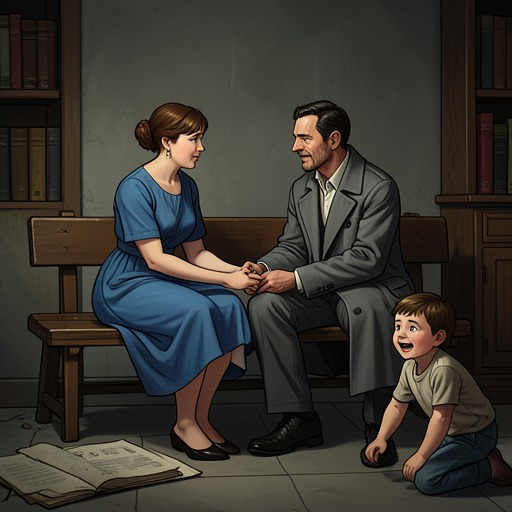
The death of Jack Lawson
Just One LookThe death of Jack Lawson is the final loss in the crisis surrounding his disappearance and captivity. The account moves from the abrupt sight of Jack falling at Grace Lawson’s side to surgery, coma, and a last bedside decision: whether their children should be with him as he dies. His death ends the possibility of asking him about the lies and uncertainties that have shaped their marriage, while leaving Grace Lawson to carry both those unanswered questions and a more intimate memory of him.
The Fall and Its Immediate Aftermath
Grace Lawson has forced her arms through and brought them in front of her when the man returns to the room. She does not look at his face; her attention fixes on his right hand. He lets go, and Jack Lawson falls to the floor beside him. The suddenness of the moment matters: Jack’s return to Grace Lawson is not a reunion she can prepare for or understand, but a sight framed first by the release of his body. The narrative gives no explanation here of what has happened to Jack or what caused his condition. It presents the fall as the point at which Grace Lawson’s immediate struggle becomes a desperate attempt to reach him.
Grace Lawson dives toward Jack Lawson and calls his name. Later, when she asks where Emma Lawson and Max Lawson are, she is told that they are at the station and safe. The news establishes a boundary around the danger: the children are out of immediate reach of the crisis, but Jack Lawson remains in grave condition. An hour later, he is in surgery, and that is all the information available to Grace Lawson. The repeated limitation of what she is told makes the hospital a place of waiting rather than explanation; the immediate question is whether Jack Lawson will live.
Surgery, Coma, and Uncertainty
While Jack Lawson is in surgery, doctors examine Grace Lawson as well. Her ribs are cracked, and an Ace bandage is wrapped around them; an injection eases her pain. An orthopedic surgeon examines her knee and offers no reassuring response. These injuries place Grace Lawson’s own body in the aftermath of the crisis, but they do not displace her concern for Jack Lawson. His treatment remains uncertain, and the account gives no medical explanation for the outcome.
Captain Stuart Perlmutter questions Grace Lawson in her hospital room. She answers most of his questions but remains deliberately vague on some subjects. Her hesitation is not presented as a simple wish to obstruct the police: she tells herself that she does not want to keep anything from them, then allows that perhaps she does. This unresolved instinct to withhold accompanies the larger uncertainty around Jack Lawson. The crisis has made information urgent, yet neither the police questions nor the medical updates can provide the explanation she most wants.
Later, Grace Lawson tells Charlaine Swain that Jack Lawson is in a coma and says she is going to see him. Charlaine Swain does not offer a hollow reassurance; the exchange rests on the honesty that both women have moved beyond platitudes. The change from surgery to coma marks a grim interval in Jack Lawson’s condition, but the narrative does not specify how much time has passed or describe a medical prognosis. It allows the blunt fact of the coma to carry the weight of what Grace Lawson cannot yet know.
The Last Decision
At Jack Lawson’s bedside, Dr. Stan Walker sits beside him and speaks in a grave voice. Emma Lawson and Max Lawson wait in the corridor because they want to be there, while Grace Lawson struggles to decide what to do. The choice is not whether to disclose Jack Lawson’s history or demand an account of it; it is whether the children should be brought to their father before he dies. Grace Lawson wishes she could ask Jack Lawson what he wants, but he cannot answer.
Grace Lawson knows there are questions about their life together that she could put to him. She does not want to ask why he lied for so long, what he did on the terrible night, or whether he had deliberately sought her out when they met on the beach. She does not seek an explanation for how their love began or what it concealed. At this bedside, those questions yield to one immediate concern: whether Jack Lawson wants his children beside him. The passage makes the distinction consequential. The past remains unresolved, but Grace Lawson can still make a choice for the family in the present.
In the end, Grace Lawson lets Emma Lawson and Max Lawson stay. The four gather as a family for the last time. Emma Lawson cries; Max Lawson keeps his eyes on the tile floor. Grace Lawson feels Jack Lawson leave for good, a quiet description that renders his death through her perception rather than a medical account. The scene gives the family a final shared presence without suggesting that it repairs what has been hidden or makes the loss easier to bear.
Death and the Memory That Remains
The funeral is blurred for Grace Lawson. She usually wears contact lenses, but takes them off that day and does not wear her glasses; the softened view makes the occasion easier to handle. What remains sharply available to her is not the beach or the vineyards, but Jack Lawson holding Emma Lawson just after her birth. She remembers his large hands supporting the newborn as though she might break, his fear that he might hurt her, and the look of awe he turned toward Grace Lawson.
That memory gives the ending its counterweight. The final hospital scene records Jack Lawson’s departure, while the funeral returns Grace Lawson to an image of him at the beginning of fatherhood: careful, awed, and holding their child. The remembered gesture does not answer the questions she chose not to ask, and it does not erase his lies. Instead, it remains beside them as a specific image of the husband and father she knew. His death closes the chance for further answers; the image she carries forward is one of tenderness witnessed at the start of their family life.