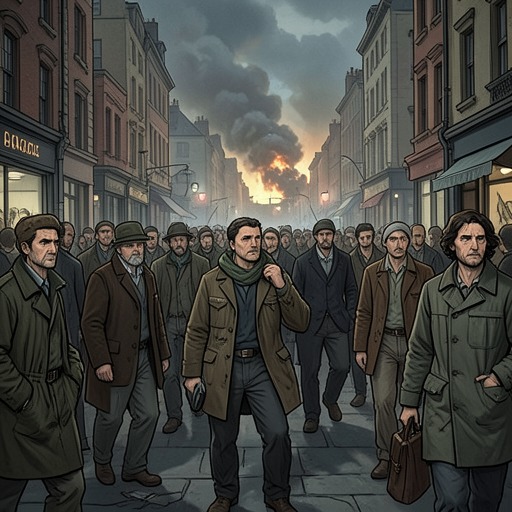
The past cannot truly be escaped
Just One LookThe past cannot truly be escaped names the pressure that earlier losses, concealed knowledge, and unfinished flight exert on the present. In Grace Lawson’s story, the idea takes shape not as a general reflection alone but through interruptions: an unfamiliar photograph turns up among family pictures, investigators decline to disclose what they have found, and Carl Vespa challenges Grace’s belief that what happened long ago can remain behind. The past is at once personal memory and an unresolved history whose consequences may surface without warning.
Memory in the ordinary present
The concept first gathers force through Grace’s thoughts about her parents and her children. Her father raised her after her parents’ deaths, but his heart, weakened by rheumatic fever he had suffered as a child, failed during her freshman year of college. Although an uncle in Los Angeles offered to take her in, Grace was old enough to choose for herself; she stayed in the East and made her own way. Her parents’ deaths had been devastating, but they also gave her a heightened awareness of how much life could be lost. She wanted to fill her memory with experiences and give Emma Lawson and Max Lawson many memories of her in turn.
That awareness returns while Grace is looking at photographs of her children. Thinking about her parents and noticing how much older Emma and Max look than they did in the previous year’s apple-picking photographs, she comes upon a bizarre image among the prints. The discovery is embedded in a recognizably domestic act of remembering: the children’s growth makes time visible, while the unknown photograph abruptly opens a different, unexplained past. The contrast does not resolve what the image means; it makes the family album a place where familiar recollection and unsettling evidence occupy the same space.
The photograph’s physical form sharpens that interruption. It is the same size as the other pictures and fits neatly among them, but its backing is flimsier, like a cheap photocopy rather than a carefully produced print. Its ordinary dimensions let it pass within the collection, while the difference in stock marks it as an object with a distinct origin. The scene offers no complete explanation at the moment of discovery. Instead, the photograph makes the past present first as a question—something inserted among known family memories but not yet understood.
What the investigation leaves unsaid
The idea also appears in the gap between what investigators know and what they will tell Grace. Captain Stuart Perlmutter says there is no evidence of bloodstains, but then explains that the investigators found something they probably should not share with her. Grace asks whether the absence of evidence means they found no bloodstains or anything similar, and Perlmutter confirms that it does; his qualification makes clear that this is not all they know. Grace asks to hear the withheld information, but the exchange leaves its content undisclosed in the scene.
That withholding gives the past a second form: not only a memory or an old event, but information that remains active because it has not been fully brought into the open. Grace is not simply recalling an earlier time; she is trying to learn what investigators have found in the present. The distinction matters. The scene does not establish what the undisclosed discovery is, so it cannot be treated as proof of a particular hidden event. It does establish an imbalance between what the investigators know and what Grace has been told, leaving the investigation shadowed by a past she cannot yet see whole.
Flight, return, and the Boston Massacre
Carl Vespa gives the concept its clearest formulation while questioning Grace about her earlier life. He recalls that she had been studying and painting, then characterizes much of what she was doing as running away. Grace offers no answer to that description. When Vespa asks why Jack Lawson was there, his questions connect her past flight to Jack’s own unresolved history, without specifying precisely what either of them was escaping.
Vespa then gestures toward the photograph and suggests that whatever Jack had been running from eventually caught up with him. Grace responds that it happened a long time ago. Vespa counters by recalling the Boston Massacre and asking whether Grace’s running away made it disappear. His comparison joins a shared public catastrophe to Grace’s personal attempt to leave something behind: elapsed time has not, by itself, erased either one. The scene does not disclose all that Grace fled or establish a full account of Jack’s past. Its force comes from the question of whether distance and silence have changed the underlying reality.
Vespa’s statement, “Nothing stays in the past, Grace. You know that,” condenses the concept into an assertion about persistence. It also turns the conversation back toward Grace’s own knowledge. His words do not prove that every buried fact must return in the same way, but they reject her appeal to age as sufficient closure. The photograph, Jack’s history, Grace’s earlier flight, and the Boston Massacre remain distinct matters; the scene brings them into relation by asking what it means to have left something behind when its effects or reminders continue into the present.
An unresolved principle
Across these moments, the past is not presented as a single, fully explained secret. It appears as family loss that shapes Grace’s attention to time, as a photograph whose presence among familiar prints demands an explanation, and as investigative knowledge withheld from her. Vespa’s conversation makes the connection explicit while preserving important uncertainties: Grace’s reasons for running away are not fully described, nor is the past Jack was running from. The concept gains its meaning from that partial knowledge, not from a complete account supplied in advance.
The sequence also distinguishes remembering from escaping. Grace’s thoughts about her parents lead her to value the memories she is making with her children, but the photograph interrupts that private act with an image she cannot place. Later, her attempt to frame the past as long ago meets Vespa’s insistence that time alone does not make it disappear. Memory can preserve what mattered, while a concealed or unexplained history can remain unsettled; in Grace’s story, both return to the present through concrete objects, unanswered questions, and relationships still marked by what has not been resolved.