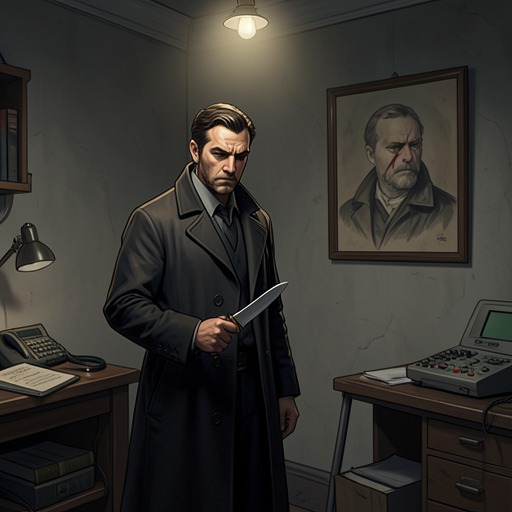
Wade Larue is assassinated
Just One LookWade Larue is assassinated after his release, just as he appears to have made peace with the past. His death turns a moment of tentative freedom into a final return to the unresolved truth he had hoped to leave behind.
Release and the Last Phone Call
Wade briefly imagines starting over: he could change his name, grow a beard, dye his hair, and try acting again, or take an ordinary job in a big city. He believes he can be free. Yet he does not go to the Port Authority bus station. A block away, he watches the buses head toward the viaduct, then turns to the pay phones. The past still holds him; he decides he needs one last phone call and one last truth.
That decision follows a genuine change in his understanding of vengeance. A few minutes before his death, Wade believes he has found peace: he has let vengeance go and accepts that he knows enough to distinguish where he was responsible from where he was not. But his resolve to stop pursuing the full truth does not survive the pull of the past. The call marks the fragile boundary between wanting to move on and needing to know more. An hour later, a gun is pressed beneath his ear. His last thought recalls Eric Wu explaining that the hollow was a pressure point, but knowing its location alone would not incapacitate an opponent. The thought ends with the bullet that kills him.
The Killing and Its Aftermath
The final account places Wade’s death less than twenty-four hours after his release. A reporter from the New York Daily News followed him after he left a press conference at the Crowne Plaza and saw him get into a black sedan with a man who fit Cram’s description. It was the last confirmed sighting of Wade alive. His body was later found near the Port Authority Bus Terminal in New York City, shot in the head at point-blank range. The timing and location connect the killing to the brief interval in which Wade had tried to leave his past behind, then turned back toward one last unanswered truth.
No one had been arrested by the time the account closes. The sedan sighting is presented as the sole significant clue, not as proof of the gunman’s identity; the narrative says the answer nevertheless seemed clear. That gap between what can be established and what can be inferred echoes Wade’s own late conviction that he knew enough without knowing everything. His attempt to stop pursuing the past ends not in freedom but in a death whose circumstances point toward an explanation while leaving the case formally unresolved.
The Cost of an Incomplete Ending
The later reckoning places Wade’s killing among deaths that have narrowed the possibility of a complete explanation. Jimmy X, whose real name was James Xavier Farmington, died from three gunshot wounds to the chest; by the time the account closes, too many of the people involved are dead for every question to be answered. Wade’s murder is therefore not simply a concealed crime awaiting a neat solution. It belongs to a history in which evidence survives unevenly, witnesses disappear, and certainty remains out of reach.
That uncertainty has a human measure in Carl Vespa. Fifteen years after his son Ryan died, time has not made the loss bearable or altered its fact. Wade had begun to relinquish vengeance, but Carl’s grief shows that such a change in one person cannot repair what remains for another. The ending sets Wade’s brief inward release against the persistence of bereavement: the truth may be incomplete, and the past may remain active, even when the pursuit of revenge has stopped.
The Death as a Limit of Knowledge
The account draws a sharp boundary between what can be known about Wade’s final hours and what remains inaccessible. His last thought is rendered from within his own consciousness, but the killing itself is not witnessed; afterward, a reporter’s observation and the condition of his body establish a trail without supplying a complete explanation. This shift from intimate thought to external evidence makes the gap consequential: Wade dies while pursuing one last truth, yet the surviving facts do not grant the reader certainty about every part of his death. The event thus closes his personal attempt to settle the past while preserving the larger story’s distinction between a persuasive answer and a fully proven one.