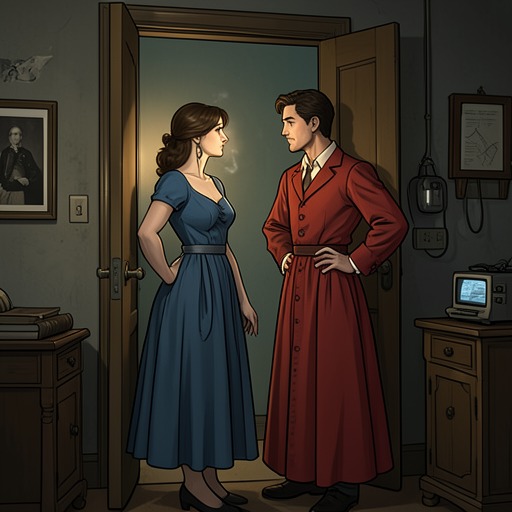
Wu assaults Officer Richardson and escapes
Just One LookWu assaults Officer Richardson and escapes is the turning point in the raid at Freddy Sykes’s home: a police visit that could expose Wu instead gives him a chance to leave with Jack Lawson. Wu relies on the same calculated deception that brought him to Sykes, then disables Officer Richardson, restrains him, and drives away in Jack Lawson’s Ford Windstar with Jack concealed in the back.
Causes and Background
The encounter grows out of Wu’s method of selecting victims through online personals. He maintained seven accounts under invented identities and cultivated numerous potential contacts at once, taking time to learn which people might be isolated enough to approach. His aim was not simply to find lonely people: he sought victims with few family, household, work, or social ties that might prompt someone to notice their absence. At the time, he also needed someone geographically close to the Lawson household.
Freddy Sykes fit that pattern. He was forty-eight, had no siblings, and had lost both parents. After caring for his mother, he inherited her house in Ho-Ho-Kus, only a short distance from the Lawson residence. Wu approached him online through the persona of Al Singer, a retired executive presented as an older man seeking a relationship. The chosen identity and photograph were calibrated to seem plausible to Freddy, not so attractive as to invite suspicion. The deception succeeded: Wu gained access to Sykes’s home and used it to conceal Jack Lawson in the attached garage.
The house’s ordinary suburban setting also served Wu’s purposes. Its attached garage allowed a person to enter or leave a car without being seen, while the neighbors generally paid little attention to Sykes. But a report of a possible break-in brought Officer Richardson to the house. Wu had to manage that unexpected attention without letting the officer discover Jack.
The Encounter with Officer Richardson
Wu saw the uniformed officer approach and assessed the immediate circumstances: Richardson’s gun remained holstered, and he had not drawn it. Wu opened the door with a welcoming manner rather than confronting the officer outside. When Richardson explained that police had received a call about a possible break-in, Wu feigned confusion and offered an explanation for being there.
He identified himself as Chang and said that the house belonged to his partner, Frederick Sykes. He added that Sykes was upstairs. The false name and relationship gave Wu a ready answer to the officer’s questions, while his invitation to come inside made the exchange appear cooperative. He turned away to call up the stairs for Freddy to get dressed because the police were there. That call reinforced the impression that the people in the house were partners and that the officer had been invited into a domestic situation rather than a trap.
Wu waited until Richardson was close, then struck and used a disabling pressure-point technique. The officer lost consciousness. Wu’s actions were controlled by a practical limit: he intended to incapacitate Richardson, not kill him. In Wu’s calculation, a dead police officer would bring far greater scrutiny and urgency than an injured one. The distinction shaped both the violence and the escape that followed.
Restraint and Escape
Knowing that Richardson would regain consciousness, Wu took the officer’s handcuffs and secured his wrist to the stairwell. He also removed the police radio from Richardson’s shoulder. These actions bought Wu time and interrupted the officer’s ability to summon assistance immediately, but they did not remove the risk of discovery.
Wu considered the neighbor next door, who might have seen what happened and could call the police again. He judged that confronting her would cost time and might expose him to further attention. Instead, he chose speed and surprise. He hurried to the garage, entered Jack Lawson’s Ford Windstar, and checked the cargo area, where Jack was being held. The officer’s arrival had not led Wu to abandon his captive; it made moving him more urgent.
Wu took the driver’s seat with a plan. Later, he drove away from the area, taking Ridgewood Avenue to the Garden State Parkway and then heading east on Interstate 287 toward the Tappan Zee Bridge. He left the main route near Armonk and continued on side roads, indicating that he had chosen a destination in advance rather than fleeing without direction.
Aftermath and Significance
That destination was the home of Beatrice Smith, whom Wu had cultivated online under another invented identity, Kurt McFaddon. Beatrice was a widow whose former social circle had dwindled after her husband’s death; her adult son lived in San Diego, and she remained alone in the large house she had shared with her husband. Her circumstances repeated the pattern Wu had used to select Sykes: personal isolation, a private residence, and a relationship built through fabricated online intimacy. Wu had kept a backup residence available, and he now used it as he escaped with Jack.
The attack therefore links two stages of Wu’s plan. At Sykes’s house, he exploits a plausible domestic explanation to draw Richardson close, then turns the officer’s presence into a brief obstacle he can manage. On the road, he falls back on preparation, moving Jack to a second residence chosen through the same predatory process that produced his first hideout. The immediate result is not freedom for Jack but a transfer of captivity, while Richardson is left restrained and without his radio. Wu escapes the police response, yet the need to keep changing locations reveals how vulnerable his carefully constructed concealment has become.