Bradford Taylor's residence
Just One NightBradford Taylor's residence is the secluded setting for the decisive private encounter between Bradford Taylor and Geneva Bryce: a single-story house set apart from its neighbors by a row of trees. The narrative brings Geneva from the car directly into the bedroom, making the house less a place to explore than a space that concentrates the encounter—and, by dawn, the choice to leave it behind.
Setting and Arrival
The house appears after a silent drive, roughly ten minutes after the couple set out. Its single-story form and position away from the neighbors, screened by trees, establish distance from the surrounding homes without describing a larger property or broader neighborhood. The emphasis is on separation: the destination is private, and the narrative offers no intervening stop or social encounter before Geneva reaches the house.
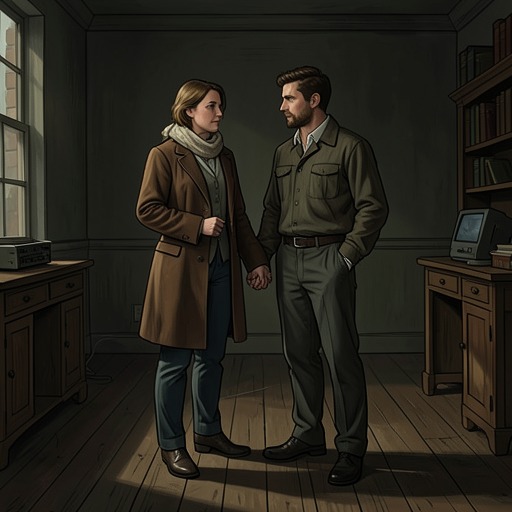
Bradford comes around to Geneva’s side of the car and helps her out. Her gown brushes her sensitive skin as they cross the threshold, but he does not speak. He takes her hand and leads her through the dark house straight to his bedroom. Geneva has no time to look around. The brisk passage from car to bedroom means the residence is introduced through movement and restricted attention rather than a tour; its layout beyond this route remains undescribed.
The Bedroom as the Scene's Focus
The bedroom becomes the principal, almost exclusive interior of the residence. Bradford drops Geneva’s hand and steps away, then tells her to remove her dress. She hesitates only briefly, even as her mind supplies reasons to leave, and begins to undress. The narrative contrasts her prior experience of lovers undressing alongside her with Bradford’s stillness: he leans against a four-poster bed and watches while she removes the dress. The bed is thus both a concrete piece of the room’s setting and the visual center of a scene organized around waiting and attention.
Bradford directs Geneva to get onto the bed. Her body responds before her mind checks that impulse; she tightens her jaw but moves forward and lies down. When instructed to spread her legs, she turns her head away. Bradford moves around the room quietly, with the soft sound of a drawer opening and closing the only audible sign of his activity. He returns to the bed and ties one of her legs to it with silk while holding the other. These details give the room a distinct physical sequence—bed, drawer, movement, and restraint—without suggesting that Geneva surveys or understands the rest of the house.
A Private Encounter and Its Limits
The bedroom’s isolation shapes the encounter by keeping the action apart from the neighbors and from any other person in the house. Within it, control is expressed through Bradford’s instructions and Geneva’s alternating hesitation and compliance. The residence itself is not presented as an elaborate or threatening structure: the evidence identifies a single-story house and a four-poster bed, while the darkness and the direct route to the bedroom supply the scene’s close, private atmosphere.
That focus also limits what the setting can establish. Geneva does not get time to look around on arrival, and the narrative gives no description of other rooms, furnishings, or the exterior beyond the trees and separation from the neighbors. The house matters less as a fully mapped domestic environment than as the bounded place where the couple’s encounter takes place. Its obscured, largely unseen spaces remain outside Geneva’s attention, just as the account of her arrival moves quickly past them.
Dawn and Departure
The residence changes meaning at dawn. Geneva’s internal clock wakes her at five-thirty, although she has slept for no more than an hour. She decides she must get out before Bradford wakes. The night is over, but the bedroom still holds its immediate traces: she slips from the bed and feels around on the dark floor for the dress she remembers Bradford tossing in that direction. The clothing, first removed in the bedroom under his gaze, becomes part of her exit from it.
Before leaving, Geneva stands beside the bed and looks at Bradford’s naked body one last time. A small, inward note of regret accompanies her decision, but she tells herself that it has to be this way: she will disappear and return to reality. The departure gives the residence its clearest narrative function. It briefly contains an encounter Geneva regards as a break from ordinary life, then becomes the place she must leave before morning can turn that temporary intimacy into a continued relationship. The account establishes her resolve to go, not what happens to the house afterward.