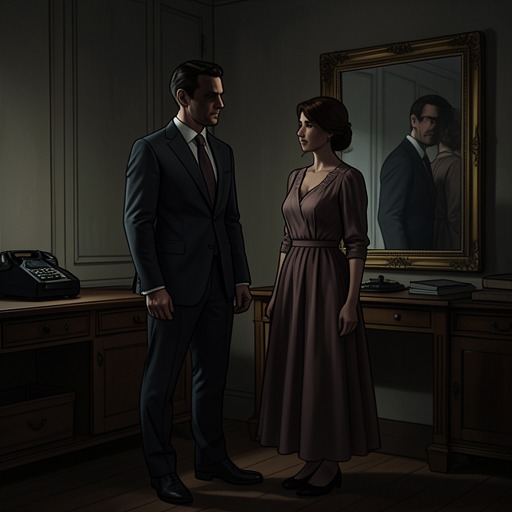
Geneva impersonates Ginny on Jessie’s setup date
Just One NightGeneva Bryce impersonates Ginny on Jessie Bryce’s setup date as a reluctant favor to her sister, but the disguise becomes much more than a social convenience. What begins with a one-night obligation at the Wayward Inn places Geneva directly before Bradford Taylor, exposes the inadequacy of her carefully managed public identity, and initiates the sexual and emotional relationship that later leads to repeated encounters, shared domestic life, and the prospect of marriage.
Causes and Background
The date is engineered by Jessie Bryce, whose relationship with Wilson has been threatened by Wilson’s brother. Jessie explains that Bradford Taylor considers her a bimbo and that Wilson has been told their relationship cannot continue unless the problem is resolved. Her proposed solution is for Geneva to go out with Wilson, meet Bradford, and make the evening appear to be a date with Wilson’s companion, whom the sisters rename Ginny. Geneva initially resists, insisting that the least she can do is nothing, while maintaining an orderly desk and signing a requisition form at work. Jessie’s appeal succeeds only after she insists that Wilson’s financial support is at stake.
Geneva accepts under tightly defined terms. Jessie promises to provide the clothes and makeup, and Geneva agrees to one night on the condition that her debt to her sister will then be repaid. The arrangement therefore begins as an exchange rather than an expression of romantic interest: Jessie needs a performance, and Geneva supplies it in return for release from an obligation. The one-night limit also gives Geneva a sense of control over an undertaking that threatens to expose a version of herself she has deliberately suppressed.
Construction of the Ginny Persona
Geneva’s disguise draws on a role she learned early to use for protection and convenience. She is tall, blonde, curvaceous, and conspicuously full-figured, but she has spent years toning down her appearance so that she can work without being reduced to it. Her gray laboratory coat helps conceal her body, while the absence of makeup and the minimal attention she gives her hair keep her professional identity separate from the sexualized image imposed on her by others. Her history of pretending to be a dumb blonde has already taught her that performing someone else’s expectations cannot make her happy.
Jessie nevertheless reconstructs that performance through highly visible material details. Geneva is put into a red silk dress with a revealing side slit and broad exposure across the chest; Jessie applies makeup that emphasizes her eyes and lower lip, then piles her blonde hair into a tousled arrangement with ringlets falling at the sides. Geneva looks at the result with alarm, feeling that the woman in the mirror belongs to a past she had worked to leave behind. Jessie assures her that no one from Geneva’s office could afford the Wayward Inn and that the disguise makes her unrecognizable. Geneva accepts the logic of the transformation and resolves to be, for one night, the seductive and powerful woman represented by the mirror.
The performance continues during the journey. Wilson addresses her as a date and places a hand on her thigh, but Geneva immediately warns him that the arrangement exists only for Jessie and threatens to break his fingers if he treats her improperly. His withdrawal establishes an important boundary before the evening begins. Geneva is willing to impersonate another woman, but she is not willing to surrender control of her body to Wilson merely because the disguise invites his assumption that she is available.
The Date at the Wayward Inn
The sisters and Wilson travel across town to the Wayward Inn, a fashionable waterfront restaurant. Once inside, Geneva goes to the ladies’ room to get into character. She straightens her posture, lets her walk roll and swivel to a beat she has suppressed for years, and emerges with enough confidence to make men turn and stare. She accepts the strawberry daiquiri Wilson ordered for Ginny even though she dislikes the drink, because it fits the role suggested by the dress. Alcohol becomes another prop in an evening she expects to endure, while her flirtatious interaction with the bartender demonstrates how quickly the costume changes the attention directed toward her.
The date changes direction when Bradford arrives. Wilson introduces her under the agreed near-variant of her real name, calling her Ginny and presenting Bradford as his brother. Bradford is dressed in an Armani suit and carries himself with a power that Geneva finds more compelling than conventional handsomeness; even his thick black glasses do not diminish the authority she perceives in him. Her physical response is immediate, and the attraction makes the supposedly controlled favor dangerous before Bradford has done more than offer a cool, polite greeting.
Bradford’s disinterest provokes Geneva into intensifying the act. She had planned merely to remain bubble-headed throughout the evening, but his controlled dismissal gives her a new objective: she wants to break his composure. Dinner becomes a contest of verbal framing. Whenever Bradford opens a topic of conversation, Geneva turns it toward sexual adventure or fantasy. Bradford answers by finding ways to suppress or dismiss her provocations without openly insulting her, and the pair battle over who will rule the table.
The exchange transforms impersonation into mutual testing. Geneva’s sexualized speech is initially a strategy for maintaining the bimbo persona and unsettling Bradford, yet the game gradually produces genuine physical excitement. Each victory or defeat alters the balance between them, and the bodily reactions that began as part of the performance cease to be pretend. The date therefore contains a reversal: Geneva enters believing that she is controlling an artificial role, but Bradford’s resistance makes the role a channel through which her own desire becomes difficult to separate from the act.
Exposure and the One-Night Pact
Bradford eventually abandons the polite fiction. In the restaurant, he blocks Geneva’s escape with his body and states that he does not believe the blonde-bimbo performance, even though it has deceived Wilson. His direct recognition of the disguise shifts the power structure of the evening. Geneva can no longer rely on the audience’s misunderstanding; the man whose judgment matters to her has identified the performance and refuses to accept it at face value.
Bradford then takes her out of the restaurant, despite the awkwardness of her four-inch heels, and confronts her about whether she is having sex with Wilson. Geneva denies it, but she also recognizes that Jessie’s plan has already become secondary to her own opportunity with Bradford. When he demands the night for himself and insists that it will mean nothing beyond that night, Geneva accepts the same temporary logic that governed her agreement with Jessie. Their exchange establishes a deliberate one-night pact: sex is permitted, but further claims are excluded.
The pact does not preserve the boundary it promises. Geneva leaves the encounter before Bradford wakes, driven by the need to protect the original fiction of a single night. Her internal clock wakes her at five-thirty after less than an hour of sleep, and she searches in the dark for the dress Bradford threw aside. She remembers him as an extraordinarily focused and powerful lover, and that memory makes departure necessary precisely because remaining would threaten the terms she had set. The event ends not with emotional closure but with an attempt to restore distance after the disguise has created an intimacy neither participant can simply dismiss.
Consequences and Significance
The date’s consequences continue long after Geneva returns to her ordinary identity. Jessie and Wilson resume dating with family approval, suggesting that Geneva’s performance has achieved its immediate practical purpose. Geneva, however, cannot return psychologically to the position she occupied before the evening. At the quarterly investor-relations gathering, she is exhausted and restless because the encounter has disrupted her nights. She has spent three nights using a vibrator to soothe herself, but the orgasms do not eliminate her fantasies of Bradford.
The later recognition scene reveals the depth of the event’s reversal. At the research laboratory, Geneva appears in a drab brown skirt and blouse with her hair tied back, looking nothing like the woman who left the restaurant and spent the night in Bradford’s bed. When the Director introduces Bradford Taylor as a potential investor interested in meeting the researcher in charge, Geneva hopes that he will not recognize her. The professional costume conceals Ginny, but the memory of the date returns through her body before the meeting can remain merely formal.
Bradford’s discovery does not end the relationship; instead, the original one-night limitation becomes a repeated arrangement. Geneva and Bradford propose using several nights of serious sex to work each other out of their systems, and Bradford immediately agrees that they should begin that night. He even takes Geneva’s panties and tells her she will not need them for the evening, turning the object that helped define the earlier disguise into a sign of the continuing sexual contract. Yet the attempt to reduce desire to a finite number of encounters fails. After four months of what Geneva describes as practically living together, she suggests telling Jessie and Wilson, and Bradford answers by proposing that they invite them to the wedding.
The event is therefore a narrative hinge built from conflicting performances. Geneva impersonates Ginny to solve Jessie’s family problem, uses the stereotype of the sexually available blonde to provoke Bradford, and discovers that the role can neither contain nor disguise her own agency. Bradford, in turn, sees through the act but does not reject the woman beneath it; he converts exposure into a direct negotiation of desire. The date begins with a borrowed name and a promise of only one night, but its decisive result is the collapse of both limits: the temporary persona leads to a real encounter, and the one-night pact develops into an ongoing relationship pointed toward marriage.