"Theft of Thought" theory
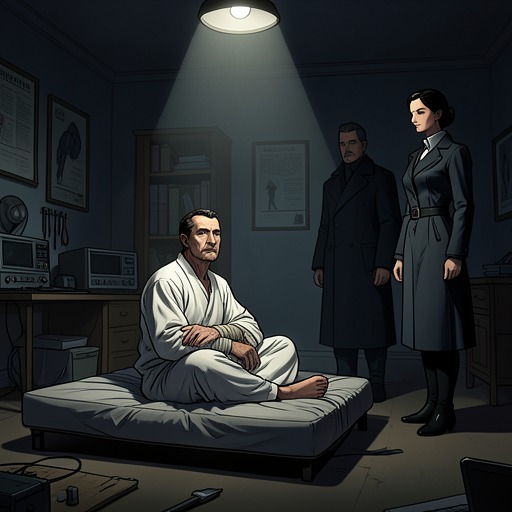
Kay ScarpettaThe mind-theft theory is Oscar Bane’s explanation for a world in which identity, thought, and private communication have become vulnerable to technical intrusion. He presents it not as a metaphor but as a literal mechanism of persecution: unknown people have stolen his identity and thoughts, monitor him through advanced electronics, and seek to control his mind. The theory matters because it occupies an unstable position between persecutory delusion and a distorted apprehension of real crimes. Digital evidence later confirms that identity theft, surveillance, and manipulated correspondence are genuinely present, even though Oscar’s conclusions about the perpetrators remain unreliable.
Origin in Oscar Bane’s Persecution Narrative
Oscar links the theory to his relationship with Terri Bridges and to what he sees as the authorities’ failure to protect either of them. He says that he tried to warn Jaime Berger by telephone, accusing her of indifference after Terri’s death and insisting that Berger could have prevented what happened. His idea of “mental justice” follows from the central premise: if someone’s mind has been stolen, justice requires that it be returned. Because Oscar has not recovered his mind and has lost Terri, he asks Kay Scarpetta for help as though she were his last remaining source of recognition and protection.
The theory also gives Oscar a collective and historical frame for his fear. He imagines that people may hate individuals with dwarfism and may want to eliminate them, comparing such persecution to the Nazi destruction of Jews, homosexuals, Roma, disabled people, and people with mental illness. This comparison does not establish the truth of his accusation, but it shows how Oscar converts personal terror into a story of organized extermination. Terri’s murder becomes, in his account, evidence of a larger campaign rather than an isolated crime.
Technology as the Alleged Instrument
Oscar describes his persecutors as using devices that can transmit voices into the skull through microwaves, produce “silent sound,” and use radar to see through walls. He cites secret postwar radiation experiments on human beings as proof that governments have already subjected people to hidden technological abuse. Scarpetta acknowledges that such experiments occurred, but that limited concession does not validate Oscar’s interpretation of his own experiences. The exchange instead demonstrates how real historical misconduct becomes, for him, a bridge from documented fact to an unproven personal conclusion.
Oscar believes fear is the method by which his persecutors control him. He says they follow him, harass him, and know exactly where he is, while he cannot identify who they are or what they want. His explanation therefore combines surveillance with a theory of psychological domination: technology does not merely observe the victim but enters the victim’s mental life and makes uncertainty itself an instrument of control.
From Private Delusion to Digital Identity Theft
Oscar says that the theory began with the internet, which he calls the easiest way to steal an identity. Because his academic e-mail address appears on his college’s website, he believes unknown people could have contacted him through it. He has offered this explanation to the district attorney’s office, but their refusal to accept his reasoning leads him to suspect that officials may themselves be cooperating in the theft of his mind. The theory thus expands whenever institutional skepticism appears: disbelief is recoded as evidence of conspiracy.
The surrounding investigation gives Oscar’s language an unsettling material basis. Lucy Farinelli works on a MacBook Air and explains that deleted files can often be recovered if action is taken quickly. In Terri’s apartment, she finds that one account contains 136 e-mails, all deleted individually the previous morning. The discovery does not prove that anyone stole Oscar’s thoughts, but it establishes that electronic communications have been deliberately manipulated and erased. Terri’s digital activity is not a neutral background to the case; it is part of the crime’s physical and evidentiary structure.
A further complication appears in the account identified as scarpetta612. Its messages are between Terri and a person presenting himself as Kay Scarpetta. The account’s MAC, or Machine Access Code, does not match the laptops under examination. Lucy therefore infers that the account may have been created to make it appear that Scarpetta corresponded with Terri and to make Terri look like the deceiver. The apparent theft of identity is consequently real at the level of the evidence, but it is also staged. The story distinguishes between the fact of impersonation and Oscar’s sweeping interpretation of that fact as the theft of a mind.
Surveillance, Access Codes, and the Morales Connection
The theory becomes more concrete when Lucy Farinelli reports that a motion-sensitive camera has been mounted on the roof for three weeks. Each time the camera detects movement, it sends an e-mail to someone whose computer is about to be breached. Lucy has the IP address and access code of Mike Morales, and she discovers that Morales uses the same access code as scarpetta612. This link changes the investigation’s shape. A device that Oscar might interpret as part of a vast campaign against his consciousness can be examined as an identifiable surveillance system tied to a particular digital identity.
The technical evidence still leaves crucial questions unresolved. Violent videos are present in Morales’s e-mail files, but their presence alone does not prove that he murdered anyone or personally recorded the videos with a camcorder on a tripod. Investigators must establish how the files entered the account and explain IP addresses, MAC codes, hidden addresses, cookies, packet sniffing, and related technical processes to a jury. The problem recalls earlier efforts to explain DNA evidence under the Frye standard: scientific sophistication can reveal connections, but it does not automatically convert an association into proof.
The mind-theft theory therefore operates beside, and sometimes against, digital forensics. Oscar’s vocabulary collapses identity, thought, surveillance, and control into one continuous assault. Lucy’s method separates those elements into accounts, devices, deletion histories, access codes, and transmission routes. That contrast supplies the book’s central tension: Oscar is wrong to treat every fear as confirmation, yet the investigators cannot dismiss the technological environment merely because his account is psychologically unstable.
Narrative Function and Significance
The theory gives form to a modern fear that private identity no longer resides securely within the individual. E-mail accounts can imitate a person, deleted files can preserve traces of hidden activity, cameras can report movement remotely, and access codes can connect apparently separate identities. In this setting, the phrase “stolen mind” is both pathological language and an exaggerated expression of a genuine loss of control over personal data and representation.
Its force also comes from the tension between subjective testimony and admissible evidence. Oscar speaks with tears, anger, historical analogy, and absolute certainty, while Scarpetta and Lucy must distinguish what he feels from what can be demonstrated. The account of mental theft is never allowed to become a simple diagnosis that ends inquiry. Instead, it remains a disturbing interpretive filter through which real acts of impersonation and surveillance are first perceived, then broken apart into testable facts.
By the time the investigation connects the scarpetta612 account, Terri’s deleted messages, the rooftop camera, and Morales’s access code, the theory has changed meaning. It no longer stands as credible proof that Oscar’s thoughts were literally extracted, but neither can it be dismissed as empty fantasy. It names, in damaged and conspiratorial form, the story’s larger crisis: people are being represented by systems they do not control, watched by devices they cannot see, and judged through technical traces whose significance must be reconstructed before truth can be separated from manipulation.