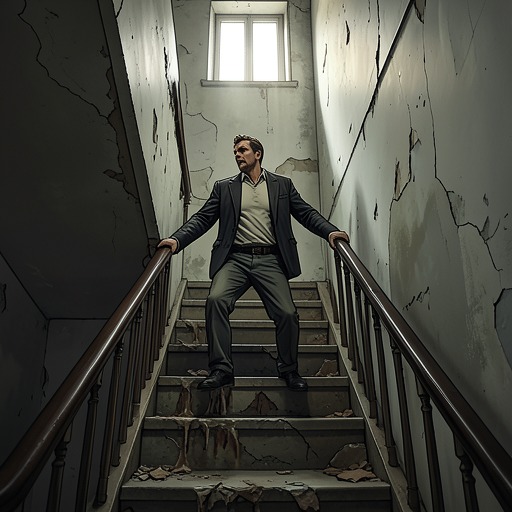
Alcohol use disorder
Kay ScarpettaAlcohol use disorder is a central explanatory framework for Pete Marino’s damaged life and attempted recovery. The narrative presents it not simply as a craving for drink but as a condition linked to anger, loss of control, family inheritance, compulsive behavior, and social withdrawal. At the same time, Marino resists allowing alcoholism to become the single explanation for everything that has happened to him, making the disorder a site of conflict between treatment, personal responsibility, and the need to recover a more complicated sense of self.
Definition and Inheritance
Alcohol use disorder is described to Marino through the language of disease and contagion. Nancy, his therapist, tells him that alcohol is the burning match that ignites the fire of his anger and that his drinking is a deadly illness inherited from his father. His father was an uneducated laborer who took little part in raising him and returned home drunk and violent on every payday. Marino therefore understands his drinking as something with both a bodily and familial history: an illness passed down through a household where alcohol and violence were repeatedly joined.
Marino extends that medical explanation into a darkly comic personal mythology. He concludes that the disease dates back to the Garden of Eden, imagining that the serpent gave Eve a bottle of whiskey rather than an apple. Eve and Adam emptied it, had sex, and were expelled from paradise with only a fig leaf for clothing. The fantasy turns inherited addiction into an origin story for human appetite, sexuality, disobedience, and punishment, while also showing how Marino uses metaphor to make an overwhelming pattern intelligible.
Abstinence and Daily Control
After leaving Charleston, Marino has given up good food and drink, but abstinence has not erased desire. His one-room flat in Harlem lies so close to Manna’s Soul Food that he constantly inhales the smell of fried chicken and roasted crab legs, an almost cruel temptation for a man who has renounced foods and beverages he once enjoyed. His meals are deliberately reduced: a whole-wheat sandwich with deli turkey, Nathan’s Coney Island mustard on a paper plate, and a Sharp’s nonalcoholic beer consumed in roughly two swallows.
The material shape of his life records the same reduction. He has lost fifty pounds and several sides of his personality since fleeing Charleston. He exchanged boxes of motorcycle clothing, including an impressive collection of Harley-Davidson leather, at a bazaar on 116th Street for three suits, a blazer, two pairs of respectable shoes, and shirts and ties, all discounted and made in China. He no longer wears his diamond stud; only a small hole in an unusual place on his right earlobe remains, like a symbol of an austere and stripped-down existence. He sold his motorcycle and pickup truck because he had nowhere to park them and promised himself that he would not look for a woman until he was ready.
These changes are not presented as a clean cure. They are acts of self-management undertaken within a life narrowed by deprivation, vigilance, and fear of relapse. Nancy has taught Marino that self-control matters in everyday dealings with other people, regardless of their shortcomings or what they may or may not deserve. The principle gives him a practical discipline, but it also places constant pressure on him to govern impulses that have previously become destructive.
Treatment, Shame, and Resistance
Nancy warns Marino that without regular attendance at Alcoholics Anonymous he will become a dry drunk: someone who is angry, mean, compulsive, and uncontrolled without needing a beer or twelve. The nearest AA meeting is held in a church near an African hair-braiding center, close enough to be convenient, yet Marino does not become either a regular or an occasional participant. When he first moved into the flat, he attended for three consecutive days, but he felt profoundly uncomfortable when the other participants introduced themselves with suspicious friendliness and left him no choice but to identify himself as though he were in the witness box.
The ritual reduces an intricate person to a public diagnostic statement. The expected exchange is stark: “I’m Pete and I’m an alcoholic.” “Hi Pete.” Marino’s discomfort suggests that the meeting’s language of shared recognition does not automatically feel like solidarity to him. It can also feel like compelled testimony, a public surrender of identity to a label. His refusal is therefore not evidence that he has overcome the condition; it shows how treatment can become entangled with shame, distrust, and the fear of being defined by the illness.
His conflict with Nancy becomes sharper when she insists that everything that has gone wrong in his life is connected to alcoholism and that aging drinkers and drug users become exaggerated versions of themselves. During an argument shortly before he stopped treatment, she lists the supposed consequences of his disease: fighting; bizarre relationships; risks involving boxing, weapons, police, and motorcycles; haphazard sex; broken friendships; divorces; and violence. She spends nearly an hour writing his failures across five pages in abbreviations that only a specialist could decipher, dates and signs the list, and even adds a smiley face.
Marino experiences the document as an accusation rather than a path toward understanding. He asks what he is meant to do with it, whether he should stick it on the refrigerator. In the chapel, with the windows open to sea air and gulls crying above the rocky northern coast, he looks toward the activities he had wanted—fishing, riding his motorcycle, or simply drinking with his feet up—and resents the demand that he attribute his failed life to alcohol. Nancy answers that he has pushed her away and that the drink has done it. The scene captures the treatment relationship as a struggle over causality: Nancy sees a disease organizing the pattern, while Marino fears that the diagnosis abolishes every other explanation.
The Charleston Dispute and Personal Agency
Marino eventually decides that Charleston was an accident waiting to happen, not the result of a so-called illness poured from a bottle. This distinction matters because it restores complexity to his past. He does not deny that drinking has harmed him, but he rejects the claim that alcohol alone explains his history or that every failure can be folded into a predetermined disease narrative.
The dispute also reveals the limits of a single therapeutic vocabulary. Nancy’s account is causal and cumulative: beer became Marino’s best friend at twelve, then a series of traumas followed, each making escape more difficult as he grew older. Marino’s response is experiential and resistant. The sea, the black granite, the gulls, and the bright day outside the chapel become counter-images to the closed list of symptoms and failures. He feels trapped not only by addiction but by an interpretation of himself that leaves no room for accident, choice, contradiction, or desire.
Narrative and Social Consequences
Alcohol use disorder remains inseparable from the institutions and labels surrounding the characters. Oscar Bane protests that mechanical restraints have been forbidden in psychiatric institutions since the middle of the nineteenth century, yet he is brought in handcuffed and treated as though he were a serial killer. His rage is not Marino’s addiction, but the parallel is important: psychiatric and behavioral labels can turn a person into a category before the person’s account is heard. In both cases, institutional language claims to explain conduct while threatening to replace the individual.
The narrative also places illness, bodily difference, and public stigma beside one another. Jaime Berger worries that press coverage of Terri Bridges’s murder will revive prejudice and stereotypes surrounding dwarfism, especially through the headline “DWARF MURDER.” A Palm Beach woman reacts to an inquiry by saying that even sitting in a waiting room with a dwarf would not lead her to speak or look at him for fear of embarrassing him. After evidence implicates Oscar, the press escalates the label from “dwarf murderer” to “dwarf monster,” and police across the country search for him while reports claim that some little people, especially young men, are staying home out of fear.
Against this atmosphere of public simplification, Marino’s condition is presented as a problem of competing reductions. Alcohol is reduced to a burning match, a hereditary epidemic, or a twelve-drink absence; Marino is reduced to an alcoholic, a dry drunk, or the sum of a five-page list. His life in Harlem, his altered clothes and body, his abandoned meetings, and his quarrel with Nancy show the cost of those labels without denying the destructive force of drinking. Alcohol use disorder thus functions both as a real source of compulsion and as a contested narrative imposed on a man trying to decide what, after sobriety, still belongs to him.