Bellevue Hospital
Kay ScarpettaBellevue Hospital is presented as both a major medical center and a controlled forensic institution, a place where medicine and criminal justice operate in uneasy proximity. Its modern complex on First Avenue at East 27th contains a glass entrance hall, a garden, a renowned trauma department, intensive-care facilities, and a men’s forensic psychiatric ward for patients held in connection with offenses ranging from fare evasion to the murder of John Lennon. The hospital therefore functions not merely as a backdrop but as an institutional threshold: patients arrive as injured or disturbed people, yet are simultaneously treated as detainees, witnesses, suspects, or potential evidence.
Identity and Setting
Bellevue Hospital’s prison psychiatric ward is separated from ordinary hospital life by locks, controlled movement, surveillance, and custodial routines. Benton Wesley speaks to Kay Scarpetta through a headset from the ward, the connection extending 240 kilometers between husband and wife while he tells her that a man was admitted to the forensic psychiatric unit the previous night. Jaime Berger wants Scarpetta to examine his injuries, immediately tying the hospital to the investigation rather than presenting it as a neutral place of treatment.
Scarpetta reaches the hospital under difficult circumstances, struggling with luggage after being dropped from a taxi and walking cold and irritable toward the complex. The detailed approach emphasizes Bellevue’s scale and public importance, but also the contrast between its impressive architecture and the restrictive unit inside it. The building’s glass hall and celebrated medical departments coexist with a ward designed for men accused of serious crimes, making the hospital’s identity inherently double: it is a center of care whose procedures are shaped by confinement and public danger.
The Forensic Psychiatric Ward
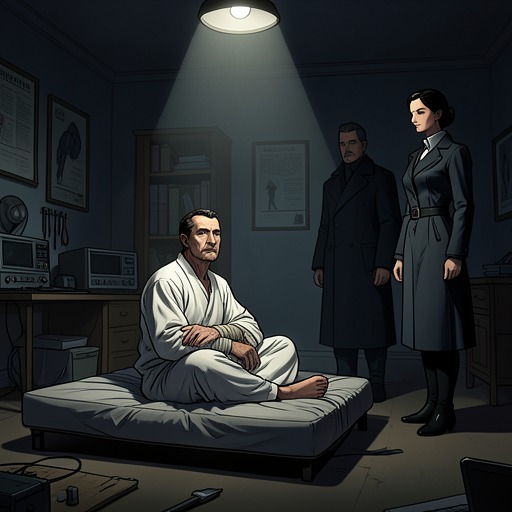
Oscar Bane is examined in one of the ward’s patient rooms, where his hairless, shackled legs hang over the edge of an examination table. A guard remains close enough to intervene if Oscar becomes violent, although Scarpetta sees fear, tears, confusion, and near-hysteria rather than aggression. The room thus stages a conflict between institutional risk management and clinical observation. Oscar is visibly frightened, but the presence of chains makes the hospital treat him first as someone who might require control.
The ward’s architecture makes that control systematic. Its doors have no handles, and only guards carry keys. The double-cylinder locks must be fully engaged so that a physician or staff member cannot accidentally become trapped with a dangerous patient. This precaution is explained through the example of a gigantic man who had recently dismembered a woman he picked up in a bar, a grim comparison that places Oscar within a population defined by the possibility of violence even before his own conduct has been established.
The rest of the unit is equally shaped by security. Scarpetta and Benton pass cells that would seem spacious for a prison if six beds were not crowded into each one. Men in ill-fitting pajamas shout to one another, look through mesh-covered windows toward the East River, or peer through bars into the ward. Doors open only when a control-room guard releases them, and the delay is ordinary enough to frustrate Benton. The recreation room contains tables, chairs, games, and an old exercise machine without removable parts; the interview rooms, group-therapy room, and legal library are designed around the same fear that ordinary objects can be dismantled into weapons. Even typewriters, television sets, and wall clocks are covered in plastic. Bellevue’s security is therefore embedded in furniture, locks, timing, and movement rather than confined to the guard standing outside a patient’s door.
Oscar Bane and Institutional Judgment
Within Bellevue, Oscar’s body is simultaneously a medical subject and a source of social misrecognition. Scarpetta identifies his short stature, disproportionate limbs, large head and torso, and distinctive hands as consistent with achondroplasia, while recording his height as 1.27 meters, his weight as 55 kilograms, and his shoe sizes, including women’s sizes because of his broad feet. The examination seeks precise clinical facts, but the surrounding descriptions show how easily those facts become spectacle. Oscar himself insists that he is a dwarf and objects to being treated like a circus monster, while protesting that psychiatric institutions have long prohibited mechanical restraints.
His anger is not quiet. He compares being shackled to Houdini and complains that the staff have treated him as though he were a serial killer, even invoking the image of a Hannibal Lecter cage. Scarpetta considers him disoriented and distressed rather than plainly dangerous, but the institution’s procedures give his protest limited practical force. The ward has made his physical difference part of the public meaning of the case, and his legal status makes it difficult to separate protection from punishment.
That problem extends beyond the ward. Newspaper coverage uses the headline “DWARF MURDER,” and later the media recasts Oscar as a “dwarf monster.” Berger worries that such language will reinforce misconceptions and stereotypes about dwarfism, especially when other news organizations repeat it. A woman from Palm Beach, questioned because her name has surfaced in the investigation, responds with open prejudice, saying that even if she were in a waiting room with a dwarf she would not speak to or look at him for fear of embarrassing him. Bellevue’s professional setting therefore stands against a wider culture that turns bodily difference into a category of suspicion, ridicule, or sensational crime.
Evidence, Confidentiality, and Institutional Networks
Bellevue is also a node through which information moves among medicine, law enforcement, laboratories, and prosecutors. Berger wants Oscar’s DNA analyzed and entered into the database as quickly as possible. The laboratory has already tested DNA from every autopsy performed that morning, every employee in the building, the medical examiner who attended the crime scene, and the officers and mortuary workers connected with Terri Bridges’s body. Most results are negative, but the process illustrates how the hospital converts bodies and contact into searchable evidence.
The investigation repeatedly encounters the medical boundary of confidentiality. Oscar tells Scarpetta things he does not tell the investigators, yet Scarpetta cannot simply pass those disclosures to Berger. Berger recognizes that Oscar is speaking to Scarpetta on the ward and that some of what he says may be important, but Benton insists that Kay will not reveal anything protected by professional secrecy unless Oscar releases her from that obligation or is arrested. Bellevue consequently becomes a site where evidence is withheld not because investigators lack interest, but because the clinical relationship imposes rules that criminal procedure cannot casually override.
The hospital’s reach also extends beyond its walls. Berger asks for Oscar’s DNA to be scanned through CODIS because of possible connections to cases in Baltimore and Greenwich, and she expects the result promptly. Later, when a porter says that Oscar has been released from Bellevue and that people are speaking cruelly about him, Scarpetta realizes that no one seems to know where he is and fears that someone may have harmed him. Release does not resolve the institution’s uncertainty; it transfers the problem from a locked ward to an uncontrolled public space.
Consequences and Narrative Significance
Bellevue’s importance lies in the tension between its stated medical purpose and the coercive environment required by forensic custody. It is a place where examination can offer protection, where restraint can be justified as safety, and where a patient can become a suspect without the narrative allowing those identities to settle comfortably into one another. Oscar’s shackles, measured body, frightened behavior, and guarded room make the contradiction visible: the institution must manage him, yet its management risks confirming the very stigma that makes him appear dangerous.
The hospital also supplies the investigation with its most consequential institutional resources: access to Oscar, clinical observation, DNA collection, laboratory comparison, and a legally protected medical relationship. At the same time, it cannot control the labels attached to him outside its doors. The shift from “dwarf murder” to “dwarf monster” shows how quickly public language can overpower clinical nuance, while the nationwide search and the alert to Interpol turn a patient’s disappearance into a matter of collective fear. Bellevue thus anchors the novel’s examination of how modern systems classify people. Its locked doors and databases promise order, but the case reveals that institutional categories can protect, obscure, stigmatize, and endanger at the same time.