De moord op Terri Bridges
Kay ScarpettaTerri Bridges’s murder is the decisive crime around which the investigation’s scattered clues become a pattern: a planned strangulation staged inside her Murray Hill apartment, concealed by Oscar Bane’s false account of an attack, and later revealed as part of Mike Morales’s serial killing method. What first appears to be a puzzling domestic scene—an apartment arranged for New Year’s Eve, a body covered by a blue towel, and Oscar apparently collapsing beside it—ultimately becomes evidence of a controlled sexual killing repeated across several years and locations.
Causes and Background
The murder initially seemed difficult to classify because Terri did not fit the profile of the two earlier victims being compared with her. In the summer of 2003, a young woman in Baltimore and a fourteen-year-old boy from Greenwich, Connecticut, had both been found naked, with their wrists and ankles bound and their deaths attributed to strangulation by an object that was never recovered. The woman’s body had been left in a harbor dumpster; the boy’s had been dumped near a Bugatti garage. Both cases remained unsolved, and neither produced usable DNA. The woman had apparently become involved in risky activity while seeking anabolic steroids, whereas investigators found no indication that Terri used anabolic steroids, took drugs, or maintained a secret life that would have made her an equivalent target.
The connection nevertheless emerged through the thin gold anklet found on Terri. Georgia Bacardi recognized it as matching the anklets associated with the other two cases: ten-karat gold, a delicate herringbone pattern, and an approximate length of twenty-five centimeters. Such an anklet could be bought cheaply at a mall kiosk or online, but its repetition gave it the force of a signature. The contrast between the earlier bodies, found outdoors, and Terri’s body, found indoors, suggested a change in circumstance rather than a break in method. The anklet was understood not merely as jewelry but as a possible token of possession and power, a mark by which the killer turned a victim into property.
The scene had also been prepared to misdirect investigators. Terri’s clothes lay in the bathtub: pink slippers, a pink robe cut open from collar to cuffs, and a red lace bra with its front closure and straps cut. The damage implied that her wrists had already been tied behind her back when the killer removed the robe and bra. That sequence pointed to a rapid surprise attack, probably immediately after she opened the door or after the assailant entered. The unnecessary undressing, together with the later evidence of sexual use, made the killing part of a ritual rather than a simple assault.
What Happens
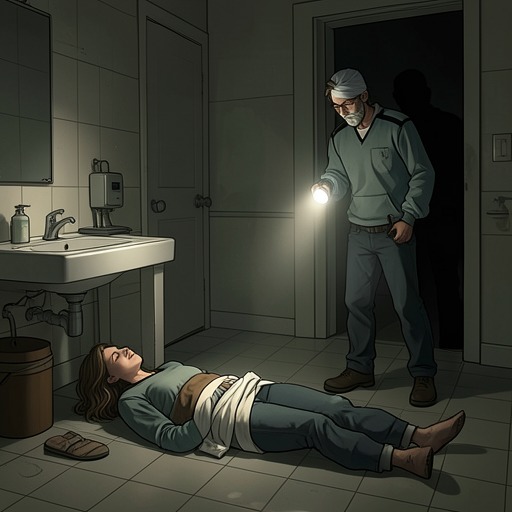
Oscar claimed that he found Terri’s body at five o’clock but waited until 6:09 p.m. to call for help. Police arrived within minutes, only to find the building’s outer door locked. With no doorman and no other residents at home, they entered from the rear after seeing through a gap in the curtains. Inside, they saw Oscar in the bathroom, hysterically crying while holding and rocking a woman covered by a blue towel. He admitted the officers when they knocked on the window, presenting himself as a devastated discoverer rather than an offender.
The forensic examination contradicted the apparent simplicity of that scene. Kay Scarpetta found Terri’s face dark red and dull, with bright red marks, and blood hemorrhages in the whites of her eyes. A Y-shaped autopsy incision ran from the clavicles through the sternum to the pubic region and had been stitched with thick thread in a pattern resembling a baseball. Beneath the skin, the opened skull shifted when the head was moved. These findings showed that Terri had not died quickly or mercifully: the pressure around her neck had obstructed the return of oxygen-depleted blood, ruptured vessels, deprived her brain of oxygen, and caused cerebral hypoxia.
The ligature marks supplied a more precise account. They formed a U-shape beneath the jaw and rose vertically under the back of the head, while overlapping horizontal streaks ended behind the jawbone. The material had been smooth, without sharp edges, and approximately one to one and a half centimeters wide. Scarpetta recognized the pattern as consistent with clothing or elastic material that narrowed under tension and widened when released. The marks could resemble those left by hanging, but they were compatible with repeated tightening and loosening of a flexible ligature.
That repetition was the crucial physical history of the crime. Terri may have lost consciousness within ten seconds and would have died within minutes had the pressure not been released. Instead, the killer allowed her to regain consciousness before strangling her again, repeating the cycle until she could no longer endure it—or until he stopped, perhaps because he had finished or because someone interrupted him. The repeated ritual accounted for the extraordinary accumulation of blood in her head and the unusually numerous small hemorrhages.
The later recording made the method visible rather than inferential. In the video watched by Jaime Berger and Lucy Farinelli on a large plasma screen in Berger’s penthouse, Terri appeared in the mirror of her bathroom while latex-gloved hands strangled her from behind with a blue medical tourniquet, the kind used when drawing blood. Terri was naked, her hands bound behind her, and she kicked violently at a chair with a heart-shaped back. The attacker nearly lifted her from it while tightening the tourniquet until she lost consciousness, then lowered her and began again when she revived.
The recording fixed the duration and purpose of the final assault. Terri made no words, only scraping and choking sounds; her eyes protruded, her tongue extended, and saliva ran down her chin. She died after exactly twenty-four and a half minutes, the killer taking that long to ejaculate and end her life because he could no longer use her. He flushed the condom down the toilet and switched off the camera. The scene therefore revealed murder as both domination and recording: the victim’s body was treated as an instrument, while the camera preserved the ritual for later repetition or consumption.
Investigation and Reconstruction
The early investigation was complicated by Oscar’s attempt to manufacture an alternate narrative. His torn shirt and injuries supported his claim that a man had attacked him as he entered the apartment, but Scarpetta suspected that he had inflicted the wounds himself, scratching himself until he bled and striking himself with a flashlight. When he realized that the injuries could not have occurred while he was still wearing his coat, he returned to his car and threw the coat inside, arranging the physical circumstances to support his story. His delayed call, locked entrance, and performance beside the body likewise became suspicious rather than exculpatory.
The staged attack also obscured the significance of the anklet and the discarded clothing. A killer who took souvenirs might preserve the ligature or underwear to replay the assault for sexual gratification. Yet the anklet might work differently from a private keepsake: it could be an object left behind as a recurring emblem. The comparison with an earlier California series involving silver rings clarified the distinction. A ring symbolized possession through a declaration of making someone one’s own; an anklet suggested power, restraint, and ownership imposed upon a captive body.
The absence of usable DNA did not dissolve the pattern. Terri had not apparently been raped in the ordinary evidentiary sense, and the earlier female victim had yielded no semen. The killing’s sexual dimension was instead encoded in the sequence of binding, undressing, repeated strangulation, bodily control, and the final recorded ejaculation. The use of latex gloves and lubricant further linked the crime to a practiced method rather than an improvised outburst.
Consequences and Aftermath
The discovery of Eva Peebles’s body extended Terri’s murder beyond a closed case. Eva was found hanging with her blue eyes open and strands of white hair caught in the loop; her only jewelry was a thin gold anklet around her left ankle, matching the one associated with Terri. The recurrence converted an isolated object into a killer’s mark and strengthened the geographical and behavioral connection among the victims.
The recording finally identified the underlying perpetrator as Mike Morales, although it withheld his face. Berger determined that Morales had also filmed the murders of Bethany in Baltimore in the summer of 2003 and Rodrick several months later near the Bugatti dealership in Greenwich. Rodrick had likely appeared on Morales’s radar because Morales worked part-time for a veterinarian in the area; Bethany may likewise have met him through veterinary work in Baltimore. In each killing, Morales bound the victim’s wrists, wore latex gloves, used the same lubricant, and followed the same pattern of sexualized strangulation.
The evidence connected Morales’s professional environment to his crime scene practice. Veterinary workplaces used spatulas and ointments like Aqualine, and Morales had stolen an opened container of Aqualine from work, possibly making that theft part of his method from the first murder onward. Berger could not determine how many people he had killed, and the face concealment prevented the videos from supplying straightforward proof. Nevertheless, Terri’s murder became the link that joined the earlier deaths, Oscar’s fabrication, the gold anklets, the repeated ligature technique, and the recordings into a coherent serial pattern.
Narrative Significance
Terri’s death changes value from apparent confusion to terrible certainty. At first, the locked building, Oscar’s tears, and the blue towel invite belief in a tragic discovery; forensic reconstruction turns those details into signs of staging; the video then reverses the scene completely by showing that the apparent aftermath concealed a prolonged, deliberate act. The investigation does not merely identify a murderer. It restores sequence to a body whose death had been disguised by performance.
The event’s most disturbing significance lies in the collision between domestic order and ritual violence. The apartment had been arranged with candles, wineglasses, linen napkins in blue rings, coordinated plates, bowls, and a vase of flowers, yet its precision contained no warmth or creativity. Against that controlled setting, the heart-shaped chair, the blue tourniquet, and the gold anklet become grotesque instruments of possession. Terri’s murder thus exposes the domestic interior as a stage on which intimacy can be manufactured, recorded, and converted into domination.
It also establishes the gold anklet as a recurring serial sign while preserving the individuality of Terri’s case. Her murder took place indoors, involved a staged assault and an intimate setting, and was captured in full on video, but its central mechanics echoed the Baltimore and Greenwich killings. The result is not a series of unrelated deaths but a repeated system: vulnerable victims selected through the killer’s access to their environments, restrained with practiced efficiency, sexually exploited, strangled in cycles, and marked by an object whose apparent modesty conceals a claim of ownership.