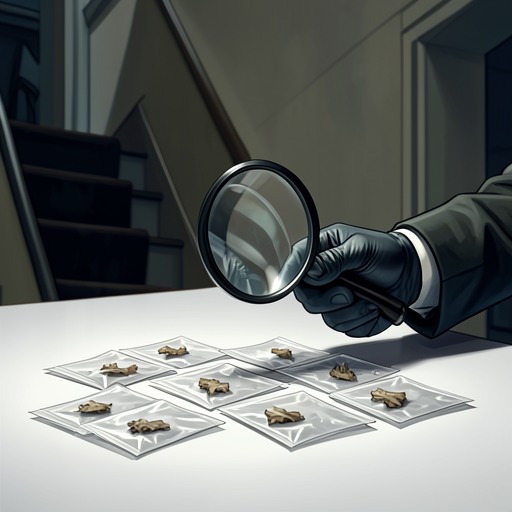
De perfecte misdaad
Kay Scarpetta“De perfecte misdaad” functions in the novel as an expression of impossible criminal control. It appears first as a supposed principle of investigation—no offender can avoid making a foolish mistake—and then as a false quotation attributed to Kay Scarpetta by Oscar Bane. The phrase therefore moves between forensic confidence and psychological distortion: it describes the limit of planning, but also reveals how a suspect’s imagined version of Scarpetta has begun to replace the real woman.
The Investigative Proposition
A perfect crime, as the expression is used in the investigation, is not treated as a realistic achievement but as a challenge to be disproved. Oscar claims that the attacker must have made at least one error and that Scarpetta will find it because, in his account, she always says that she can find everything. Scarpetta recognizes the statement as false. She cannot remember ever quoting Oscar Wilde, saying that nobody commits a crime without doing something foolish, or claiming that she could solve a perfect crime. The gap between Oscar’s certainty and her actual memory turns the expression into an early indication that his testimony is contaminated by invented dialogue and misplaced beliefs.
The expression also carries an ironic reversal. Oscar presents Scarpetta as nearly infallible, yet the very compliment is absurd and repellent to her because it attributes to her a boast she would never make. His version of her is not evidence of her character; it is evidence about his own mental construction of her. When she later asks whether he would doubt her ability to discover that he had injured himself, the phrase becomes a test applied directly to his story. The question is no longer whether an unknown attacker made a mistake, but whether Oscar has left enough physical inconsistency behind to expose his performance.
The Phrase Applied to Staging
Scarpetta’s examination identifies the central error in Oscar’s account: the scratches and bruises have the position they would have if he had inflicted them himself. He can reach the injured areas, and his silence when challenged offers no alternative explanation. The expression thus acquires a material meaning. A crime scene cannot be made convincing merely by adding violence; the arrangement of wounds, clothing, and objects must also remain anatomically and chronologically plausible.
Benton Wesley extends this reasoning to the death of Terri Bridges. The missing strip used to strangle her does not fit a simple staging of the scene, because its removal suggests that the killer took it for a reason. Benton considers the possibility of a keepsake, along with an item of lingerie, retained to replay the violence and intensify sexual fantasies. Such souvenirs point toward a sexual predator who treats a victim as an object, an unknown person rather than a friend or lover. At the same time, Benton repeatedly allows that Oscar may have staged the scene with unusual intelligence and calculation.
The reconstruction of Oscar’s movements makes the alleged perfection even less credible. If he had truly been attacked as he entered the apartment, his torn shirt and injuries would have occurred while he was wearing his jacket. Yet the jacket was found in his car. Scarpetta suspects that, after scratching himself until he bled and striking himself with the flashlight, Oscar realized that his injuries could not have been sustained in the manner he described while the jacket remained on him. He therefore returned to the car and threw the jacket inside to make the account appear coherent. His planning is quick, but it is reactive; the effort to repair one inconsistency creates another.
Contradictions Beyond the Crime Scene
The expression also governs the novel’s digital evidence. When the Gotham Gotcha website appears corrupted—its buildings dark, red lightning crossing the sky, and the Rockefeller Center Christmas tree upside down in Central Park—the apparent technical breakdown becomes another layer of uncertainty. The damaged website suggests that information itself can be manipulated, just as Oscar manipulates the appearance of an assault. But a digital performance remains vulnerable to records that preserve when an action was attempted, even if it was never completed.
Lucy Farinelli discovers that the scarpetta612 account composed an email at 8:19 the previous evening but did not send it. Because Terri’s body was already in the morgue, and because Oscar was implicated elsewhere, the record makes it impossible for either of them to have been the person behind that account. The unsent message changes the investigation by separating the online identity from the two obvious candidates. In this context, “De perfecte misdaad” becomes a problem of temporal contradiction: a carefully maintained false identity cannot be perfect if its activity occurs at a time when its supposed user could not have produced it.
The same logic appears in the encounter between Pete Marino and Mike Morales. Marino climbs a narrow, unstable fire escape while carrying a .40 Glock, expecting that the armed figure on the roof may be the serial killer. Morales turns out to be the man waiting there, and the confrontation exposes the danger created by incomplete knowledge. Marino’s mistake is not a criminal error, but the scene reflects the expression’s broader structure: appearances encourage a conclusion, then a physical fact reverses it. The investigation advances through such corrections rather than through any single flawless revelation.
Physical Proof and the Collapse of the Perfect Crime
The decisive refutation of Oscar’s story comes through traces that he cannot fully control. Shoeprints on the toilet lid in Eva Peebles’s bathroom match the shoes Oscar wore when, according to his statement, he found Terri’s body the previous evening. More damaging still are Oscar’s fingerprints on the glass lamp removed from the ceiling and placed in the bathtub by the killer. The objects preserve his contact with the scene in a way his narrative cannot explain away.
These clues convert the expression from a philosophical claim into a forensic verdict. Oscar may be intelligent, calculating, and fast, but intelligence does not erase contact evidence. His false injuries, displaced jacket, and elaborate account depend on the investigators accepting a sequence that the physical scene contradicts. Once the shoeprints and fingerprints connect him to the relevant locations, the supposed victim becomes a suspect, and the idea of an external attacker loses its protective force.
An arrest warrant is issued shortly after midnight, and the search for Oscar spreads through radio, the internet, and Interpol. Public language hardens as the “dwarf killer” becomes the “dwarf monster,” showing how quickly an unresolved investigation can become a media narrative. Reports that small people, especially young men, are staying home out of fear widen the consequences beyond Oscar himself. The failure of the perfect crime therefore produces not only legal exposure but also social distortion: a private deception helps generate public suspicion toward an entire vulnerable group.
Narrative and Psychological Significance
The expression is significant because it links the novel’s major forms of deception. Oscar stages bodily injury; the killer removes or leaves symbolic objects; Gotham Gotcha’s website is corrupted; the scarpetta612 account creates a misleading digital identity; and physical evidence quietly records what performance tries to conceal. Each layer asks whether appearances can survive contact with time, anatomy, technology, or material residue. The recurring answer is negative, though discovery is delayed because investigators must distinguish genuine clues from deliberately manufactured ones.
At the same time, Oscar’s repeated attribution of the expression to Scarpetta makes “De perfecte misdaad” a symptom of unreliable perception. He does not merely defend himself with a false story. He supplies Scarpetta with a fictional doctrine and then uses that doctrine to describe the kind of investigator he imagines confronting him. His invented version of her is absolute—someone who can find everything and never make a foolish mistake—while the real Scarpetta proceeds through doubt, examination, and correction. The phrase consequently exposes both the vulnerability of criminal staging and the instability of the mind that stages it.
The novel does not claim that every mistake is immediately visible or that every crime is solved by a single clue. Instead, it builds recognition cumulatively. A frightened glance at the pliers, a refusal to explain self-inflicted wounds, the mismatch between a jacket and an injury, a missing strip of tape, an unsent email, shoeprints, and fingerprints each narrows the space available to deception. “De perfecte misdaad” names the fantasy that those spaces can remain sealed forever. Its narrative force lies in showing that the smallest uncontrolled detail can reopen them.