Eva Peebles
Kay ScarpettaEva Peebles is a seventy-two-year-old woman whose death transforms an apparently local animal-cruelty investigation into evidence of a wider chain of human and animal violence. After entering the basement of a pet shop and witnessing activity she was never meant to see, she is murdered and displayed in a manner that closely repeats the killing of Terri Bridges. Her body, the golden cord around her neck, and the thin gold anklet on her left ankle become the physical link between the two cases and intensify Kay Scarpetta’s fear that Oscar Bane may be involved.
Identity and Connection to the Case
Eva is not introduced through a developed biography but through the consequences of what she saw. She becomes important because she was present in the basement of a pet shop at the wrong moment, where the treatment of animals revealed a hidden system rather than an isolated act of cruelty. Jaime Berger’s task force had already pursued Jake Loudin after a raid on one of his Bronx stores, and the investigation had exposed a business environment in which unwanted puppies could disappear without a clear public account of what had happened to them.
Eva’s connection to that system is therefore circumstantial but dangerous. The evidence later suggests that she may have encountered Mike Morales, who sometimes operated under the name Juan Amate, in the basement. Berger considers the possibility that Loudin had contacted Morales after Eva became an inconvenient witness, not necessarily to commission a murder in explicit terms but because Morales treated the removal of a human obstacle as another opportunity for violence.
The Pet-Shop Discovery
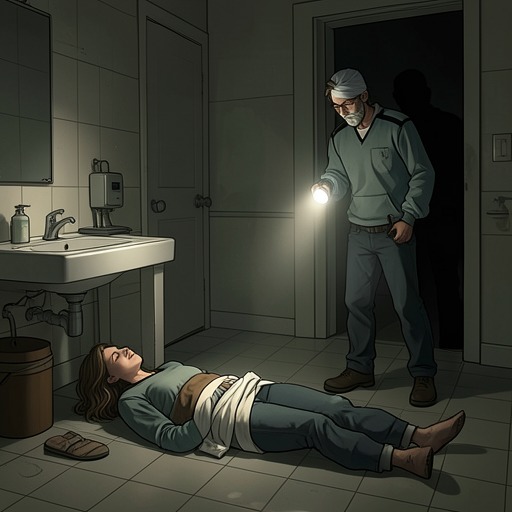
Eva entered a dim storage area that smelled of disease, excrement, and urine. Cages filled with dirty paper stood among boxes of animal supplies and bags of food. On a wooden table were glass tubes, hypodermic needles, red bags marked as hazardous waste, and heavy black rubber gloves. The room’s objects made the setting legible as a place where living creatures were handled, treated, discarded, or killed under the cover of routine commerce.
Behind the table stood an open freezer room. Eva saw a man in a dark suit and black cowboy hat and a woman in a long gray coat with their backs toward her. A noisy fan prevented her from hearing what they said. She recognized what they were doing and wanted to leave immediately, but fear seemed to fix her to the concrete floor. When the woman noticed her, the woman ran; a heavy male voice called after Eva to stop. This moment makes Eva a witness whose knowledge is visual and fragmentary: she sees enough to become a threat, but not enough to identify the entire operation with certainty.
The discovery also places animal suffering and human murder within the same physical landscape. Jake Loudin had faced eight charges of aggravated cruelty after dead animals were found in a freezer at one of his stores, although the charges were withdrawn when prosecutors could not prove that the animals had been placed there alive or establish that the police had adequately demonstrated the absence of justification for euthanasia. Eva’s encounter occurs against that unresolved legal background, where technical uncertainty protects a profitable system and leaves witnesses exposed.
Murder and Staged Body
When Pete Marino enters Eva’s bedroom, he finds her naked body suspended from a dull-gold cord looped around her neck and fastened to a chain attached to the ceiling. Her wrists and ankles have been bound together with transparent plastic straps, and her toes barely touch the floor. Cold air from an open window causes the body to rotate slowly from side to side, while the cord follows the movement. The scene is not merely a killing site; it is a deliberate display organized around restraint, exposure, and motion.
The cord came from a curtain in the dining room and had been tied to a short iron chain. An alabaster half-sphere that had hung from an S-hook beneath the chain lay in the bathtub on folded clothing. Scarpetta observes that the seams of the clothing had been cut open and the garments removed from Eva’s body after her wrists and ankles were tied, probably while she was still alive. The detail turns the staging into evidence of prolonged control rather than a simple postmortem arrangement.
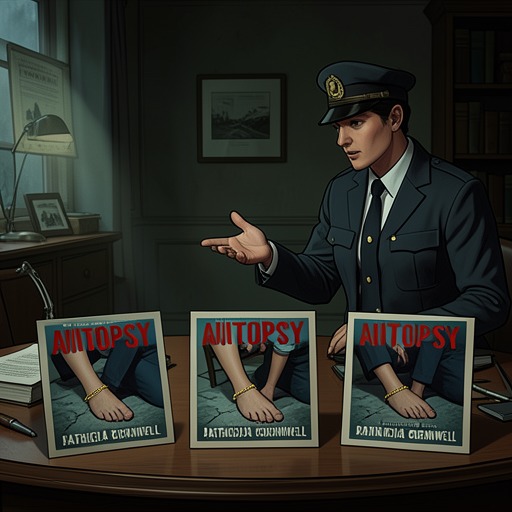
Eva’s blue eyes remain open in her thin, wrinkled face, and strands of her white hair are caught in the noose. Her only jewelry is a thin gold chain around her left ankle, matching the anklet worn by Terri Bridges. That small repeated object gives the investigators a signature: a private emblem transformed into a forensic pattern. Scarpetta fears that the person who killed Eva also killed Terri, and she specifically fears that Oscar Bane is that person.
Consequences and Narrative Significance
Eva’s death confirms that the danger around Terri’s murder is expanding beyond the original victim. Marino reports that Eva had recently called the emergency number again, while he describes her as terrified because of what happened to Terri. The apparent reason for her call was to report animal abuse, but its timing suggests that her fear was connected to both the pet-shop evidence and the human violence surrounding it. Her attempt to seek help becomes part of the case’s grim irony: the institutions she contacts are forced to reconstruct her danger only after she has been silenced.
For Berger, Eva’s murder sharpens the suspected relationship between Jake Loudin and Mike Morales. The investigators have so far traced Loudin, but Loudin has not admitted knowing Morales or sending him animals that could not be sold. Berger imagines Morales entering pet-shop basements as Juan Amate, accepting payment to add more misery to an already brutal system. She does not think Loudin necessarily asked Morales literally to kill someone; instead, Eva may have become a disruptive presence whom Morales used as a pretext for further amusement.
Eva consequently occupies a crucial structural position in the novel. She is both witness and victim, and her death forces the investigators to read animal cruelty, commercial disposal, and serial murder as connected practices rather than separate crimes. The gold anklet makes that connection visible, while the freezer, medical supplies, restraints, and suspended body show how a culture that treats vulnerable life as merchandise can conceal escalating violence. Eva has little opportunity to speak for herself, but the material arrangement of her death becomes her testimony: it identifies recurrence, exposes method, and turns an overlooked witness into the case’s decisive second human link.