Kay Scarpetta—Benton Wesley
Kay ScarpettaKay Scarpetta—Benton Wesley is not presented as a settled refuge but as a marriage whose promises are continually tested by the histories, loyalties, and injuries that the two partners carry into domestic life. Its decisive significance lies in the contradiction at its center: Benton Wesley and Kay Scarpetta have finally built a shared household, yet the intimacy that marriage was expected to secure has also made their emotional distance impossible to ignore.
Origins and Domestic Reality
The relationship began with adultery more than fifteen years before the main crisis, but for most of that time Benton Wesley and Kay Scarpetta had never lived in the same city and had never learned what ordinary daily life together meant. They married without ceremony in the garden of Kay's carriage house in Charleston, South Carolina. Immediately afterward, Kay had to close the private practice she had only recently opened, making the marriage part of a larger professional and geographical upheaval rather than an isolated romantic resolution.
They moved to Belmont, Massachusetts, to be near McLean Hospital, where Benton worked, and Kay's new headquarters in Watertown, where she had become head of the forensic medical service for the northeastern district. Their proximity to New York City also enabled Kay to accept an invitation to give guest lectures at John Jay College of Criminal Justice. Through that position, the New York City Police Department's medical examiner and forensic psychiatric departments such as Bellevue Hospital could consult them without charge. The marriage therefore unfolds inside an unusually demanding professional network, where public responsibility repeatedly competes with private closeness.
Affection Under Strain
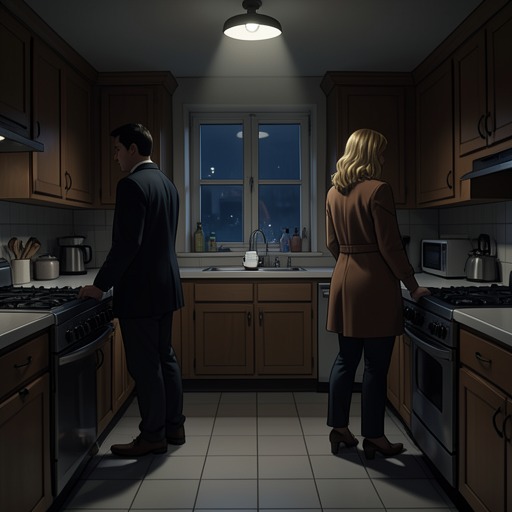
The shared home does not restore the easy intimacy that preceded marriage. Kay believes that Benton was happier before they married, and she does not attribute that painful fact to Pete Marino. Their conversations have become shorter and more impersonal, and they spend less time in bed. Kay does not think Benton is sleeping with someone else, but the absence of sexual ease still registers as a profound change in the marriage. A desk between them in Benton's small hospital office becomes an almost physical emblem of the emotional barrier she cannot cross.
Benton is also reluctant to discuss the deepest contradictions in their domestic life. His reluctance is not indifference: it reflects the fact that the marriage contains unresolved feeling that neither partner can easily organize into a reassuring account. He tells Kay that he does not want sex, at least not with her, while Kay remains convinced that the marriage has diminished his happiness. The relationship thus operates through avoidance as much as through devotion; silence protects them from immediate confrontation while allowing resentment and uncertainty to accumulate.
Their conflict becomes inseparable from the crisis surrounding Pete Marino. Benton admits that he is furious with Kay, even though he knows that such anger is unfair because she is the person who was harmed. He recognizes that Marino had worked with her for years and that Kay was not unreasonable to let him in when he was drunk and completely disoriented. Benton's anger is therefore directed against a situation he intellectually understands, not against a culpable act by Kay. His self-accusation exposes the marriage's moral difficulty: love does not prevent jealousy, and moral clarity does not automatically dissolve emotional pain.
Shared Judgment and Professional Alliance
Despite their distance, Benton remains one of the people best positioned to challenge Kay's judgment. When she considers bringing Jack Fielding, someone from her professional past, into her current work, Benton warns her that looking backward can mean seeing only what feels safe. His advice identifies a pattern within Kay's decisions: after a life marked by upheaval, she may seek stability in familiar people even when familiarity conceals risk. His warning is both professional counsel and an oblique intervention in the emotional insecurity of their marriage.
Benton also urges Kay to trust her intuition about a threatening man and apologizes for behaving rigidly, explaining that he has not slept and is in an intolerable position. Kay replies that her intuition tells her she should not have spoken with the man, while her reason tells her something else. The exchange shows the pair working as intellectual equals even when they cannot communicate easily as spouses. Their marriage sustains a form of professional intimacy: they test evidence, interpret behavior, and correct one another's assumptions, even while the private conversation between them remains constrained.
The surrounding investigation repeatedly confirms how much their shared work depends on separating appearance from fact. A frightened patient's belief that Kay had often spoken of committing the perfect crime is contradicted by her inability to remember ever saying such a thing. The Gotham Gotcha website then appears to have malfunctioned or crashed, displaying dark buildings, red lightning, and an upside-down Rockefeller Center Christmas tree in Central Park. Later, an unsent email written from the scarpetta612 account at 8:19 p.m. proves that neither Terri Bridges nor Oscar Bane could have authored the account, overturning an apparent conclusion about identity. Benton and Kay's partnership is therefore built around disciplined doubt, even as their own marriage is burdened by feelings that resist such orderly analysis.
Recommitment Amid Violence
The marriage's emotional reserve is interrupted when Kay finally asks the question she has repeatedly postponed. Benton answers that what he feels for her has not changed and that she has no idea what he sometimes feels but does not say. When Kay suggests that he should say it, he tells her that he is saying it now. The moment is significant not because it resolves every difficulty, but because it converts concealed attachment into spoken commitment after a long period of silence.
That declaration acquires added force against the violence surrounding them. Kay reconstructs a murder from the cut sleeves of a pink robe, the severed straps of a red lace front-fastening bra, and the likelihood that the victim's wrists had already been bound behind her back. Elsewhere, Pete Marino climbs a dangerously narrow ladder while armed and encounters Mike Morales on the roof; an apparent threat turns into a shocked recognition between colleagues. The investigative world offers no secure boundary around the marriage. Danger enters through bodies, homes, digital identities, and professional obligations, making Benton's verbal affirmation a form of emotional protection rather than a sentimental conclusion.
Meaning and Limits of the Bond
The relationship's defining pattern is a tension between pursuit and withdrawal. Kay wants direct conversation and reassurance, yet she postpones the question that might provide it. Benton loves her intensely, but he withholds speech and retreats from sexual intimacy. Their attachment is neither securely tranquil nor simply broken; it is a bond that persists through avoidance, anger, guilt, and repeated acts of care. Their professional alliance gives them a language of evidence and inference, while their marriage repeatedly confronts them with feelings that cannot be made harmless by analysis.
The public scandal surrounding Kay intensifies this contrast. Terri Bridges's anonymous columns portray Kay as weak and blame her for the assault attributed to Pete Marino, transforming a private injury into a public accusation. Kay later understands that Terri had received cruel and belittling emails from someone she believed was her heroine, and that Terri's hatred grew from the resulting humiliation. The revelation does not erase the damage, but it allows Kay to see Terri as a person caught in a chain of idealization, betrayal, and retaliation rather than merely as an enemy.
By the ending, Benton displays affection publicly in a way he had never done before, kissing Kay's hand and then her mouth. He suggests that, if Gotham Gotcha still existed, their entire group would probably appear in it the next morning. The gesture does not prove that the marriage's old wounds have vanished. It does show a change in Benton's relation to visibility: after concealment, professional danger, and the exposure of private lives through hostile media, he no longer seems equally troubled by being seen loving Kay. The marriage remains imperfect and emotionally scarred, but its final movement is toward acknowledgment rather than retreat.