Morales' murder video
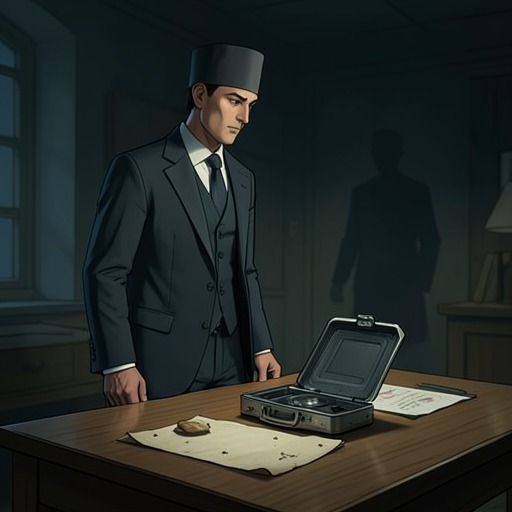
Kay ScarpettaMorales's murder videos are not merely records of violence; they are the central technological and evidentiary objects through which the investigators reconstruct a serial killer's method. The recordings connect Terri Bridges's death with earlier killings, reveal the killer's repeated sexualized procedure, and make Mike Morales's hidden identity legible even while withholding the one image the prosecution most needs: his face.
Discovery and Identification
A crucial file was found in Mike Morales's personal email account, where his username was Forenxxx. Lucy Farinelli recognized that the material was wholly illegal and discovered that one recording had been made by an apparatus different from the surveillance camera on the roof. The distinction mattered: the investigators were not viewing an accidental security record but a deliberately created private archive.
The recording was from New Year's Eve and had been made inside Terri Bridges's apartment. Its discovery abruptly changed the investigation. The police had already been dealing with a murder whose circumstances were concealed from the public, with a suspect associated with a yellow rose confined in Bellevue Hospital, and with uncertainty about what had happened to Terri. The video supplied a direct account of the killing, but it also introduced a more disturbing problem: the recording showed not only what the murderer did, but how deliberately he had preserved the act.
The Recording of Terri Bridges's Death
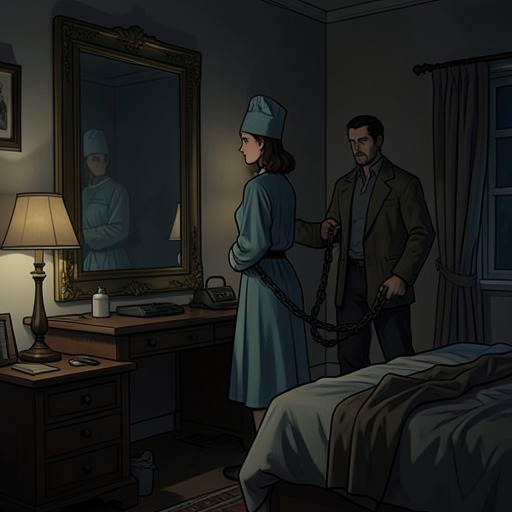
The film showed Terri Bridges in the bathroom, visible through the mirror, while gloved hands tightened a blue tourniquet around her neck. She and the naked killer were both unclothed; her hands had been tied behind her, and she kicked violently against a chair with a heart-shaped back. He nearly lifted her from it as he strangled her until she lost consciousness. When he lowered her and she regained consciousness, he began again.
Terri made no intelligible speech during the central violence. Her body communicated panic through scraping and gagging sounds, protruding eyes, an extended tongue, and saliva running over her chin. The killing lasted exactly twenty-four and a half minutes. The duration was tied to the killer's sexual climax and to his decision that Terri could no longer be used. He then flushed the condom down the toilet and switched off the camera. The sequence makes the recording an instrument of domination twice over: Terri is controlled in the apartment, and her suffering is converted into a repeatable image under the killer's control.
The investigators also heard indications that the encounter was not an isolated sexual meeting. Jaime Berger observed that Terri and the killer seemed to have had sex before, and Lucy inferred from their familiarity and remarks that Terri had known him for years through Dr. Elizabeth Stuart's practice. The possibility that Terri called him Juan supported the identification of Morales as Juan Amate, though the sound was difficult to hear. The video therefore exposed a relationship that had been hidden behind ordinary professional and personal identities.
Links to Earlier Murders
The recording gained its full significance when Berger compared it with two earlier videos. One showed Morales killing Bethany in his bare apartment in Baltimore during the summer of 2003, after he had graduated from Johns Hopkins medical school. Another was made several months later, when he killed Rodrick and left the victim's slight young body near the Bugatti dealership in Greenwich. Rodrick may have come to Morales's attention through a radar-like field of opportunity created by Morales's part-time work for a veterinarian; Bethany may likewise have met him through veterinary employment in Baltimore.
The same procedural elements recur across the recordings. Morales tied the victims' wrists, wore latex gloves, inserted his fingers into them, and used the same lubricant. The opened container of Aqualine taken from his work may have been part of his method from the first murder onward. Berger wondered whether the ointment also served to confuse investigators by mixing or complicating DNA profiles. The videos thus preserve a behavioral signature more powerful than any single scene: restraint, gloves, sexual penetration, lubricant, strangulation, and the controlled production of a record.
Yet the recordings remain frustratingly incomplete as courtroom evidence. Morales's face never appears for even a second, neither in the Terri video nor in the recording of Bethany's murder or the later recording of Rodrick's death. The camera shows enough of the body and the act to make the identity seem morally and analytically obvious, but not enough to provide the straightforward visual confirmation investigators would want. This absence turns the videos into a study in evidentiary asymmetry: they reveal the crime with terrible clarity while concealing the perpetrator's most legally useful feature.
Investigation, Proof, and the Missing Face
The video did not automatically establish that Morales had murdered anyone. His DNA was present in Terri's apartment and even on or in her body, but that fact could be explained by his official role in the investigation. He had been responsible for examining the scene and had touched Terri and many other objects connected with the case. Without a scientifically established link between Morales and the killing itself, the investigators still lacked sufficient proof, and no arrest warrant had yet been issued.
The physical route suggested by the recordings and the surrounding investigation was equally difficult to convert into certainty. Morales may have entered Terri's building through the roof, raised the ladder, and returned it to a storage closet, avoiding cameras that might have captured him entering or leaving. Earlier meetings may also have taken place elsewhere, because appearing repeatedly at Terri's apartment would have increased the risk of being seen. The recordings preserved the violence but not the complete chain of movement that could have made the case easier to prove.
The apartment video also prompted Berger to demand a closer review of what was said before Terri was taken into the bathroom. She wanted to determine whether their previous sexual relationship, the killer's remarks, or another motive established premeditation beyond sexual sadism. The request shows how investigators had to read the recording in layers: as a visual record of death, as a behavioral document, as a record of a relationship, and as possible evidence of intent.
Digital Secrecy and Narrative Significance
The murder videos belong to the same hidden-information world as Gotham Gotcha's anonymous columns, Terri Bridges's pseudonym lunasee, the forged scarpetta612 correspondence, and the many nearly untraceable email accounts discussed by Lucy. Online identities can multiply into a one-person crowd, while the real person remains concealed behind usernames, free accounts, anonymous provider records, and offshore companies. Morales's username, Forenxxx, is another mask in that system, but his videos paradoxically make the mask more revealing: the hidden account contains the clearest record of his conduct.
That digital concealment extends beyond Morales. Gotham Gotcha's writer used an anonymous IP address and an internet-provider account registered to an LLC with an Isle of Man address; the machine access code did not match any known laptop or device, and offshore jurisdictions made beneficial ownership difficult to discover. Investigators therefore confront two related forms of secrecy: a killer who records his physical acts but excludes his face, and a media operation whose financial and technical structures obscure the person behind its public voice. In both cases, information exists in abundance, yet identity remains deliberately compartmentalized.
The videos finally alter the moral and investigative meaning of the case. Before their discovery, Terri's death could be treated as a horrifying mystery surrounded by rumor, professional conflict, and an apparently unrelated psychiatric suspect. Afterward, the investigators can see a repeated design reaching back to Baltimore and Greenwich and can recognize Morales's professional access, sexual predation, and evidence-contaminating habits as parts of one pattern. The recordings do not deliver a clean legal ending, but they destroy the possibility that Terri's death was an isolated aberration. They are the archive through which a concealed serial killer becomes visible—everywhere except in the frame where his face should be.