Morales' GPS surveillance and implant incident on Oscar
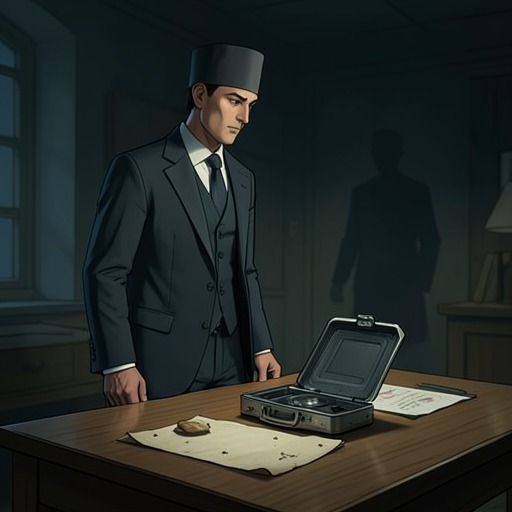
Kay ScarpettaMorales’s GPS surveillance and implantation of Oscar is the technological and investigative breakthrough that transforms Oscar from a seemingly delusional suspect into a monitored victim. What first appears to be paranoid fear—his suspicion that unseen forces track and manipulate him—proves to have a material basis: Morales follows him, places surveillance equipment around Terri’s apartment, and arranges for a GPS microchip to be implanted in his body. The revelation also connects the monitoring to the murders, the forged correspondence sent under Scarpetta’s identity, and the hidden recordings that expose Morales as the killer.
Oscar’s Fears Become Evidence
Morales initially presents Oscar’s surveillance as police protection. He tells Marino that he has installed a wireless camera beneath the roof structure in case Oscar returns to Terri’s apartment, invoking the familiar investigative idea that a perpetrator may revisit the scene. He claims to be leaving open the possibility that someone other than Oscar might appear, but he simultaneously insists that Oscar probably committed the two earlier murders as well. The camera therefore occupies an unstable position between legitimate observation and private fixation: it is described as a safeguard against Oscar while also functioning as an instrument for watching him and the apartment.
Oscar’s defensive habits had already made him look irrational. He carries plastic shielding attached to the back of his mobile phone and in the rear pocket of his jeans, keeps an antenna fixed magnetically to his car’s trunk, and uses a TriField Meter to detect electromagnetic fields in the extremely low- and very low-frequency ranges. Morales says such devices should deflect radiation; Benton explains that the meter is intended to detect whether someone is being watched electronically. These objects make Oscar appear to be constructing an elaborate private theory of persecution. The later discovery that Morales is actually monitoring him reverses the apparent diagnosis: Oscar’s interpretation of his environment is distorted by fear, but it is not wholly baseless.
The Rooftop Camera and the Digital Trail
The surveillance operation is exposed when Lucy investigates the camera on the roof of Terri’s building. She first tells Marino that the device has probably been removed, not installed, and that Morales may have been caught pretending to set it up. She then discovers that the camera has been in place for three weeks. It is motion-sensitive and automatically sends an email whenever it records activity, directing the material to an account that is itself about to be broken into. The scale of the monitoring is substantial: Lucy reports that the camera has sent more than ten thousand emails during that period and that Morales is viewing them in real time.
Lucy’s discovery links the device to Morales through the infrastructure of access rather than through a confession. She has his IP address and access code, and the code is identical to the one associated with the scarpetta612 account. That same access trail connects the camera to the messages sent to Terri while impersonating Scarpetta and to the photograph sent from the internet cafe near Dr. Elizabeth Stuart’s practice. The camera is thus not an isolated surveillance measure. It belongs to a coordinated digital system in which wireless networks, disposable or anonymous accounts, stolen credentials, and remotely transmitted images allow Morales to observe others while concealing his own identity.
The wireless network intensifies the sense of an environment without private boundaries. Lucy logs into the network serving all the apartments and says that it reaches the servers, meaning that anyone connected to it can see everything. The apartment building becomes a technological panopticon: residents occupy separate domestic spaces, yet their communications and devices can be penetrated through shared infrastructure. Morales’s camera watches the physical building, while the network exposes the digital activity passing through it. The distinction between public investigation and private intrusion consequently collapses.
Impersonation, Images, and Murder
The same access code provides the decisive connection between Morales’s surveillance and the campaign conducted under Terri’s name and Scarpetta’s identity. Lucy concludes that the person who installed the camera and receives its emails is the same person who sent messages to Terri while pretending to be Scarpetta. The impersonator apparently used a handheld computer while standing outside John Jay College of Criminal Justice and hijacking its wireless network, which explains why the IP address points to that building. The forged communication is therefore not merely a literary or reputational attack; it is part of a carefully engineered method of hiding the sender’s physical location.
Lucy also traces Morales to the image that Terri was ordered to delete on 3 December. She reasons that Morales arranged for the photograph to be made, probably while he was in the mortuary, and that he similarly arranged for the photograph of Jaime at Tavern on the Green to be sent to Gotham Gotcha. His actions turn images into instruments of coercion and manipulation. He does not simply collect evidence after crimes have occurred. He stages, transmits, and weaponizes visual material, using the circulation of photographs to make other people participate in a narrative he controls.
The hidden files make the connection still more direct. Lucy finds video files in Mike Morales’s personal email account, whose username is Forenxxx. One recording shows New Year’s Eve inside Terri’s apartment rather than on the roof. Its existence demonstrates that Morales’s interest in Terri was not limited to watching the exterior of a suspected crime scene. He had access to the apartment itself and recorded events within it. The discovery changes the meaning of the surveillance: the camera is part of a pattern of intrusion that includes private video capture, identity theft, and the manipulation of murder-related evidence.
The Implantation and Its Consequences
The GPS element is revealed through the physical examination of Oscar. Scarpetta explains that Oscar would never knowingly consent to an implant and that he had complained about painful treatments, including laser hair removal. Because his body is hairless almost everywhere except his face, head, and pubic region, he may have been vulnerable during treatment. If someone entered wearing surgical clothing and a mask while Oscar lay face down, he might not have seen the person and might not later have recognized the attacker. Morales could therefore have encountered Oscar in Terri’s apartment after the murder without Oscar realizing that the detective was also one of Dr. Stuart’s assistants.
The proposed device is small enough to disappear into ordinary bodily experience. Scarpetta describes wireless GPS chips sealed in glass capsules with miniature antennas, functioning for about three months and measuring approximately the size of a grain of rice or smaller. If implanted in Oscar’s buttock, the chip might initially cause no noticeable sensation, especially if it shifted and became embedded in the tissue. An X-ray could locate it, but only if Oscar were found and examined. The technology gives Morales a means of following Oscar while preserving the appearance that Oscar’s movements are inexplicable or self-directed.
The eventual outcome confirms the implantation. Oscar contacts the Federal Bureau of Investigation, and a GPS microchip is removed from his left buttock. He is recovering and receiving therapy in the Pavilion, the private psychiatric unit of McLean Hospital, where he can feel safe until he becomes fully well. His location and treatment carry an important reversal: the institution that might have been used to dismiss his fears becomes a place of protection after the physical source of those fears has been identified and removed. Scarpetta and Benton plan to return to Belmont, while Oscar remains under care rather than being treated as the murderer Morales tried to make him appear to be.
Narrative Significance
The operation makes surveillance the book’s central mechanism of misdirection. Oscar’s plastic shields, antenna, and electromagnetic detector seem to mark him as a man trapped in persecutory delusion, while Morales appears to be the rational professional observing a dangerous suspect. Once the camera, access code, hidden recordings, and implanted chip are connected, that arrangement is inverted. The apparent observer is revealed as the perpetrator, and the apparent object of investigation is revealed as a target.
The event also gives technological form to the novel’s recurring concern with unstable identity. Anonymous usernames allow one person to become a crowd of aliases; the scarpetta612 account lets Morales speak in Scarpetta’s name; the Forenxxx account stores his private recordings; and the GPS chip converts Oscar’s body into a trackable signal. Identity is no longer confined to a face, a signature, or a professional role. It is distributed across passwords, IP addresses, images, databases, wireless networks, and flesh.
Most importantly, the implantation makes the body itself an involuntary communication device. Oscar’s movement supplies data to an unseen watcher without his knowledge, while his own attempts to protect himself are interpreted by others as proof of madness. The eventual removal of the chip does not erase the damage caused by the surveillance, but it restores the possibility that his perceptions can be assessed without being automatically discredited. Morales’s system depends on making reality look like paranoia; its exposure shows that the most dangerous technology in the case is not merely the GPS device, but the power to control what others believe about the person being tracked.