New York City Animal Abuse Special Task Force
Kay ScarpettaThe New York City Animal Cruelty Task Force is Jaime Berger’s newly established prosecutorial initiative against animal cruelty, created to confront a pet-trade system in which puppies and other animals can be treated as merchandise, inventory, or disposable risk. Its first major case, the prosecution of Jake Loudin, demonstrates both the task force’s ambition and the limits imposed by proof, procedure, and the commercial normalization of animal death.
Formation and Mandate
The task force is associated with Jaime Berger, who helped create it after determining that New York residents would no longer tolerate the neglect and killing of animals in pet stores. Its purpose is not merely to respond to spectacular cruelty after the fact, but to pursue businesses that fail to provide basic care: medical attention, warm and clean cages, sufficient food, and water. Berger’s stated objective is to place violators behind bars, giving the initiative a punitive legal mission as well as an animal-protection mandate.
The organization’s work is framed by a conflict between formal responsibility and informal commercial practice. Berger explains that some stores routinely have dogs, cats, and other animals euthanized when they cannot be sold or have become commercial liabilities. A puppy that is sick or three or four months old is no longer the appealing “cute little animal” displayed in a window, and the economic logic of the store can turn its diminished market value into a justification for killing it. The task force therefore challenges a system in which the language of routine disposal conceals a chain of decisions about which lives remain profitable.
The Jake Loudin Prosecution
The task force led an October raid on one of Jake Loudin’s Bronx pet stores. Prosecutors brought eight counts of aggravated cruelty to animals against Loudin, a Missouri businessman whom animal-rights activists called the “puppy Pol Pot.” The comparison connected the pet-store owner’s alleged treatment of animals with mass violence, making the case part of a larger moral indictment rather than an isolated licensing or husbandry dispute.
The evidence included eight dead animals found in the store’s freezer. Yet the case turned on a precise forensic and legal gap: prosecutors could not prove that the eight animals, puppies between three and six months old, had been placed in the freezer alive. The prosecution also failed, in the judge’s view, to establish sufficiently that the police had shown the absence of justification for euthanizing the animals. The maximum sentence for the eight charges could have amounted to sixteen years in prison, but the evidentiary weakness prevented the task force from converting the disturbing discovery into a conviction.
By December, the eight charges had been withdrawn and Loudin had been acquitted. The result does not erase the conditions that prompted the raid; instead, it reveals how the task force’s moral certainty encounters the courtroom’s demand for demonstrable facts about timing, intent, procedure, and cause of death. The animals’ presence in the freezer was concrete, but the legally decisive question was what had happened immediately before they were placed there.
The Pet-Trade Network and Hidden Cruelty
The Loudin investigation becomes important beyond its own case because the pet store is connected to other forms of exploitation. Elizabeth Stuart describes an employee who worked full-time in her large veterinary practice and also appeared to be involved with a pet store. He had given puppies to members of her staff and once offered her a young Chinese dog that was nearly hairless except for its head, tail, and legs. The puppy looked malformed, trembled, and coughed; Stuart returned it and regarded the episode as deeply disturbing. Her account suggests a commercial network in which veterinary labor, pet retail, defective animals, and questionable transfers overlap without transparent accountability.
The task force’s investigation also reaches the animals entrusted to Terri Bridges. Terri gave Shrew a tiny puppy named Ivy after a boyfriend had unsuccessfully tried to return the animal to the store. Ivy was no larger than a small flashlight, appeared nearly lifeless, and was already understood to be unlikely to survive. The puppy moved only after Shrew lifted it and held it against her, pressing its muzzle into Shrew’s neck; the name Ivy arose from the animal’s clinging attachment. This episode gives the task force’s abstract concern with inadequate care a personal and bodily dimension: a supposedly marketable gift arrives as a fragile, failing life that has already passed through a chain of attempted disposal.
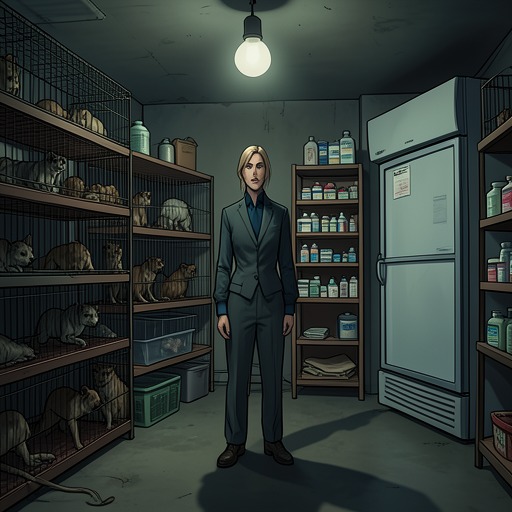
A darker discovery follows in a pet-store basement. Shrew enters a dim storage area that smells of disease, excrement, and urine, with cages lined by filthy paper scraps. On a wooden table are glass tubes, hypodermic needles, red hazardous-waste bags, and heavy black rubber gloves. An open freezer room contains two people, including a man in a dark suit and black cowboy hat and a woman in a long gray coat, apparently handling something Shrew finds horrifying. The scene connects the task force’s animal-cruelty concerns to concealed medical or killing practices and to the wider criminal investigation surrounding Mike Morales.
Consequences and Investigative Significance
Although Loudin has escaped conviction, Berger considers him a possible gateway to Morales. The investigators suspect that Loudin may have known Mike Morales, may have arranged for unsalable pets to be killed, or may have paid Morales to add further suffering to an already abusive system. Berger also considers whether Eva Peebles entered the basement at the wrong moment and became an inconvenient witness, giving Morales an opportunity to turn an animal-related setting into a site of human murder. The task force thus becomes an institutional bridge between commercial animal abuse and the serial killer investigation.
The organization’s significance lies in that bridge. It treats the neglected puppy, the frozen animals, and the basement apparatus as connected evidence rather than as unrelated misfortunes. At the same time, the withdrawn charges expose the danger of relying on moral outrage without a complete evidentiary chain. The task force confronts a culture that converts living creatures into inventory and waste, but its effectiveness depends on proving exactly how that conversion occurred, who authorized it, and whether the law can recognize the animals’ deaths as crimes rather than as failed transactions.