Online Identity and Multiple Avatars
Kay ScarpettaOnline identities and multiple avatars are not merely a feature of internet culture in the novel; they are a practical system through which people work, hide, impersonate others, manipulate reputations, and become discoverable. A username can function as a mask, a job title, a private refuge, or a false evidentiary trail. Yet the masks are never entirely weightless. Accounts carry patterns of use, payment, language, device access, and association, so the apparent freedom of anonymity repeatedly becomes another form of exposure.
Usernames as Masks and Extensions of the Self
Shrew’s username is the most intimate example of an online alias. Her husband often called her “Shrew,” sometimes as an insult and sometimes as a pet name, and the name therefore carries the residue of their marriage into her digital life. The account is not an arbitrary disguise but a private identity assembled from a relationship that has ended: her husband once went out to run an errand and never returned, leaving the name behind as one of the few surviving signs of their shared domestic world.
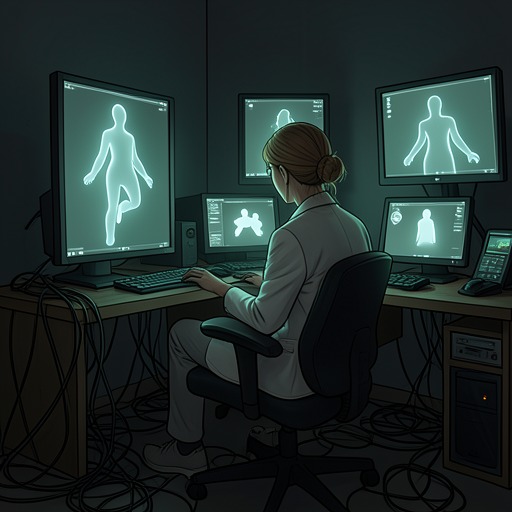
Shrew’s online identity also conceals a precarious economic reality. She was recruited by telephone by an alleged English “agent” for an anonymous employer associated with Gotham Gotcha, after her previous work as a database marketing manager made her seem technically suitable. The recruitment demanded confidentiality and legal signatures she was not allowed to have reviewed by her lawyer. After an unpaid trial month, she received no praise or formal confirmation, yet money continued to arrive in her bank account every two weeks. No taxes were withheld, and she received no compensation for equipment, illness, holidays, or overtime, although she was expected to remain available twenty-four hours a day. Her alias thus protects not only the website’s public anonymity but also an employment arrangement in which the worker is real, indispensable, and deliberately unrecognized.
The asymmetry troubles Shrew increasingly. The invisible employer, whom she compares with God because neither has a visible face or known name, controls her schedule, social isolation, and sense of purpose while taking credit for work she performs. She selects and processes the thousands of gossip messages, photographs, hostile remarks, and fabricated fan comments that keep the site supplied. After Terri Bridges is killed and Pete Marino visits her, Shrew begins to see that the anonymity she accepted as an honor has also surrendered authority over her life. The digital persona is therefore both a chosen identity and an instrument of dependency.
One Person as a Crowd
Lucy Farinelli explains that the proliferation of online accounts can turn a single individual into what she calls a one-person crowd. Terri Bridges had eighteen usernames, each assigned to a particular activity: opinion polls, blogs, chat rooms, consumer information, online publications, and news sites. Because the services were free and required no credit card or identifying personal information, the accounts were difficult to trace. The same person could appear in several digital communities under different names, arguing, purchasing, subscribing, or commenting without presenting a stable public identity.
Lucy nevertheless distinguishes concealment from complete disappearance. In most cases, she says, one alias corresponds to the person’s ordinary correspondence and therefore offers a route back to the actual individual. Oscar Bane’s familiar account name is “carbane,” a simple combination of his first name and surname. Terri’s personal account is “lunasee,” a name whose sound prompts Jaime Berger to notice its proximity to “lunacy.” The choice gives the account a psychological and historical charge: an apparently playful or personal username can also suggest how its owner wishes to be read, misunderstood, or remembered.
This system makes identity modular. Different accounts permit different forms of conduct, but they also create a network of repeated habits and connections. The alias designed for anonymity may share an internet provider, a device, a schedule, a vocabulary, or a financial pathway with other accounts. What appears to be a collection of independent voices can consequently become a map of one person’s activities. The crowd is both a shield and a pattern.
Impersonation and Digital Evidence
The most consequential abuse of online identity is the creation of “scarpetta612,” an account used to exchange messages with Terri while pretending to be Kay Scarpetta. The number six-twelve corresponds to Scarpetta’s birthday, making the impersonation more convincing to someone who knew personal details about her. The deleted messages were sent from an IP address associated with John Jay College of Criminal Justice. They were not simply Terri’s ordinary correspondence: someone had adopted Scarpetta’s name and voice, and the account did not appear in the history of Terri’s laptop as an account she had created or used.
The technical record complicates the first assumption that Terri herself must have manufactured the correspondence. Lucy notes that the messages were removed only a few hours before Terri’s murder and before Oscar was expected to arrive for dinner. Their presence in the trash, rather than their complete destruction, leaves open the possibility that someone wanted them hidden without understanding how easily deleted files could be recovered. The uncertainty over who deleted them, and why, turns online identity into a material crime-scene problem. A false name is not only a matter of rhetoric; it is attached to timestamps, devices, addresses, and recoverable data.
The impersonation also reshapes the relationship between Scarpetta and Terri. Terri’s communications with a supposed relative could be read as evidence of deception, but the discovery of the account raises the possibility that she was being manipulated or framed. Digital correspondence becomes a contested object whose meaning depends on authentication. The question is not merely what a message says, but who created the account, who accessed it, from which location, and who benefited from making it appear genuine.
Anonymous Platforms, Money, and Investigation
Gotham Gotcha extends the problem from individual aliases to institutional anonymity. The columnist’s IP address is concealed, while the internet-provider account is registered to an LLC based on the Isle of Man. Lucy emphasizes that offshore jurisdictions can make it exceptionally difficult to identify the beneficial owners of companies or trusts. The platform’s public voice is therefore supported by a corporate structure designed to keep the person behind it out of reach.
The financial network provides another route toward identity. Eva Peebles had apparently received money from England on behalf of Gotham Gotcha, and investigators pursue her bank records to determine who sent it. The platform may also generate substantial income through products connected with its name, with commissions held in protected accounts. Lucy reasons that anyone trying to evade taxes must still rent or own property, pay bills, or employ someone somewhere in the city. Privacy protection can delay discovery, but ordinary economic necessities leave physical traces.
The same logic applies to the apartment above Terri Bridges. A tax inquiry identifies the unit as rented by Cesare Ingicco, an Italian financial figure whose company is based on the Isle of Man. The rent is paid by an offshore firm, and investigators suspect that Ingicco does not actually live there. The unresolved difference between the named tenant, the person using the apartment, and the company paying for it shows how multiple identities can be distributed across legal, financial, and physical layers. The anonymous platform is not disembodied; it is embedded in intermediaries.
Lucy’s analysis also uses language rather than money alone. After examining roughly fifty stored columns, she concludes that Mike Morales is unlikely to be the writer or owner of Gotham Gotcha. The work would require too much sustained effort for his apparent pattern of acting quickly and leaving, and the linguistic evidence does not support attributing the columns to him. The conclusion illustrates the novel’s broader method: identity is reconstructed by combining behavior, technical traces, financial arrangements, and style rather than accepting a name attached to a file or account.
The Cost of Multiplicity
The novel treats multiple online identities as both an enabling technology and a moral hazard. They allow Shrew to perform invisible labor, permit Terri to participate in numerous communities, and give unknown operators room to publish, pay, and communicate behind legal shields. They also make it possible to impersonate Scarpetta, distort the interpretation of Terri’s correspondence, and conceal relationships among the platform, its workers, and its victims.
Yet multiplicity never produces unlimited freedom. Shrew’s supposedly anonymous employment leaves her isolated and controlled. Terri’s many accounts create a dense but dangerous record. The forged Scarpetta correspondence becomes incriminating precisely because it can be examined as data. Gotham Gotcha’s offshore structure delays identification but invites scrutiny of its payments, tenants, employees, and corporate links. Online identity is therefore presented as a paradox: the more successfully a person separates the avatars, the more investigators must trace the connections among them. The digital self can multiply, but the consequences remain attached to a living body, a bank account, a workplace, or a crime scene.