Oscar Bane
Kay ScarpettaOscar Bane is a central figure in the investigation because his apparent vulnerability conceals a carefully staged account of violence. He is presented first as a frightened, shackled patient and later as someone who has manufactured at least part of his own evidence, while his online identity and connections draw the investigators toward the larger conspiracy surrounding Terri Bridges, Kay Scarpetta, and Mike Morales.
Identity and Physical Presentation
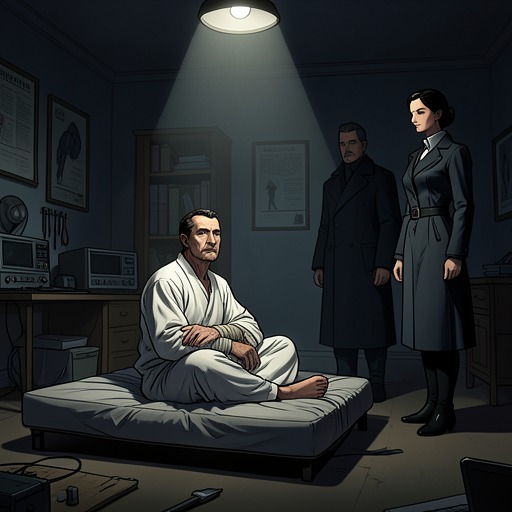
Oscar is thirty-four years old, with the middle name Lawrence, and is right-handed. Kay Scarpetta encounters him in the psychiatric section of a prison ward, seated on an examination table with his hairless, shackled legs hanging over the edge. One eye is blue and the other green, an asymmetry that makes Scarpetta feel as if two people are watching her. He has cried and appears afraid rather than aggressive; the thin hospital gown, the softly clinking restraints, and his embarrassed efforts to cover himself make his first presentation one of exposed dependence rather than power.
Scarpetta suspects that Oscar has achondroplasia, a spontaneous mutation affecting bone formation and especially the long bones of the arms and legs. His head and torso are large in relation to his limbs, his fingers are short and thick, and the separation between his middle and ring fingers gives his hands a trident-like appearance. His arms measure 40.3 centimeters on the left and 40.6 on the right. His legs are only five centimeters longer than his arms and are somewhat bowed. The examination also establishes that, apart from the consequences of ordeals he voluntarily underwent for money, he is anatomically normal. The narrative therefore gives his bodily difference precise physical detail while refusing to make it a sufficient explanation for his conduct.
Accusation, Resentment, and the Examination
Oscar deliberately demands Scarpetta’s presence before he will cooperate. He wants Jaime Berger to know that he will not submit to examination until Scarpetta arrives, and he treats Berger with open hostility. When Scarpetta verifies his identifying information, he interrupts to ask why she has not asked why he insisted on her specifically. His answer is that Berger is responsible for Terri Bridges no longer being alive. The accusation connects Oscar’s personal grievance to the murder investigation and reveals that his attachment to Scarpetta is inseparable from his hatred of Berger.
His behavior during the examination is sexually intrusive and unsettling. While Scarpetta studies his broad, hairless chest and measures superficial scratches, Oscar keeps his bound wrists over his groin; his blue-green eyes seem, from Scarpetta’s perspective, to reach toward what lies beneath her laboratory coat. He asks whether women are afraid to work in the ward and whether she is afraid. The combination of fear, erotic provocation, resentment, and physical restraint makes his presentation internally divided: he seeks protection from Scarpetta while attempting to control the emotional terms of the encounter.
The Staged Evidence and the Digital Self
Scarpetta eventually concludes that Oscar may have inflicted the scratches and bruises himself. The injuries are positioned where they would be if he had created them, and he can reach every relevant area. When she tells him that the police laboratory can study the impressions under a microscope and that she already has the information she needs, Oscar remains silent. Her challenge undermines the idea of a perfect crime by treating his body not as transparent testimony but as a scene that can be reconstructed.
Oscar’s identity is equally unstable in the digital realm. Lucy Farinelli identifies his personal email name as “carbane,” a simple construction from the second syllable of Oscar and his surname. She contrasts it with the many disposable accounts that can be opened without a credit card or personal information, creating an anonymous crowd of aliases around a single person. Terri Bridges uses “lunasee,” while Oscar’s “carbane” appears to be the more direct trace of his ordinary identity. These usernames turn correspondence into evidence of self-presentation: anonymity multiplies the possible selves, but one recurring name can still lead investigators back to the person behind them.
The investigation also links Oscar indirectly to disturbing treatment of animals. Dr. Elizabeth Stuart recalls that a man who worked with her practices and a veterinary practice, and who helped care for animals in a pet shop, gave members of her staff puppies. She remembers his attempt to give her a sickly, trembling Chinese dog as a strange and deeply unpleasant encounter, and she returns the puppy. Although the testimony does not by itself establish every detail of Oscar’s conduct, it places him near a network in which animal care, bodily abnormality, and concealed abuse overlap. The abandoned puppy becomes another troubling object in the pattern of appearances that conceal violence.
Links to the Murder Pattern
Mike Morales argues that the killer may have acted before the current case and has located two similar murders outside New York City. He notes that Oscar works for himself, does not have a regular office, owns a car, and possesses ample independent money supplied annually by his family. Because Oscar supports only himself and moves without the ordinary constraints of a workplace, investigators have little idea where he goes or what he does. Morales therefore treats Oscar’s mobility and financial independence as practical conditions that could allow him to move between jurisdictions and leave older crimes unconnected.
Oscar’s importance expands further when Lucy Farinelli discovers video files in Mike Morales’s personal email account. Morales uses the username “Forenxxx,” and one recording, made by a device other than the rooftop camera, shows Terri’s apartment on New Year’s Eve. The discovery shifts the investigation from speculation about isolated murders and suspicious identities toward recorded evidence of surveillance and direct access. Oscar’s digital presence, the fabricated injuries, and his insistence on controlling who examines him all become part of a wider system in which the apparent victim and the hidden observer cannot be separated easily.
Recovery and Narrative Significance
By the later account, Oscar has contacted the Federal Bureau of Investigation, and his condition is described as improving. A GPS microchip has been removed from his left buttock, after which he rests in the Pavilion, the private psychiatric unit of McLean Hospital. He is receiving therapy and is temporarily secure there until he becomes fully well; Scarpetta and Benton Wesley plan to return to Belmont the following morning. His recovery does not erase the suspicion attached to his injuries or the questions raised by his aliases, but it changes the immediate narrative emphasis from exposure to protection.
Oscar consequently occupies an unstable moral and narrative position. He is small, frightened, restrained, and in need of psychiatric care, yet he is also capable of sexual intimidation, hostile accusation, digital concealment, and self-inflicted evidence. The plot repeatedly makes identity a matter of performance and verification: a body can appear attacked, an email can appear to come from Scarpetta, and a username can either hide a person or point toward him. Oscar’s decisive function is to force the investigators to test every surface claim against material facts, turning his body, his communications, and his dependence on institutional protection into evidence rather than accepting any of them at face value.