Puppy
Kay ScarpettaPuppies occupy a deceptively tender but structurally important place in the novel. They appear as sick gifts, frightened inhabitants of commercial cages, disposable casualties of an illicit animal business, and clues that connect apparently separate human crimes. Through them, the narrative traces a continuum in which living creatures are treated as commodities, burdens, evidence, or instruments of emotional harm, while their suffering becomes a route toward uncovering violence against people.
Vulnerability and Emotional Attachment
A puppy named Ivy first enters the story through Shrew’s recollection of Terri Bridges. Terri brought the animal to Shrew after a woman across the street had given it to her and she could not keep it. Ivy was no larger than a small flashlight, lay so still that Shrew initially thought it was dead, and moved only when Shrew lifted it and held it against her. The puppy pressed its muzzle into Shrew’s neck, and Shrew named it Ivy because it clung to her like ivy. The detail gives the animal a distinct physical presence rather than reducing it to a plot token: its weakness, desperate contact, and dependence establish the attachment that makes its later death devastating.
Ivy died of parvovirus less than a week later, around Thanksgiving. Shrew spent those days crying while holding the puppy and trying to make it drink water or eat, but by the time she reached a veterinarian it was too late. The death also reveals Terri’s cruelty. Terri knew that Ivy was gravely ill and dying when she handed it over, exploiting Shrew’s tenderness toward dogs. Marino identifies the gift as deliberate emotional violence: Terri, who feared bacteria, dirt, illness, and death, would have understood exactly how distressing a dying puppy would be. The puppy therefore functions simultaneously as a suffering animal and as the means by which Terri tested, manipulated, and hurt another person.
The Pet-Shop Network
The investigation widens from Ivy’s death to the pet shops through which vulnerable animals circulate. Shrew had read a flattering description of the Heartthieves chain, presenting its stores as exceptionally clean establishments where white-coated staff supplied nutritious food, medical care, and affection. The shops supposedly remained open every day from morning until evening, kept heating or air-conditioning running overnight, and played music so puppies would not be left alone. After Ivy died, Shrew researched the needs of young dogs and understood the importance of hydration, warmth, and companionship.
When she visits the Lexington Avenue store, the physical setting contradicts that publicity. The window is dirty and littered with newspaper scraps; the plastic fire hydrant in the display leans dangerously; no puppy is visible; and the shop stands between a secondhand store and a music shop holding a closing sale. Although a sign says the store is closed, its lights are on, a large bag of ribs sits on the counter, and a black Cadillac waits outside with its engine running. Inside, puppies bark, kittens sleep on wood shavings, and fish move slowly in aquariums. The animals are arranged as merchandise behind a counter running along three walls, while cages rise almost to a water-stained ceiling. Shrew deliberately avoids eye contact because she knows she would want to take every suffering animal home, even though she cannot save them all.
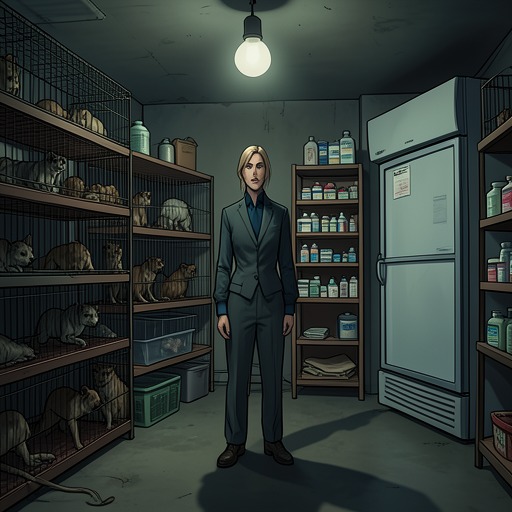
The basement strips away the store’s retail surface. It smells of disease, excrement, and urine; cages contain filthy paper; and a table holds glass tubes, injection needles, hazardous-waste bags, and heavy black rubber gloves. In front of an open freezer, Shrew sees a man in a dark suit and black cowboy hat with a woman in a long gray coat. The woman runs when she notices Shrew, while the man tries to reassure her that dead animals from contagious disease must be dealt with quickly and temporarily removed so the others will not become ill. Six empty cages, the medical equipment, and the freezer make that explanation visibly suspect. Shrew responds that some of the animals were still moving, turning the question of disposal into direct evidence of living puppies being treated as waste.
From Cruelty to Criminal Evidence
The store’s owner is Jake Loudin, a Missouri businessman whom animal-rights activists call the “puppy Pol Pot.” After an October raid on one of his Bronx shops, Loudin was charged with eight counts of aggravated cruelty to animals, but the charges were withdrawn in December. The dead animals found in the store’s freezer were puppies between three and six months old. Prosecutors could not prove that the eight had been placed there alive, and the court found that police had not sufficiently established the absence of justification for euthanizing them. The legal failure is significant: the visible horror of the freezer does not automatically become admissible proof of how each animal died.
That evidentiary gap also explains why the puppies matter to the human investigation. Jaime Berger’s newly formed animal-cruelty task force had entered Loudin’s store, and the shop’s basement became a possible meeting point between Loudin and Mike Morales, who may have used the identity Juan Amate. Berger considers the possibility that Loudin disposed of pets he could not sell through Morales, or paid Morales to handle them. When Eva Peebles happened to enter the basement at the wrong moment, her presence may have made her a dangerous witness. The puppy trade thus supplies not merely background criminality but the setting and practical mechanism through which human murder could be arranged.
The same network reaches back to Terri. Shrew’s account suggests that Ivy came through a chain of transfers involving a woman, Terri, a boyfriend who supposedly tried to return the animal, and the pet shop itself. Dr. Elizabeth Stuart later describes a strange veterinary assistant who also had connections to a pet shop and had given puppies to members of her staff. He once offered Stuart a two-month-old Chinese dog with hair only on its head, tail, and paws; the animal looked malformed, trembled, and coughed. Stuart returned it, found the encounter deeply unpleasant, and could only ominously speculate about what happened afterward. The recurring appearance of diseased and visibly compromised puppies makes the commercial system look less like care than selection, circulation, and disposal.
Consequences and Narrative Significance
The puppies’ suffering changes the investigation’s scale. An initial report of animal cruelty, made by a frightened caller after Terri’s death, appears at first to concern only a dead dog. It instead points toward the pet shop, Loudin’s withdrawn charges, the basement’s freezer and instruments, and the relationship between Loudin and Morales. The animals become the material trace that human perpetrators have failed to erase: their bodies, illnesses, cages, and transfer histories preserve the structure of a criminal enterprise.
The novel also places animal vulnerability beside the stigmatization of people with achondroplasia. Public language turns a killing into the sensational label “dwarf murder” and then casts Oscar Bane as a “dwarf monster,” while the investigation shows how quickly categories of victim, suspect, and spectacle can be imposed. The puppies are similarly classified according to human use: a gift, a saleable product, a medical problem, an unwanted remainder, or hazardous waste. In both cases, labeling determines whose suffering is noticed and whose testimony is discounted.
Yet the puppies are not only mirrors of human prejudice. Ivy’s body, Shrew’s grief, the barking animals in the shop, and the discovery that some animals were still alive insist on material vulnerability that cannot be reduced to symbolism. Their dependence generates care, but it also exposes how easily care can be marketed, falsified, or weaponized. By linking a dying puppy in a neighbor’s home to a contaminated basement, a freezer of young bodies, and the suspected murders of Eva Peebles and Terri Bridges, the narrative makes animal welfare part of the central crime pattern rather than a detachable subplot.