Scarpetta’s forensische reconstructie van Terri’s wurging
Kay ScarpettaScarpetta’s forensic reconstruction of Terri’s strangulation is the investigation’s decisive material inquiry into how Terri died and whether Oscar Bane could have killed her. It begins with microscopic fragments and broken bones rather than with a suspect’s story, then turns the bathroom into a measurable mechanism: the injuries show where Terri’s body struck, the furniture supplies the source of the wood, and the proportions of the victim, chair, and accused expose the physical limits of the proposed murder. The reconstruction does not merely offer another theory; it changes the evidentiary balance by making Oscar’s guilt difficult to reconcile with the scene’s mechanics.
From Injuries to a Scene
Scarpetta first examines Terri’s knees and finds that both kneecaps have been broken into several pieces. The pattern resembles the impact injuries of a car crash, in which the knees strike a dashboard, but the context points elsewhere. The thighs contain deep bruising and ruptured blood vessels extending nearly three centimeters toward the muscles. Scarpetta photographs the injuries with a fifteen-centimeter ruler for scale and records them on body diagrams, converting apparent violence into a set of locations, depths, and trajectories.
The splinters provide the next link. Scarpetta removes fragments from Terri’s knees and the tops of both feet, places them on dry slides, and examines them under a compound microscope at one-hundredfold magnification. She identifies tracheids, the wood’s water-conducting cells, and observes that they have been brutally crushed where the material had been joined with strong adhesive. The fragments are from rough plywood, not from a random external object. That distinction matters because the bathroom contains a specific, concealed source: the rear of the vanity is white-painted plywood, while its unpainted underside and the underside of a drawer could have produced the unpainted splinters embedded in Terri’s body.
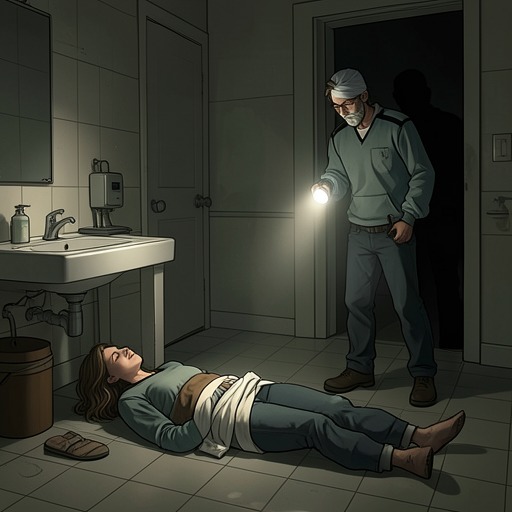
The bathroom photograph supplies the spatial pattern. Terri is shown naked on the floor; behind her are the white marble counter, an oval mirror hanging crooked, perfume bottles, a brush, a comb, and a small gold-colored chair with a heart-shaped back and black satin seat. Scarpetta notices that the marble surfaces of the sink cabinet and dressing table form one connected piece, while the back of the furniture meets the tiled wall as a plywood panel. The sharp, angular edge of the marble counter explains the linear abrasions and deep bruises on Terri’s thighs, while the underside of the furniture offers a source for the wood driven into her knees and feet.
The Proposed Strangulation Sequence
Scarpetta’s reconstruction places Terri on the chair rather than treating the body’s final position on the bathroom floor as the position in which the assault began. She proposes that the attacker forced Terri to sit and made her look at herself in the mirror while strangling her. When Terri fought to break free, she kicked violently. Her legs struck the edge of the vanity, producing the streak-like abrasions and deep thigh bruises; her knees hit the underside with enough force to fracture both kneecaps; and her feet struck the underside of the drawer or adjacent plywood, accounting for the splinters.
Terri’s short legs are central to the reconstruction. Because they could not reach the wall, her frantic kicking would have been directed against the underside of the drawer rather than the tiled surface behind the chair. The violence of the resistance also changes the interpretation of the death. Lester acknowledges that a victim forced to sit before a mirror and struggle so fiercely presents a very different account from a passive or consensual sexual encounter. The physical scene therefore becomes evidence not only of strangulation but of coercion, resistance, and the victim’s attempt to survive.
The clothing supports the timing of the attack. Scarpetta observes that Terri’s wrists were probably bound behind her before the attacker removed her dressing gown and bra: the gown’s sleeves had been cut open from collar to cuffs, and the bra straps had been cut. The cuts suggest that the attacker overpowered her rapidly in a surprise assault, either immediately after she opened the door or as soon as he entered. Scarpetta also distinguishes intended sexual violence from completed intercourse. Smear testing finds no sperm, and DNA-laboratory results are negative, but she insists that the absence of intercourse does not exclude sexual intent or the possibility of an agreed practice involving impact and domination that became fatal. The later video reinforces that distinction: Terri and Mike Morales appear to have had an established sexual relationship involving dominance, yet Terri recognizes that the attack has crossed into something entirely different and lethal.
The Chair Reconstruction and Oscar Bane
Scarpetta later makes the spatial argument visible. She places the chair against the tiled wall, cuts lengths of rope corresponding to the bodies of Terri and Oscar Bane, and fixes them above the seat with blue tape. She asks Jaime Berger to record the measurements while Pete Marino holds the ropes, presenting the demonstration as a simple calculation rather than an impressionistic judgment. Terri’s body measures eighty-four and one-quarter centimeters, approximately thirty-four and one-eighth inches. With the chair seat twenty-one inches above the floor, the seated body reaches roughly fifty-five and one-eighth inches from the floor.
The measurements also require careful treatment of Terri’s achondroplasia. Her limbs are abnormally short, but her head and torso are approximately the size of those of an average adult, making her body appear disproportionately large. Scarpetta notes that this bodily configuration affects practical arrangements such as driving, where adapted pedals may be necessary even though a cushion is not. In the reconstruction, Terri’s total body length is therefore not equated with a conventional estimate based simply on limb length; her actual measured proportions determine the geometry of the assault.
Oscar is four feet tall, or forty-eight inches. His arms extend only about sixteen inches from shoulder to fingertips, giving him still less leverage. Scarpetta contrasts this with Benton Wesley’s reach, which is more than eight inches longer; if Benton had stood behind Terri on the chair, he would have risen nearly twenty inches above her and could have pulled sharply upward. Oscar would not have possessed that advantage. The required action was not a single abstract act of choking but repeated, forceful upward-and-backward pulling against a victim nearly as tall as he was, a victim who was resisting with enough strength to damage her knees and feet.
Marino immediately recognizes the implication: even with strong arms, Oscar would have struggled to perform the maneuver repeatedly, particularly if Terri had been allowed to regain consciousness between pulls. Berger accepts Scarpetta’s conclusion that Oscar probably could not have done it. The reconstruction does not claim absolute impossibility, but it converts Oscar’s alleged opportunity into a problem of reach, height, leverage, resistance, and repetition. In forensic terms, that physical mismatch weakens the accusation more powerfully than sympathy for Oscar could have done.
Competing Stories and Consequences
The reconstruction also tests the circumstances of the delayed police call. Scarpetta explains that investigators often encounter late reporting when a killer needs time to remove evidence, when a person who found the body tries to conceal what happened, or when shame, embarrassment, or financial interests interfere. She gives examples of relatives hiding evidence in deaths involving autoerotic asphyxia and of lovers restoring a body because they cannot accept its death. These possibilities frame Oscar’s account as something requiring examination rather than automatic belief, especially because the bathroom’s condition when he arrived could determine whether his story was compatible with the physical evidence.
At the same time, Scarpetta refuses to let the absence of sperm settle the meaning of the encounter. The search for lubricant, possible evidence of oral sex, and biological material in Terri’s stomach or lungs shows an investigation willing to pursue uncomfortable possibilities without treating them as conclusions. Her approach separates sexual intention, consensual practices, assault, and homicide instead of allowing one category to stand in for all the others. That distinction becomes especially important because the public narrative has already attempted to blame Kay Scarpetta for her own sexual assault by Pete Marino, using Marino’s drunkenness and their prior relationship to recast violence as the woman’s responsibility.
The broader emotional stakes remain inseparable from the mechanics. Benton Wesley admits that thinking about Marino gives him homicidal thoughts and that a fresh public reference has made the trauma feel as though it has happened again. He is furious at Marino, but also startled to discover anger directed toward Scarpetta because she was the person harmed. His reaction exposes how trauma can distort judgment even in someone professionally trained to analyze sexual violence. Benton recognizes that the enemy he has studied throughout his professional life has entered his own home, and he cannot easily drive it out.
Marino’s own trajectory supplies a counterpoint. After confronting his fear of suffocation and the knowledge that he had treated the people who loved him, especially Scarpetta, disgracefully, he chose treatment rather than suicide. Six months later, he works for Berger and waits covertly in a parking lot for a glimpse of Scarpetta before accompanying her to a crime scene. He can see her moving in green light, knows every gesture, and yet feels like a ghost because her life has continued without him. The forensic reconstruction thus takes place within a network of damaged relationships in which evidence must resist both physical deception and the self-justifying stories produced by shame, desire, and guilt.
Reassessment of Terri’s Death
The reconstruction’s immediate consequence is a shift away from Oscar as the likely killer and toward the possibility that Terri’s death was staged or misrepresented. Scarpetta’s physical argument complements the later discovery that Terri and Morales had a sexual history but that this encounter exceeded their prior practices. Terri tries to behave as if the assault remains a game even while her hands become numb and she begs to be released; Morales tells her that Oscar’s arrival is her fault. The scene’s language of play therefore conceals a coercive reality that the forensic evidence makes legible through damaged bone, bruised tissue, cut clothing, and embedded plywood.
The investigation ultimately connects Terri’s private violence to her public deception. Terri had written the New Year’s Day columns two days before they were automatically sent after her death, and she deleted more than a hundred emails from the presumed correspondence with Scarpetta shortly before she was killed. Benton believes she erased them because she was conscientious and wanted to destroy evidence linking her to Gotham Gotcha, not because she foresaw her death. Scarpetta offers no final theory beyond the recognition that theories will always exist, but she writes Oscar a long letter on personal stationery, explaining Terri’s family difficulties, her lifelong need for control, and the way hurt people can hurt others while remaining, in essence, good people. That letter places the reconstruction’s hard physical reasoning beside a more difficult act of moral interpretation.
For that reason, Scarpetta’s reconstruction is significant beyond its conclusion about Oscar Bane. It demonstrates how forensic knowledge can restore complexity to a scene flattened by accusation: Terri is neither reduced to a sexual history nor treated as an inert body, Oscar is not convicted by proximity and stereotype, and the investigators’ own trauma is not mistaken for proof. The chair, the mirror, the plywood, the broken kneecaps, and the measurements become a material counter-narrative to victim blaming and premature certainty. The event’s decisive movement is from an apparently plausible story to a physically tested one, and from the authority of suspicion to the discipline of what bodies and rooms can actually show.