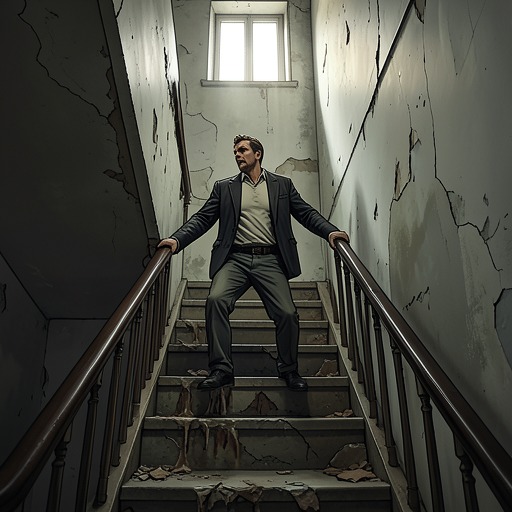
Suicidal ideation
Kay ScarpettaSuicidal ideation is presented not as a single impulsive wish for death but as an unstable psychological state in which guilt, self-loathing, fear, and the need to regain control contend with the possibility of treatment. Its most sustained expression belongs to Pete Marino after he has hurt Kay Scarpetta: he considers death as both punishment and escape, yet his attention to the physical consequences of each method repeatedly exposes the terror beneath the fantasy. The episode ultimately turns away from suicide toward a long stay in treatment, making survival an arduous decision rather than a sentimental resolution.
Definition and Psychological Context
Suicidal ideation emerges within a wider landscape of uncontrolled aggression and remorse. Benton Wesley tells Dr. Thomas that thinking about Pete Marino gives him homicidal impulses, although he insists that he will not act on them. The disclosure is complicated by his sense that an earlier injury has been revived: a recent mention has made the event feel as though it has happened again, or perhaps has only now fully registered. The novel places Marino’s suicidal crisis beside Benton’s violent thoughts, creating a disturbing symmetry between the wish to kill oneself and the wish to kill the person who caused unbearable damage. Neither impulse is treated as a simple declaration of intent; each is a recurrent mental possibility that must be contained, interpreted, and witnessed.
Marino’s altered life supplies the material conditions for this crisis. After leaving Charleston, he has lost fifty pounds and several visible parts of his former identity. He lives alone in Harlem, eating a turkey sandwich dipped in Nathan’s Coney Island mustard and drinking Sharp’s alcohol-free beer while traffic moves along Fifth Avenue. He has sold his motorcycle and pickup truck, traded Harley-Davidson clothing for inexpensive suits, and stopped wearing his diamond stud. His therapist, Nancy, teaches him to understand alcohol as the match that ignites his anger and alcoholism as a fatal inherited disease, linked to a father who returned home drunk and violent on payday. Abstinence therefore removes more than liquor: it leaves Marino face to face with hunger, deprivation, anger, and the stripped-down self that intoxication once concealed.
The Crisis After Harm to Scarpetta
The decisive source of Marino’s suicidal ideation is shame over what he has done to Scarpetta. While secretly watching her through a night-vision scope, he remembers lying in the guest bed at her carriage house the morning after he hurt her. He had wanted not to exist and had reviewed possible ways to die while waves of nausea and the worst headache of his life overwhelmed him. The retrospective structure matters: the crisis is recalled from a later moment, after Marino has survived it, but the memory remains physically immediate. Seeing Scarpetta again makes her seem to have risen from the dead, while he imagines himself as a ghost who can see her without being seen.
His thoughts move through methods with methodical, frightening concreteness. He considers driving his pickup or motorcycle from a bridge, but fears surviving the impact and dreads suffocation. He rejects using a plastic bag, hanging himself, and cutting his throat in the bath because each possibility includes the chance of changing his mind too late. Carbon-monoxide poisoning and poison seem intolerable because they would leave too much time for reflection, and he imagines the humiliation of calling emergency services and having his stomach pumped. The catalogue is not evidence of calm planning so much as a map of competing fears: pain, breathlessness, disability, regret, exposure, and the loss of dignity all obstruct the imagined escape.
The final option is a nine-millimeter pistol, but Scarpetta has hidden it. Even this apparent access to a firearm is transformed into uncertainty, because Marino cannot find the weapon and is too ill to search. He knows that other guns remain in his fishing shack, yet his worst imagined outcome is not immediate death but survival with catastrophic brain damage, perhaps a life of vegetating in an iron lung. The thought of an iron lung is darkly absurd in the conversation that follows, but the humor does not erase the danger; it gives Benton a way to answer Marino without endorsing the fantasy or allowing it to remain sealed inside shame.
Interruption and Choice of Treatment
When Marino confesses these thoughts to Benton during a conversation in a motel near the Boston Bowl Family Fun Center, Benton responds with controlled irony. He points out that fear of an iron lung would matter only if Marino intended to die of polio, while acknowledging that a failed shooting could still leave serious brain damage. The exchange redirects Marino from imagined technique to the fact of his continuing relation to other people. His fear of suffocation returns with the realization that he has treated the people who loved him most disgracefully, especially Scarpetta; yet this recognition does not end in another method.
Instead, Marino decides not to kill himself. He calls the next step the longest vacation he has ever permitted himself and enters a clinic on the north coast of Massachusetts. The decision is conditional rather than triumphant: if the drugs that enhanced his sexual performance and the alcohol disappear from his system, and if he submits willingly to therapy, then employment can follow. Six months later he is in New York working for Jaime Berger, positioned covertly in a parking lot so that he can glimpse Scarpetta before joining her on the way to a crime scene. The movement from a concealed pistol to concealed observation marks a change in the direction of his compulsion. He remains fearful, ashamed, and fixated, but he has chosen continued life and supervised recovery.
Control, Recurrence, and Bodily Fear
The novel repeatedly links Marino’s mental state to gestures of bodily control. In another encounter, he stares anxiously at a pair of forceps and insists that he can remove or manage something himself; the fear in his eyes makes his claim of self-sufficiency unconvincing. His insistence that he will do it himself echoes the larger logic of suicidal ideation: the desire to control the body becomes inseparable from terror that the body may betray, injure, or permanently disable him. His newly developed fear of heights works similarly. He once lacked acrophobia, but after leaving Charleston he becomes terrified while climbing a narrow ladder secured to an old brick building with only a few screws.
On the roof, the bodily panic is interrupted by an unexpected recognition. Marino reaches the top holding a .40 Glock and finds Mike Morales lying prone with a revolver, apparently waiting like a sharpshooter. Morales angrily demands to know what Marino is doing there; Marino replies that he believed Morales was the serial killer. The encounter converts a private fear of falling into an immediate external threat, but it also shows Marino acting within the world rather than retreating into self-destruction. His weapons, his vigilance, and his terror remain dangerous, yet the scene makes survival depend on recognition, timing, and the correction of mistaken assumptions.
Narrative Significance
Suicidal ideation also belongs to the novel’s broader system of delayed knowledge and misleading appearances. Benton’s homicidal confession reveals that forgiveness has not erased injury. Marino’s later recollection reveals that his disappearance after harming Scarpetta was not merely flight but a period in which he seriously contemplated several forms of death. At the same time, the surrounding investigation repeatedly demonstrates that appearances cannot be accepted at face value: a crashed Gotham Gotcha website produces a grotesque inverted image of Rockefeller Center’s Christmas tree in Central Park; an email written but not sent from the scarpetta612 account proves that neither Terri Bridges nor Oscar Bane could have authored it; and physical evidence at Eva Peebles’s murder scene, including shoeprints on the toilet lid and fingerprints on a glass lamp, points toward Oscar.
These investigative reversals provide a formal counterpart to Marino’s crisis. The visible fact of his anger does not reveal its whole history, just as a suspect’s apparent evidence does not settle guilt. His suicidal thoughts initially seem to promise an ending, but their detailed recurrence instead exposes an unresolved struggle among culpability, fear, attachment, and self-preservation. The narrative’s most important change is therefore not that Marino becomes free of destructive impulses. It is that he survives their pressure long enough to enter treatment, accept the possibility of work, and approach Scarpetta from a distance while acknowledging that her life has continued without him. Suicidal ideation becomes the threshold between disappearance and accountability: a state in which death is imagined repeatedly, but recovery begins when the imagination is interrupted and another future is chosen.