Terri Bridges
Kay ScarpettaTerri Bridges is a small person studying forensic psychology whose life becomes the point at which intimate betrayal, online anonymity, and serial violence converge. She is remembered not merely as a murder victim but as a woman divided between a professional ambition, a concealed digital identity, and an increasingly perilous attempt to control how others saw her. Her death exposes the criminal use of impersonated correspondence and helps transform scattered suspicions into a pattern of coercion and murder.
Identity and Background
Terri is described as a small person, a description that matters because the people around her repeatedly treat bodily difference as a conspicuous social fact. She is blond, attractive, and well built, though very short, and her boyfriend is also a small person. A neighbor who received a puppy from her wider circle remembers seeing that boyfriend step from an SUV carrying a long-stemmed yellow rose. The rose’s symbolism becomes part of the neighbor’s emotional account: yellow suggests sensitivity and strength rather than the conventional romance associated with red, and its color nearly matched his hair. The observation presents Terri’s relationship through an outsider’s mixture of tenderness, curiosity, and projection.
Terri was taking a history-of-psychiatry course taught by Oscar Bane and had been one of his students for some time. She wanted to become a forensic psychologist, placing her within the same professional world as the investigators and clinicians who later reconstruct her life. That connection is not incidental. Her academic interest brought her into contact with Oscar as a teacher before their relationship became intimate, creating an ethically forbidden boundary that Oscar himself recognizes but refuses to discuss openly.
Online Identity and Work
Terri’s digital life is built around concealment. She used the personal username “lunasee,” a name that Jaime Berger associates with “lunacy,” an old term for madness. The choice is revealing without being conclusive: it links Terri’s emerging professional identity in forensic psychology to the language of psychiatric history, while also giving her an online persona that can be separated from her ordinary correspondence. Lucy Farinelli identifies “lunasee” as the account from which investigators should begin examining Terri’s emails.
Terri also had access to the anonymous online world surrounding Gotham Gotcha. The site allowed users to create numerous nearly untraceable accounts without credit cards or personal information, making one person capable of appearing as a crowd of aliases in chat rooms and comment spaces. This environment is crucial to Terri’s characterization because anonymity is not merely a technical convenience: it is a means of staging multiple selves, concealing connections, and controlling exposure. The investigation later treats her messages as evidence of a hidden relationship between Terri and Kay Scarpetta, but the correspondence is fabricated rather than genuine.
A phone call that changed Shrew’s life offers the broader mechanism behind this digital world. An Italian-sounding caller, claiming to be an agent for an English cartel, recruited Shrew as a webmaster after finding her name through her former work as a database marketing manager. The proposed job required initiative, independent work from home, technical experience, dramatic flair, and extreme secrecy, with the promise of high earnings. Terri’s role in this network is not fully identical to Shrew’s, but the episode establishes the atmosphere in which hidden operators, invented employers, and theatrical online identities become ordinary instruments of manipulation.
Relationship with Oscar Bane
Terri met Oscar online after having been his student. Their relationship therefore combines intellectual authority, sexual and emotional intimacy, and a serious professional imbalance. Oscar’s own account makes clear that the relationship began while she belonged to his academic sphere, although he says that the subject is not one he will pursue. His defensiveness suggests that Terri’s connection to him cannot be understood simply as a private romance; it is also a breach of the boundary between teacher and student.
The relationship is surrounded by imagery of possession and surveillance. Oscar tells Kay Scarpetta that the spying began when he became involved with Terri, while later evidence shows that Mike Morales kept recordings connected to Terri’s apartment and used the username “Forenxxx.” The violence that reaches Terri is therefore both physically intimate and technologically mediated. Her private spaces are entered through cameras, her correspondence is manipulated, and her identity is made to serve purposes that exceed her control.
Murder and Reconstruction
Terri’s death is described as the first murder in a sequence that also includes a young woman who had moved from a small North Carolina town to Baltimore, found work at a radio station, and hoped to reach television. That earlier victim became vulnerable while trying to obtain anabolic steroids. She was found naked, with her hands bound, strangled with an object that was never recovered, and left in a garbage container near the harbor. No useful DNA was recovered, and there was no evidence of rape. The comparison places Terri within a serial pattern whose violence cannot be reduced to a single sexual motive.
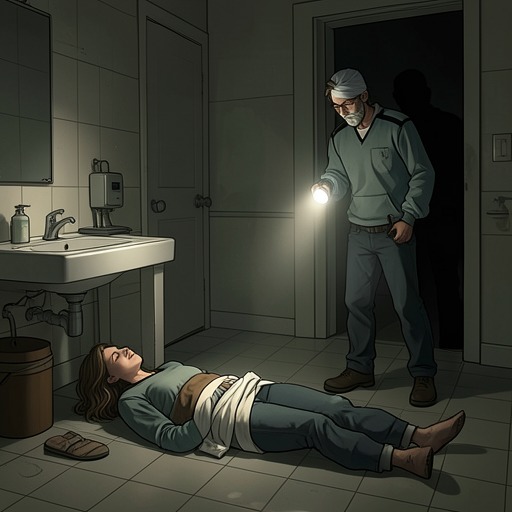
The most direct record of Terri’s murder comes from a video found in Mike Morales’s personal email account. The recording was made on New Year’s Eve, not from the rooftop camera but inside Terri’s apartment. In it, Terri is seen reflected in a bathroom mirror while gloved hands strangle her from behind with a blue tourniquet of the kind used in hospitals for blood draws. She and the killer are naked, her hands are tied behind her back, and she kicks violently at a chair with a heart-shaped back. The attacker nearly lifts her from the chair while strangling her until she loses consciousness, then lowers her and begins again after she regains consciousness. The repetition makes the killing a controlled performance of domination rather than a single impulsive act.
The investigators’ broader forensic reasoning also allows for delayed reporting or altered scenes. Kay Scarpetta notes that police may not be called immediately when a killer needs time to remove evidence, when a body finder attempts to conceal what happened out of shame or embarrassment, or when someone cannot release a loved one’s body and tries to restore it to a normal condition. These possibilities do not erase the violence done to Terri; they explain why the scene’s apparent chronology may not correspond to the moment of death and why investigators must distinguish grief, concealment, sexualized conduct, and deliberate staging.
Correspondence, Erasure, and Narrative Significance
The false emails sent in Scarpetta’s name make Terri both target and participant in an identity crime. A message dated December 28, 2007, shortly before midnight, is addressed from “Scarpetta” to Terri, but Kay states that she did not send it and that the address is not hers. The forged exchange creates the appearance of a relationship between the two women and helps construct defamatory material around Terri and Scarpetta. Its power lies in its documentary surface: dates, sender fields, and recipients imitate proof while concealing the person who manufactured them.
Benton Wesley theorizes that Terri deleted more than one hundred emails from the supposed correspondence because she was conscientious and frightened. In this interpretation, she tried to erase every trace connecting her to Gotham Gotcha and to remove from her life the image of Scarpetta as a fallen heroine. The deletion is therefore simultaneously an act of self-protection and an act that weakens the evidence available to those investigating her death. Terri’s fear turns the management of information into another form of entrapment.
Kay’s later letter to Oscar offers a counterpoint to the punitive logic surrounding Terri. Kay explains that Terri’s family had made life difficult for her and that this history had encouraged her need to control everything. She describes Terri as angry because she felt wounded, while insisting that wounded people often hurt others without becoming wholly bad. This account refuses to divide Terri into either innocent victim or culpable manipulator. Her death remains an atrocity, but the letter preserves the contradiction of a person whose concealment, ambition, and harmful actions coexist with vulnerability and moral complexity.
Terri’s narrative significance ultimately lies in that unstable overlap. Her small stature is observed through other people’s assumptions; her professional aspirations connect her to the science used to interpret her death; her usernames and emails make identity portable; and the video turns the private apartment into a staged crime scene. She is repeatedly represented by others—through a neighbor’s memory, Oscar’s confession, forged messages, digital records, and forensic reconstruction—yet none of those representations fully possesses her. Terri’s story demonstrates how the attempt to control identity in an anonymous technological culture can become evidence against the person who needed concealment most.