Terri Bridges master thesis
Kay ScarpettaTerri Bridges's master's thesis is more than an unfinished academic document: in its recovered fragments, it becomes a forensic object that links her study of criminal knowledge to her fixation on Kay Scarpetta and helps investigators reconsider who Terri was, what she believed, and how her digital archive may relate to her murder.
Subject and Intended Argument
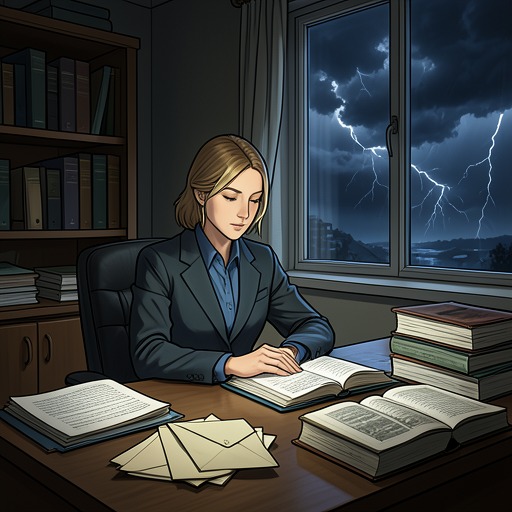
Terri was a student at Gotham College, where her father was the head, and was working toward a master's degree in forensic psychology. The recovered material presents a historical survey of forensic science, medicine, and psychiatry, including references to the Body Farm, Bellevue and Kirby psychiatric hospitals, and prominent forensic experts such as Kay Scarpetta. The subject therefore fits Terri's stated academic identity: she was not merely collecting sensational crime material but attempting to place modern forensic practice within a longer history of medical and investigative ideas.
An email to Jaime Berger gives the project a provisional title, “Forensic Follies,” and describes its central movement as a historical circle. Terri proposed tracing the field from the absurd toward the sublime and back again: from the quackery of phrenology and physiognomy, and from the notion that a victim retains an image of a killer on the retina, to the supposed “magic tricks” presented by modern films and television dramas. The thesis thus appears to examine the unstable boundary between scientific authority, popular fantasy, and the public's appetite for forensic spectacle.
Recovery from the Damaged Laptop
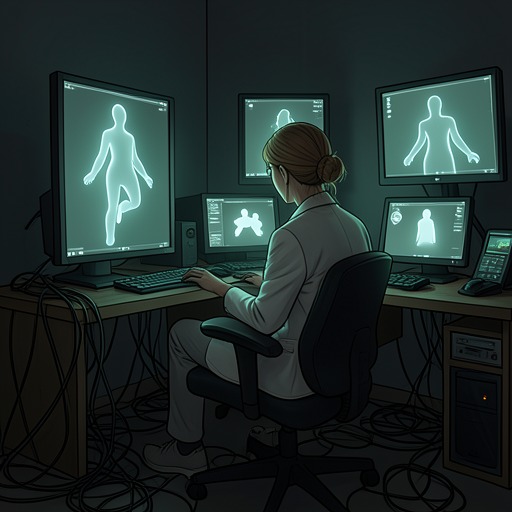
Lucy Farinelli reconstructs the thesis from deleted or corrupted data on Terri's computer. The recovered material does not form a clean manuscript. Large stretches of complete text appear beside fragments of varying lengths, many of them tiny scraps, because later data have occupied the empty portions of the hard drive and made it more difficult for the software to retrieve the original files. The thesis is therefore encountered as a damaged digital body: its gaps are not merely editorial inconveniences but part of the evidence investigators must interpret.
The recovery also supplies a date. A title page belongs to a correction made approximately three weeks earlier, on December 10, while the larger file remains far from completely restored. Lucy turns the recovered material into a text file, and Jaime Berger reads it as Lucy moves through the document. What the investigators see is consequently both an academic work and a technical reconstruction, dependent on the sequence of deletion, overwriting, and retrieval rather than on Terri's original organization alone.
Scarpetta as Academic Subject and Obsession
Kay Scarpetta's name recurs throughout the recovered thesis in different forms and sizes. The repetition makes Scarpetta more than one expert among many: she becomes the document's visual and intellectual center. Lucy finds material headed “SCARPETTA, by Terri Bridges,” and Berger realizes that Terri, or whoever used the laptop, had accumulated hundreds of articles, video clips, photographs, and other publications about Scarpetta.
That archive creates a serious conflict of interest for Berger, who is involved in the investigation and has professional ties to Scarpetta. It also changes the meaning of Terri's research. A thesis ostensibly concerned with the evolution of forensic science has become saturated with one living forensic authority, suggesting that Terri's scholarly interest and personal fixation have become difficult to separate. Berger is tempted to dismiss Terri for several reasons, but the recovered material makes the problem larger than an ordinary professional impropriety: the person under investigation may have been building an entire intellectual and visual world around Scarpetta.
Terri's email makes the intended academic approach explicit. She asks Berger to help her contact Kay Scarpetta because Scarpetta seems the obvious person to consult on the history of forensic science. Terri says that she has already tried several times to reach Scarpetta at her office in Charleston without success and assumes that Berger remains friendly with her. The request initially resembles a plausible research inquiry, yet the accumulation of Scarpetta-related materials gives the earlier correspondence a more intrusive significance.
Evidentiary and Psychological Significance
The thesis becomes central to the theory that Terri was the person using the identity “lunasee.” Berger states that her official opinion is that Terri was lunasee, while acknowledging that the conclusion is not proven, and Lucy agrees that it is plausible. Their uncertainty matters because the thesis does not by itself establish authorship of every email or explain who caused Terri's death. Instead, it supplies a pattern of fixation that must be tested against the digital evidence and the murder investigation.
The document also raises the possibility that Terri genuinely believed the material she possessed came from Kay Scarpetta. Berger says that she thinks Terri believed the Scarpetta material was authentic. That belief would make the thesis an unstable composite: part historical research, part archive of another person's identity, and part record of Terri's attempt to make sense of material she may have regarded as Scarpetta's own words or thoughts.
The investigators later discover that an email was composed in the scarpetta612 account at 8:19 on the evening of Terri's death but was not sent. Because Terri's body was probably already in the morgue by then, Lucy concludes that neither Terri nor Oscar Bane could have written it, and that neither of them could have been the person behind the account. This revelation does not erase the thesis's importance; it separates Terri's demonstrable Scarpetta obsession from the still-unidentified person who used the account and may have been connected to the killing.
The Thesis within the Novel's Pattern of Misreading
Terri's work is surrounded by competing labels and false explanations. Oscar Bane protests that he has been restrained as though he were a serial killer, while the press turns him from a “dwarf killer” into a “dwarf monster”; a woman questioned about Oscar responds with contemptuous language about little people; and posters of Scarpetta eventually cover every wall of an apartment, creating what investigators call a shrine. Against this background, the thesis shows how categories associated with forensic expertise can coexist with spectacle, stigma, and projection.
Its damaged form also echoes the novel's wider concern with incomplete knowledge. A crashed Gotham Gotcha website displays dark buildings, red lightning, and an upside-down Rockefeller Center Christmas tree in Central Park; Marino climbs a narrow ladder expecting disaster before finding Mike Morales on the roof; and Scarpetta's own supposedly repeated statement about the “perfect crime” is revealed as something Oscar has invented or misremembered. The thesis belongs to the same world of broken surfaces and misleading signals. It appears to offer interpretation, but its fragments also require interpretation; it appears to identify an author, but the later email evidence proves that digital identity cannot be assigned from fixation alone.
In that sense, Terri Bridges's master's thesis is both a scholarly artifact and a trap for investigators. It clarifies Terri's education, the historical argument she intended to make, and the extraordinary scale of her attention to Kay Scarpetta. At the same time, its fragments, date, corrupted storage, and uncertain relation to the scarpetta612 account preserve the central mystery: the thesis reveals a powerful motive for identification and imitation without conclusively naming the person who converted that fixation into violence.