Transparent nylon sash
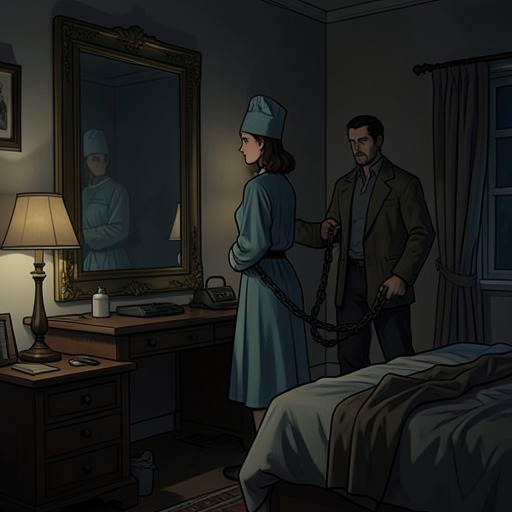
Kay ScarpettaThe transparent nylon cable tie is one of the most important physical objects in the murder investigation. It appears to be a commonplace fastening device, but its material properties distinguish it from a police restraint or consensual bondage equipment. Found around the wrists and ankles of multiple victims, it inflicts characteristic injuries, controls the sequence of the crimes, and helps transform a collection of unsolved deaths into a recognizable pattern.
Appearance and Identification
The tie found in connection with Terri Bridges is colorless and almost transparent, unlike the black, yellow, or white flexible restraints Kay Scarpetta had previously encountered. Photographs showed a strip approximately six millimeters wide and fifty-four centimeters long from its pointed end to its ratchet lock. One side was ribbed, the other smooth, and both edges were sharp. It carried no serial number or manufacturer’s mark, making it impossible to identify its source from the object alone. Its ordinary appearance therefore conceals a significant evidentiary problem: it resembles a flexible handcuff in function, but not in construction.
The distinction matters because a genuine flexible handcuff is designed with rounded edges to reduce injury and is ordinarily associated with law-enforcement or custodial use. Scarpetta explains that the transparent tie is instead a one-way cable tie: once tightened, it cannot simply be loosened or opened with a key. It can only be released by cutting it or forcing a sharp object beneath it. The object thus converts a cheap, easily obtained fastening strip into a potentially lethal restraint.
Injuries and Forensic Significance
The marks on Terri’s wrists were red, dry, deep grooves consistent with something having a sharp edge being pulled very tightly around them. Scarpetta rejects the suggestion that these injuries came from ordinary handcuffs, whose rounded edges would produce a different pattern. The tie had constricted Terri so severely that it impaired circulation and caused pain incompatible with an ordinary consensual sadomasochistic scene. A small cut near her left wrist bone could have resulted when someone forced a knife or another sharp implement beneath the strip to remove it.
The absence of blood elsewhere on Terri’s body further complicates the timing. If the tie had been removed after she was already dead, the wrist cut would have produced little or no bleeding. Scarpetta therefore treats the restraint as evidence of coercion rather than play: it was too painful, too mechanically irreversible, and too damaging to fit the explanation of a mutually controlled sexual encounter. The object records not only that Terri was bound, but also the force and circumstances of the binding.
The same reasoning applies at the scene involving Eva Peebles. Eva’s wrists and ankles were bound with transparent plastic strips, and Scarpetta identifies them as the same kind of tie used on Terri. Her clothing had been cut away only after the restraints were applied, suggesting a deliberate sequence rather than an accidental disrobing. The tie therefore becomes part of the killer’s procedural signature: restraint first, clothing removed afterward, and the victim left in a configuration meant to be read by investigators.
Recurring Pattern Across the Murders
The cable tie connects the newer murders to two earlier cases from the summer of 2003. One victim was a fourteen-year-old boy from Greenwich, Connecticut, who was addicted to anabolic steroids. He was found naked, with his wrists and ankles bound, and strangled with an instrument that was never recovered; his body had been dumped near a Bugatti garage. The other was a beautiful twenty-one-year-old woman who had moved from a small town in North Carolina to Baltimore, where she worked at a radio station and became involved in dangerous efforts to obtain anabolic steroids. She too was found naked, with her hands bound and her body in a harbor-side dumpster. Neither case yielded usable DNA or a suspect.
The repeated restraint is not an isolated technical detail. It appears alongside a repeated form of strangulation, the absence of a recovered ligature, and the selection of victims whose vulnerability could be exploited. The murders occurred in different places and involved different victims, yet the binding method supplies a material continuity that ordinary geography initially obscures. Later, the thin gold ankle chain found on Terri and Eva adds another recurring marker, turning the cable tie into one component of a broader ritualized pattern.
Staging, Misidentification, and Control
At Terri’s apartment, a supposedly disposable flexible restraint lay beside a pair of scissors. The arrangement suggested that the tie had been cut with those scissors, but Scarpetta recognizes that the scene does not support that conclusion. Such a tie cannot ordinarily be severed with a kitchen scissors; a heavy-duty tool such as a Scarab would be required. The scissors may therefore have been placed to imply a false method of release, or the item on the floor may have been presented as something it was not. In either case, the object participates in the staging of the crime rather than merely surviving it.
The discrepancy also works as a test of the investigators’ assumptions. A surface reading treats the tie as a flexible handcuff and the scissors as the instrument that freed the victim. Close examination reverses that interpretation: the restraint’s color, edges, locking mechanism, and the physical demands of cutting it all point away from the apparent story. Its materiality becomes visible precisely because the staged explanation fails. What looks like a disposable prop instead exposes the scene’s artificial construction.
At Eva’s residence, the same kind of strip helps make the murder legible as a performance. Scarpetta observes that the lamps had been removed and positioned so that the body could be seen clearly. Eva had been suspended by a gold cord, while the transparent ties held her wrists and ankles; the arrangement of the body and the cut-open clothing appeared designed to communicate the order in which the killer acted. The restraint is consequently both practical and theatrical. It immobilizes the victim, preserves the killer’s control, and leaves investigators a deliberately composed image.
Role in Identifying the Killer
The transparent nylon cable tie becomes especially damaging to Oscar Bane because it appears at Eva’s scene in combination with other evidence tied to his account of discovering Terri’s body. Scarpetta fears that the person who killed Eva may also have killed Terri, and the matching restraint strengthens that connection. Later, shoeprints at Eva’s bathroom correspond exactly to the shoes Oscar had been wearing when he claimed to find Terri, while fingerprints on a glass lamp removed from the ceiling also belong to Oscar. The tie is not the sole proof against him, but it helps establish the repeated method that makes the other evidence meaningful.
The broader revelation is that the restraint belongs to a system of repeated acts rather than a single improvised assault. The killer binds victims with an object that can be bought cheaply, tightens it until it wounds them, removes or cuts clothing in a consistent order, and leaves behind additional signs of possession and power. The cable tie’s banality is part of its usefulness: it is accessible, unmarked, and easy to carry, yet once tightened it creates injuries that preserve the violence in the body.
Narrative Significance
As an object, the transparent nylon cable tie moves from background utility to forensic witness. It has no voice and no identifying inscription, but its dimensions, texture, edges, locking mechanism, and effects on the victims contradict the false explanations arranged around it. Its apparent transparency is therefore ironic: the material is difficult to notice, while the pattern it reveals becomes impossible to ignore.
The object also concentrates the novel’s tension between human intention and material resistance. The killer attempts to control what investigators will believe by placing scissors, arranging lights, and composing bodies, but the tie refuses to cooperate with the fiction. Its one-way mechanism, sharp borders, and distinctive injuries preserve traces of what actually happened. Through that resistance, a cheap fastening device becomes a recurring signature, a link among geographically separated murders, and one of the clearest routes toward the killer’s identity.