Y-12 National Security Complex
Kay ScarpettaY-12 National Security Complex is presented as a highly specialized government installation whose scientific infrastructure is repurposed to investigate Terri Bridges’s murder. Its importance lies in the contrast between its association with the United States nuclear arsenal and its practical role in examining intimate, contaminated, and materially complex evidence that ordinary forensic facilities cannot resolve quickly.
Institutional Identity and Scientific Capacity
Y-12 National Security Complex is described as a facility that produced components for the United States nuclear weapons arsenal and possessed the country’s largest stockpile of enriched uranium. That security-oriented identity initially makes its involvement in Terri Bridges’s case seem startling. Jaime Berger even wonders whether Terri could have had some connection to terrorism, but Kay Scarpetta explains that the installation is being used not because the victim is connected to nuclear weapons, but because it employs engineers, chemists, physicists, and especially materials scientists capable of answering unusual forensic questions.
The installation’s authority therefore rests less on its symbolic connection to national defense than on the transferability of its technical expertise. Scarpetta specifically invokes its Visitec Large Chamber Scanning electron microscope, an instrument unavailable to the investigators locally. The microscope represents the book’s broader understanding of modern evidence: a conclusion is produced through a network of samples, machines, specialists, permissions, transport arrangements, and interpretation rather than by observation alone.
The Shipment from Terri Bridges’s Case
Scarpetta asks that swabs from every bodily opening of Terri Bridges, together with a chair, be flown to the Y-12 National Security Complex in Oak Ridge, Tennessee. The chair matters because the suspected method of strangulation and the distribution of stains cannot be understood from biological samples in isolation; the material setting may reveal how the ligature and the victim’s body were positioned. Scarpetta tells Berger that the requested materials can be examined rapidly once received, although removing oxygen from the chamber will take longer than usual because the petroleum-based lubricant contains substantial moisture.
The plan also shows how the investigation crosses institutional boundaries. Berger must authorize the transfer, Scarpetta relies on contacts at Y-12, and the evidence travels by private jet because the investigators are under pressure for results. The chain of custody is consequently inseparable from urgency: the faster the material moves, the more important it becomes to preserve its identity, condition, and interpretive context.
Dr. Kiselstein’s Preliminary Findings
Dr. Kiselstein contacts Scarpetta after the material arrives safely. His German-accented voice and his account of receiving an unusual specimen shipment from a private jet give the installation a human and procedural dimension, while his references to military cargo, Langley, NASA, defective heat shields, and prototypes place the forensic examination within a much larger technical-security world. He has already obtained preliminary findings, though the official report will take longer.
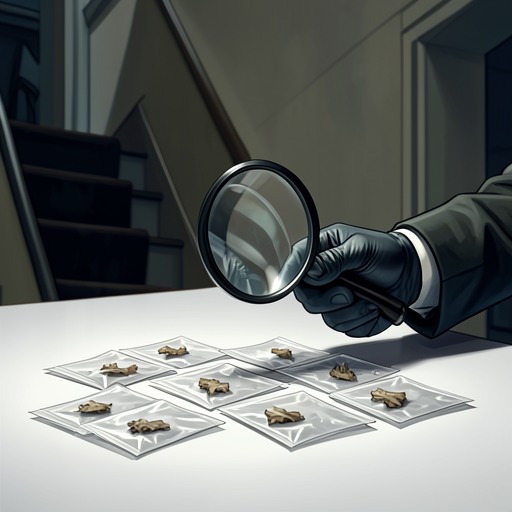
The initial analysis identifies an ointment mixed with blood, possibly sweat, silver salts, and wood and cotton fibers. Dr. Kiselstein specifies silver nitrate and potassium nitrate, along with carbon and oxygen. At magnifications reaching one thousand times, the blood remains visible, while the silver-rich material appears bright because of its high atomic number; silver nitrate also appears in the wood as evenly distributed whitish, silver-rich points. These observations turn an apparently chaotic trace pattern into a material problem that can be described chemically and microscopically.
Relation to the Wider Evidence Network
Y-12 does not replace conventional forensic systems. Earlier testing of Terri Bridges’s vaginal swabs had produced a confusing mixture: no sperm, but DNA from several donors, with one CODIS hit belonging to a woman. Investigators were considering contamination or mistaken labeling and were comparing the samples with autopsy material, building employees, officers present at the crime scene, the medical examiner who attended it, Mike Morales, and the men who transported the body. Y-12 is brought in because such uncertainty requires more than a single database match; it requires a specialized examination of how substances and fibers reached the body and chair.
The organization also stands beside other investigative technologies that remain evidentially limited. Scarpetta discusses transparent flexible restraints, digital material, DNA databases, and wireless GPS chips, while the investigation repeatedly confronts the difference between detecting an object and proving who used it. Even violent videos found in a suspect’s email account do not by themselves establish who recorded them, and digital evidence must be translated for courts that may not understand IP addresses, machine access codes, cookies, or packet sniffing. Y-12’s instruments enlarge what investigators can see, but they do not eliminate the need for inference, authentication, or courtroom explanation.
Narrative and Thematic Significance
Y-12 National Security Complex embodies the novel’s tension between technological power and uncertainty. A facility associated with enriched uranium and weapons production is redirected toward reconstructing a murder through stains, lubricant, fibers, and microscopic residues. The movement is deliberately paradoxical: the same modern system that can engineer weapons, track bodies with rice-grain-sized GPS chips, and process immense databases is still vulnerable to contamination, mislabeling, concealed origins, and misleading interpretation.
Its role also reinforces the investigation’s dependence on collaboration rather than on a solitary detective. Scarpetta identifies the scientific need, Berger supplies institutional authorization, Lucy helps coordinate communications and logistics, and Dr. Kiselstein converts the transferred material into preliminary findings. The installation’s contribution is thus both practical and structural. It makes the case legible at a level ordinary facilities cannot reach, while simultaneously showing that forensic truth emerges only when specialized knowledge is carried across organizational borders and tested against the competing demands of secrecy, speed, evidence preservation, and legal proof.