Alcoholism
Kevin the Star StrikerAlcoholism is a recurring condition shaping Joey’s life rather than a detached background detail. His mother’s drinking makes the family’s home unstable, interrupts her ability to care for him, and repeatedly places Joey in the position of managing adult disorder while trying to remain loyal to her. The narrative contrasts the apparent freedom of living in a van with the insecurity produced by poverty, drinking, and unreliable parental support.
Definition and Family Context
Joey and his mother live in a van because she is poor and out of work. The arrangement is described with a child’s mixed perspective: the van can seem “kind of cool” because it can travel wherever they want, yet Joey cannot afford cleats, lacks a jacket, and sometimes does not even appear for soccer. His mother’s drinking is the central reason given for that unreliability. Joey does not discuss it openly, but the pressure becomes visible when he presses his lips together, a small physical sign that he is carrying pain he cannot or will not explain.
The condition also separates Joey from the material expectations surrounding organized sport. While other players can arrive in proper equipment, Joey’s resources are so limited that ordinary clothing becomes his soccer gear. His brown wool sweater, checkered pants, and worn sandals are not a temporary costume but all he has available. When he worries that this means he cannot play, the problem is not lack of talent; it is the way family poverty and disrupted care turn participation into a privilege. His skill remains extraordinary—when he is “on,” he plays like a magician, as though he had cast a spell on the ball—but the conditions around him make that ability precarious.
Drinking, Neglect, and Interrupted Care
The narrative makes the effects of the drinking concrete through Joey’s absences and his mother’s inability to keep promises. Before an important game, she promises to accompany him, but she does not come home until late at night. She arrives with a strange man, and the two adults drink and sing before beginning to fight. The conflict ends with Joey’s mother throwing the man out of the van and taking Joey in her arms. Her behavior is therefore not reduced to a single emotional category: she is both a source of danger and the person who, in the middle of the disorder, turns toward her son.
That reversal is followed by another promise. As she drives toward the highway, she tells Joey to forget the man and says that she will meet his friends the next day. Joey’s reply makes the practical stakes clear: if she keeps driving, he will leave her rather than abandon his team. His loyalty to the Wild Soccer Bunch forces him to oppose the direction of the adult responsible for him. The scene turns a child’s journey to a soccer match into an act of self-protection and determination.
The drinking also distorts the ordinary rhythm of sleep, waking, and responsibility. Joey’s mother stops the van in a grocery-store parking lot and goes to sleep. The next morning she will not wake up. Joey waits until it is too late, then wakes her, only to be yelled at. The sequence shows neglect without requiring an abstract diagnosis: a promised escort disappears, transportation becomes uncertain, an adult sleeps through the crucial morning, and the child must decide what to do next.
Joey’s Response and the Letter
Joey’s response is neither public denunciation nor passive surrender. After being yelled at, he writes his mother a letter addressed simply to her, beginning with “Dear Mom” and “I love you.” The letter condenses the contradiction at the heart of the condition. Joey is hurt and abandoned by her behavior, but he does not sever affection from the account of what has happened. Love remains present without making the drinking harmless.
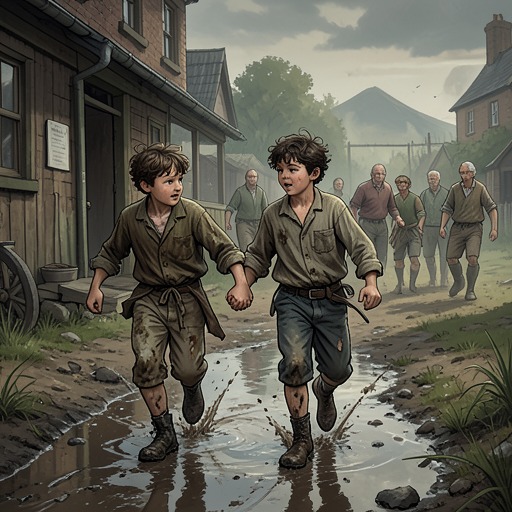
He then leaves the van, reaches the EL station, paces until a suitable train arrives, and runs to the soccer field. The movement gives the condition a social consequence: his mother’s drinking does not merely create private sadness; it threatens his place within the team and forces him to travel alone under pressure. By writing before leaving, Joey also preserves a connection even as he refuses to let her instability decide whether he will reach his friends.
Consequences for Soccer and Community
Joey arrives late, alongside Kyle, and finds the Wild Soccer Bunch suffering under Mickey the Bulldozer and the Unbeatables. The team is physically battered: Julian’s eye is dark green, blue, and violet; Tyler holds his ribcage; Kevin has a badly scraped knee. Joey’s delayed arrival therefore intersects with a wider crisis, but his personal struggle has not made him less committed to the group. He sits beside the injured players only briefly before anger drives him to his feet.
The team’s communal structure offers Joey something his home cannot reliably provide: a place where attendance matters, talent is recognized, and friends wait for one another. That does not erase the drinking or the poverty. Joey still lacks equipment, still sometimes disappears, and still has to navigate an adult’s broken promises. Yet the Wild Soccer Bunch gives those facts a counterforce. Larry, whose own lemonade stand provides only a modest livelihood but who is regarded as the team’s greatest coach, represents an adult form of steadiness that Joey’s home life lacks.
Narrative Significance
Alcoholism is presented through consequences rather than explanation. The book does not offer a clinical account of Joey’s mother or claim that affection cures the problem. Instead, it places drinking beside poverty, unemployment, van living, missing equipment, broken promises, and a child’s forced independence. The result is a form of children’s realism in which the lively language of soccer does not cancel the severity of what Joey experiences.
At the same time, the narrative refuses to define Joey solely by family damage. His face may reveal pain, but his play remains dazzling; his mother may fail him, but he still loves her; his home may be unstable, but he actively chooses his team. Alcoholism thus functions as a pressure on Joey’s life and on his access to community, not as his identity. The contrast gives his arrival at the soccer field its full significance: reaching the match is not merely punctuality or athletic ambition, but a small act of agency carried out against neglect, uncertainty, and the pull of an adult world he cannot control.