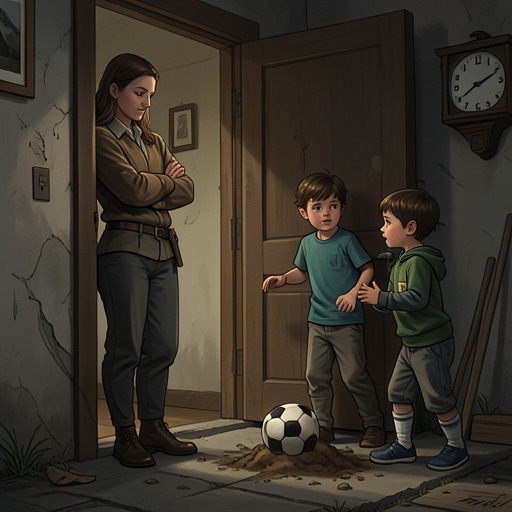
Alex's globe-kicking incident
Kevin the Star StrikerAlex's globe-kicking incident is the explosive culmination of his refusal to accept a complete soccer ban. Facing twenty days of grounding after his equipment is taken away, Alex converts a household globe into a soccer ball, kicks it through a living-room window, strikes his father, and destroys the globe itself. The incident is both comic catastrophe and sacrifice: its immediate violence deepens Alex's punishment, but his defiance later becomes a symbol of what the Wild Soccer Bunch owes to one another.
Causes and Background
Alex's punishment follows a serious family confrontation. His father sentences him to ten days of grounding and a complete soccer ban, then carries three garbage bags of Alex's soccer equipment through the gate at One Woodlawn Avenue. The equipment represents more than ordinary possessions: Alex spent over five years saving for it, so watching it taken toward a garbage truck makes the ban feel like the attempted removal of his entire identity as a player.
Alex sits stone-faced behind the living-room window while the truck waits outside. His sense of injustice intensifies into an absolute conviction that soccer is indispensable. The globe beside him becomes the object through which that conviction finds physical form. It is round, like a soccer ball, and it represents the whole world that Alex imagines no one can live without soccer. The substitution is absurd, but it is also exact: when the real ball is confiscated, Alex refuses to let the ban determine what counts as a playable object.
The Globe as a Soccer Ball
Alex first removes the globe from its stand by loosening the screws, an action presented as quick and effortless. He then fires it repeatedly against the living-room wall. His private protest escalates into an imitation of the techniques that define him as a soccer player: he lifts the globe with his knee, gathers momentum, and attempts a bicycle kick. His right foot strikes the coast of Madagascar, turning a map of the world into the target of a spectacular shot.
The globe shoots toward the wall, rebounds, and bursts through the only surviving living-room window in an explosion of glass. The incident therefore transforms a symbolic refusal into an unmistakable act of property destruction. Alex has not merely found a substitute ball; he has made the household itself part of the game, and the game's momentum carries the consequences beyond the room.
Impact and Escalating Punishment
Outside the gate, Alex's father is watching the garbage truck drive away with the soccer equipment when the globe crashes through the window. It strikes him in the head, leaving both father and son stunned. Alex stands framed in the shattered window, while his father traces the globe's trajectory and confronts the physical result of the rebellion.
The punishment immediately doubles. Alex's father declares ten more days, making the total twenty days of grounding. The broken glass on the lawn gives the sentence a material sharpness: the punishment is no longer only about forbidden soccer, but about the damage Alex has caused while resisting it. Alex can only nod numbly as his father throws the globe into the air and kicks it into the sky with a shot impressive enough to impress Alex himself. Even in anger, the father momentarily mirrors the athletic gesture that caused the disaster.
The End of the World and Its Afterlife
Alex watches the globe rise toward the morning sky, pass the sun, fall into a neighbor's driveway, crack and bounce, and finally come to rest broken in half on a neighbor's flower bed. The destruction gives the incident its ironic title, “The End of the World”: the globe has literally been shattered, but the larger world has not ended. The phrase captures Alex's childlike exaggeration while also registering the genuine scale of his loss. His soccer equipment is gone, his punishment has doubled, the window is destroyed, his father has been hit, and the substitute ball is broken beyond repair.
The next day, the Wild Soccer Bunch experience the consequences collectively. The weather is grey, the neighborhood seems drained of color, and the children remain silent at school while other students discuss their spring-break plans. Their silence is for Alex and for themselves, because his twenty-day grounding removes a central member from their shared life. Later, Kevin describes Alex's action as a sacrifice for the group and calls him a real “martyrist, or something like that.” The awkward word still identifies the emotional meaning of the incident: Alex paid for his defiance, but the others understand that he acted on behalf of all of them.
That interpretation is reinforced by the group's later play. Their opening attack begins with Kevin, Alex, Tyler, Danny, and Joey moving the ball through the Unbeatables, and Alex's shot helps produce the Wild Soccer Bunch's first goal. In the rain-soaked comeback, Alex again provides decisive force by thundering the ball toward the goal, where it carries Octopus into the net. The globe-kicking incident thus echoes through the team's competitive language: the same player whose kick shattered a household world becomes part of the coordinated movement that restores the team's place on the soccer field. Its decisive significance lies in that reversal. Alex's wildness first produces punishment and apparent ruin, then becomes remembered as an act of loyalty within the larger struggle of the Wild Soccer Bunch.