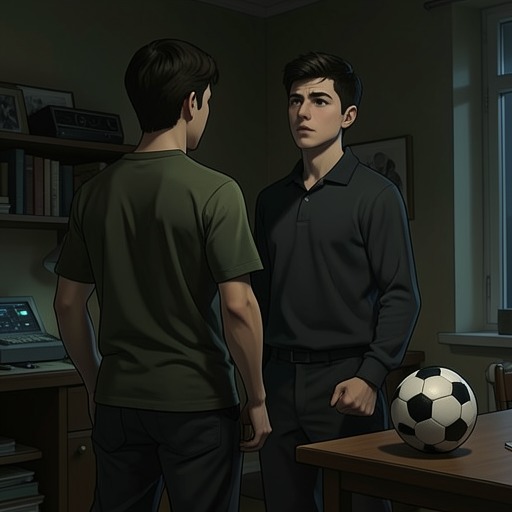
Alex’s Globe Bicycle Kick
Kevin the Star StrikerAlex’s Globe Bicycle Kick is the explosive household action through which Alex resists a complete soccer ban, converts a globe into an improvised ball, and discovers that his passion cannot be neatly contained by punishment. The episode is comic and destructive at once: it turns a living-room object into sporting equipment, sends a ball through a window and into Alex’s father, and leaves the globe broken in a neighbor’s flower bed. Its significance grows retrospectively when Alex’s powerful shooting later becomes essential to the Wild Soccer Bunch’s comeback, transforming an act of private defiance into an early image of the player he will become.
Causes and Background
Alex’s bicycle kick begins immediately after his father grounds him for ten days and imposes a complete soccer ban. The punishment follows the removal of Alex’s soccer equipment: his father carries three garbage bags of it through the gate at One Woodlawn Avenue toward a garbage truck. The equipment represents more than ordinary possessions, because Alex had spent over five years saving for it. Watching it disappear makes the ban feel like an attempt to remove the central structure of his life rather than merely restrict his leisure.
The contrast between Alex’s silent shock and the globe beside the living-room window gives the scene its distinctive turn. Alex handles the globe while thinking that no one can live without soccer, not anywhere in the world. The object therefore becomes an accidental substitute for the forbidden ball, but also a compressed image of what Alex believes is being taken from him: the whole round world of soccer. His response is not a verbal argument with his father. It is a physical translation of protest into play.
The Improvised Shot
Alex first taps the globe and watches it rotate smoothly. He then removes the screws holding it to its stand, sending the equator onto the hardwood floor and exposing the North Pole to a powerful kick. The sequence follows the grammar of football practice even though it occurs in a living room: Alex fires the globe against the wall, lifts it with his knee, and prepares a bicycle kick. The forbidden sport reappears as a chain of controlled touches, each one making the domestic object more completely into a ball.
The decisive strike is both technically imaginative and recklessly destructive. Alex gathers momentum with his left leg and follows with his right, hitting the coast of Madagascar with enough force to send the globe toward the wall like a cannonball. It rebounds and flies through the only surviving living-room window in an explosion of glass. The action gives concrete force to Alex’s claim that a soccer ban cannot simply erase soccer from his body: even without equipment, the movements, instincts, and desire remain available.
The shot immediately crosses the boundary between private rebellion and public consequence. Outside the gate, Alex’s father is watching the garbage truck leave with the soccer gear when the globe crashes through the window. It strikes him in the head, and he sees Alex framed in the shattered opening. The image reverses the original power arrangement: the father has removed the boy’s equipment, but the boy’s improvised ball returns through the house and physically interrupts the punishment.
Punishment and the Broken World
Alex’s father responds by adding ten more days to the sentence, making the total twenty days of grounding. The added punishment is prompted not by soccer alone but by the damage and the assault caused by the globe. Alex can only nod numbly while his father throws the globe into the air and kicks it into the sky with a shot impressive enough to earn Alex’s admiration. Even at the moment of conflict, football skill remains a language the two can recognize in each other.
The globe’s final flight extends the episode’s title into a literal visual joke. Alex watches it rise toward the morning sky, descend past the sun, strike the neighbor’s driveway, crack and bounce, and come to rest broken in half on the neighbor’s flower bed. The “world” has been kicked out of the room and destroyed, while Alex’s soccer ban has doubled rather than disappeared. The ending is therefore not a victory in practical terms. Alex loses the object, receives a harsher punishment, and is left with the spectacle of his own rebellion as its consequence.
Echoes in the Wild Soccer Bunch
The globe kick later acquires a second meaning through Alex’s role in the Wild Soccer Bunch’s decisive match against the Unbeatables. During the comeback, Alex receives a pass after Kevin is brought down by Rick the Grim Reaper and drives the ball toward Octopus’s goal. Octopus throws himself at the shot, but the ball strikes his chest and carries him into the net. The goal gives the Wild Soccer Bunch its first score after falling seven goals behind, changing the team’s understanding of the match from hopeless deficit to possible recovery.
Alex’s force is not the whole comeback, but it is one of its turning points. Earlier, the team’s opening attack has moved through Alex, Tyler, Danny, and Joey before Octopus stops Kevin’s shot. Later, the team’s coordinated play, the rain-softened mud, and twelve days of training on comparable ground allow Kevin, Danny, Joey, Tyler, and Diego to contribute to the reversal. Alex’s cannon-like strike belongs inside that collective rhythm rather than above it: the same player who once converted a globe into a solitary protest now supplies power within a chain of passes and shared effort.
The parallel also clarifies the difference between the two forms of kicking. In the living room, Alex’s bicycle kick is driven by anger at exclusion and ends in broken glass, an injured father, and twenty days of grounding. On the field, his shot is received as a goal that awakens hope in the entire team. The action’s significance shifts from isolated refusal to useful participation without losing its original energy. Alex’s strength becomes constructive when it is placed inside the Wild Soccer Bunch’s trust and tactical cooperation.
Narrative and Thematic Significance
The episode embodies the book’s recurring transformation of ordinary objects and hostile conditions into football challenges. A globe becomes a ball because Alex’s soccer identity is stronger than the boundary between sport and home. The living room, the window, the driveway, and the flower bed are unwillingly reorganized as parts of a playing field, while the later rain and mud turn the actual soccer field into another difficult surface that the team has learned to use.
The action also complicates the idea that punishment can regulate ability. Alex’s father can confiscate equipment and impose a timetable, but he cannot confiscate the trained gesture that makes Alex lift, strike, and redirect an object. At the same time, the story does not romanticize defiance: the globe is destroyed, the window is shattered, Alex’s father is hit, and the punishment becomes twice as long. The scene grants Alex a powerful expression of agency while making the cost of uncontrolled agency unmistakable.
Finally, the globe kick foreshadows the book’s later redistribution of heroism. Alex’s private shot is spectacular but disastrous; the Wild Soccer Bunch’s eventual victory depends on passing, recovery, defensive commitment, and shared recognition. The team ultimately wins, and Alex’s powerful shooting contributes to that success, but the larger lesson is that talent becomes meaningful when it no longer serves only the player who possesses it. Alex’s broken globe is the comic “end of the world” of solitary soccer; his later goal is one force within the collective world the Wild Soccer Bunch builds together.